Organizations have never had more access to information, technology, training resources, and performance data. Learning management systems deliver training at scale. Knowledge bases provide instant access to information. Collaboration platforms connect teams across continents. Artificial intelligence is rapidly reshaping how knowledge is created, distributed, and consumed.
Yet despite these advances, many organizations continue to struggle with a fundamental challenge: people often fail to communicate effectively with one another.
Misunderstandings delay projects. Assumptions create friction. Teams with exceptional talent fail to realize their full potential because individuals struggle to understand how colleagues think, process information, and approach work. While organizations frequently focus on improving knowledge, processes, and systems, communication remains one of the most overlooked drivers of workforce performance.
Vujade was created to address this challenge.
Developed through decades of organizational development experience, Vujade represents an attempt to move beyond traditional behavioral assessments and create a practical framework for understanding human differences in ways that improve collaboration, trust, and organizational effectiveness. Rather than focusing solely on self-awareness, Vujade seeks to help people understand one another, making communication more intentional and team performance more sustainable.
At a time when organizations are increasingly dependent on collaboration, distributed workforces, and knowledge-based performance, Vujade offers a compelling perspective on how communication intelligence may become a critical component of organizational success.
The origins of Vujade stretch back nearly three decades.
The company’s founders first met during a business transformation initiative in India during the late 1990s. One founder was completing doctoral work in Organizational Change while supporting a large-scale organizational transformation project. The other was operating an organizational development consultancy focused on helping organizations navigate growth, change, and workforce development.
The project required more than strategic planning. It required instructional design, content development, organizational alignment, and workforce engagement. The transformation effort ultimately helped an organization grow from approximately twenty-five employees to more than five hundred while achieving business goals significantly faster than expected.
The success of the initiative established a professional relationship that would continue for decades.
Over the years, both founders built extensive experience across organizational development, consulting, cultural enhancement, international business expansion, leadership development, workforce transformation, and performance improvement. Their careers included work with global organizations, large-scale customer support operations, technology companies, and workforce enablement initiatives throughout Asia and North America.
Throughout these experiences, a recurring pattern emerged.
Organizations consistently invested in strategy, technology, and training. Yet communication remained one of the most persistent barriers to execution.
This observation became the foundation for Vujade.
Modern organizations are increasingly dependent on collaboration.
Employees work across departments, geographic boundaries, time zones, and cultures. Managers coordinate teams with diverse experiences and perspectives. Organizations rely on knowledge workers whose success depends not only on what they know, but on how effectively they communicate that knowledge to others.
As organizations become more interconnected, communication becomes more important.
At the same time, communication becomes more difficult.
Individuals bring different experiences, assumptions, preferences, and thinking styles into every interaction. These differences are not inherently problematic. In many cases, they are valuable sources of creativity, innovation, and problem solving.
The challenge arises when people fail to understand and appreciate those differences.
Traditional approaches to workplace communication often assume that individuals process information similarly. Yet organizations repeatedly discover that communication failures rarely result from a lack of intelligence or commitment. More often, they stem from differences in how people perceive information, interpret messages, and approach decision-making.
This challenge extends beyond employee relationships.
Organizations involved in customer education, channel enablement, franchise development, and stakeholder collaboration frequently encounter similar issues. Whether an organization is delivering internal workforce development, supporting a customer training initiative through customer training programs, or managing complex partner ecosystems through extended enterprise training strategies, communication effectiveness often determines whether knowledge is successfully translated into performance.
The challenge is not simply transferring information.
The challenge is creating shared understanding.
For decades, organizations have used behavioral and personality assessments to improve self-awareness and team development.
These tools frequently provide valuable insights into personality traits, behavioral preferences, and communication tendencies. They help individuals better understand themselves and often create productive conversations about workplace interactions.
However, many organizations encounter a common limitation.
The assessment generates awareness, but the path from awareness to action remains unclear.
Individuals receive reports describing their characteristics and preferences. Teams discuss personality differences. Managers gain insights into behavioral tendencies. Yet organizations often struggle to translate these insights into measurable improvements in collaboration and performance.
This challenge became a central focus during the development of Vujade.
The founders questioned whether existing approaches provided sufficient precision to help organizations operationalize communication insights. They observed that many assessments categorized individuals into broad groups; type and traits while offering limited guidance for understanding nuanced differences between people.
As a result, organizations frequently gained information about individuals but lacked practical mechanisms for utilizing data to improve relationships and performance.
The question became straightforward.
How can behavioral information become actionable?
Vujade approaches this challenge by focusing on relationships rather than labels. It also focuses on core traits over “Super Strengths” as opposed to competencies.
Rather than emphasizing broad categorization, the platform seeks to identify the unique characteristics that influence how individuals communicate, collaborate, and solve problems.
At the center of the platform is an analytical framework known as Cabo. This framework, which has a U.S Utility Patent, uses relational analysis to examine differences between individuals and identify areas of alignment, divergence, and potential collaboration. According to the founders, the methodology was developed over several years and incorporates extensive validation efforts intended to improve precision and reduce bias.
The philosophy behind the system is simple.
People are more complex and diverse than traditional categories suggest.
By understanding those complexities, organizations can improve communication and create stronger working relationships.
The Vujade methodology examines three primary dimensions.
The first dimension, sensory, focuses on how individuals experience and process information. Some people strongly prefer visual information. A majority engage through direct experience and hands-on interaction called Kinesthetic, and the balance process information primarily through verbal communication.
The second dimension explores temperament, including differences related to introversion, ambiversion, and extroversion.
The third dimension, cognitive, examines planning for action and decision-making preferences, including the balance between outcome-oriented thinking and process-oriented thinking.
Together, these dimensions create a richer picture of how individuals engage with their work and with one another. The data is displayed in a second U.S. Design Patent called Radials with 9.85 trillion possibilities, enabling the system to show how all humans are unique and special.
One of the most important insights underlying Vujade is the recognition that communication is not merely a soft skill.
Communication is an operational capability.
Every organizational process depends on people exchanging information, aligning expectations, solving problems, and making decisions. When communication improves, organizations often experience improvements in collaboration, productivity, and execution.
The Vujade approach reflects this reality.
Rather than treating communication as a secondary consideration, the platform positions communication as a foundational element of organizational performance.
This perspective aligns closely with broader trends in workforce enablement and learning strategy. Modern learning leaders increasingly recognize that successful development programs must extend beyond content delivery. Training must ultimately influence behavior, decision-making, and performance.
This philosophy is reflected in structured development frameworks such as the Training Program Roadmap, which emphasizes the progression from foundational learning through knowledge acquisition and ultimately toward measurable business impact.
Vujade contributes to this progression by helping individuals and teams apply communication insights within their daily workflows.
Unlike traditional assessments that generate static reports, Vujade is designed as an ongoing relationship management system.
Users complete an assessment and receive insights into their sensory, temperament, and cognitive tendencies. However, the experience does not end with a report.
The platform allows users to establish connections with colleagues, compare communication styles, evaluate team dynamics, and identify opportunities for stronger collaboration by building bridges to each other.
This relational approach changes how behavioral information is used.
Instead of asking users to remember behavioral descriptions, the system provides ongoing access to communication insights. Individuals can review relationship-specific information before meetings, projects, or collaborative activities with notifications from common calendar invites.
This capability transforms behavioral information into a form of performance support.
The information becomes available at the point of need, allowing users to adapt communication strategies based on the specific people involved in an interaction.
From a learning technology perspective, this represents a shift from episodic assessment toward continuous application.
Many organizations view differences as challenges to manage.
Vujade approaches differences as assets to leverage to create synergy.
The platform recognizes that individuals bring different strengths, perspectives, and problem-solving approaches to the workplace. These differences often create tension when misunderstood, but they can create extraordinary value, in fact super strengths when properly understood and utilized.
One of the examples discussed by the founders involved analyzing a team associated with NASA. The results revealed that team members frequently occupied positions well outside average behavioral ranges. Rather than indicating dysfunction, these differences reflected a group characterized by exceptional self-awareness, openness, and diversity.
The observation highlights an important principle.
Innovation rarely emerges from uniformity.
Innovation emerges when diverse perspectives are combined through effective communication and mutual respect.
Organizations seeking to improve problem solving, innovation, and collaboration may therefore benefit from understanding not only individual strengths but also the relationships between those strengths. This can result in building cultures where peoples’ potential is realized, individual performers can be more authentic and genuine in the workforce and relationships.
Vujade shows how people are unique and special, even within the constructs. The founder’s data is a good example.
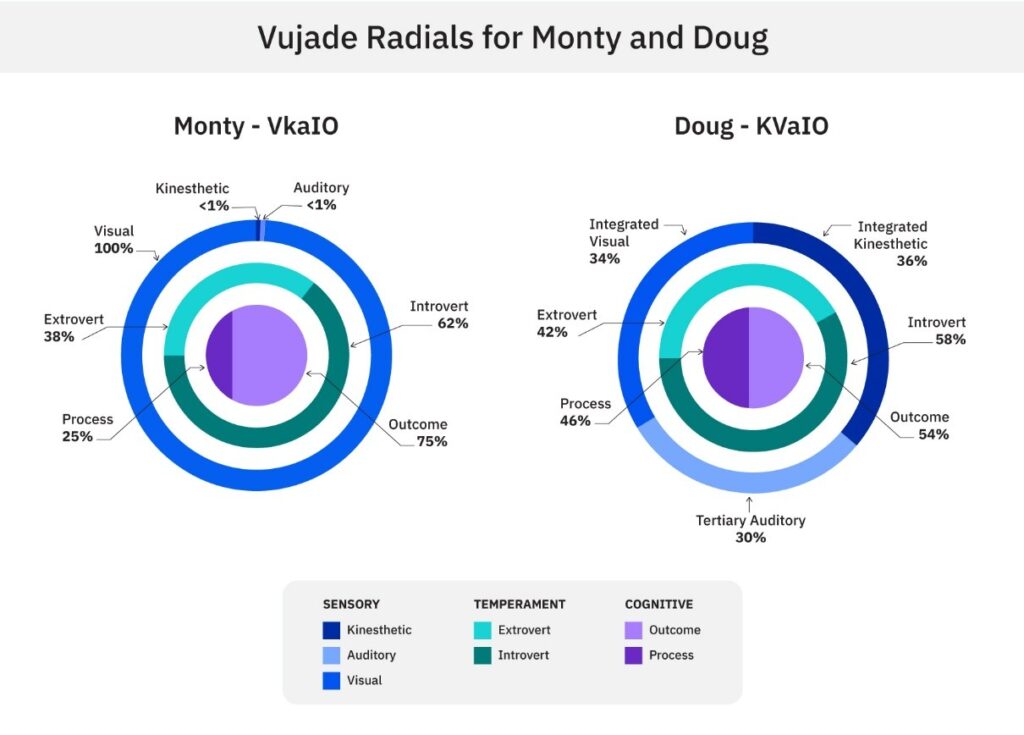
Doug is integrated Kinesthetic/Visual indicating he can easily toggle back and forth for bringing in information and experiencing the world. Furthermore, he is Highly Introverted and solid Outcome.
Monty, when experiencing the world, is Extraordinarily Visual, with slight preference for Kinesthetic and Auditory, Extremely Introverted and Extraordinary Outcome.
How this plays out and is demonstrated with data. Doug often needs to physically engage concepts to “get it” and creates visuals to clarify and vet. Monty grasps by “seeing-it” and creates visual imagery to express, while watching Doug pace the floor in his ideations. Regarding Temperament both are Introverted, but Monty more so, thus Doug has learned, when engaging Monty to give him more space and time to collect his thoughts and express himself. For Cognitive, both are Outcome with huge differences, Monty aligns with 0.013% of the population with dreams of possible outcomes, while Doug aligns with 34.13% of the population and more focused on methodology.
Result, Monty sees things that many don’t, and Doug focuses on doing and envisioning. Both need space for thinking, but Monty more so. Finally for Cognitive even though Doug is Outcome, he must play more of a Process role when working with Monty for determining plans, steps and methods. These dynamics are graphically represented below in the patented radials.
Vujade highlights what makes people unique and special, their Super Strengths allowing them to be more authentic and genuine in the workplace and relationships. With this knowledge of self and colleagues, trust builds.
Trust is one of the most frequently discussed components of organizational culture.
It is also one of the most difficult to build.
The Vujade approach suggests that trust often begins with understanding.
When individuals understand how colleagues think, communicate, and process information, they are more likely to extend patience, empathy, and respect during interactions. This understanding reduces assumptions and creates opportunities for more productive relationships.
The platform also supports greater vulnerability within teams.
Individuals who better understand their own preferences and tendencies are often more comfortable discussing strengths, limitations, and development opportunities. As these conversations become normalized, teams can develop stronger foundations of trust.
This relationship between understanding, vulnerability, and trust has important implications for organizational performance.
Trust accelerates communication.
Communication strengthens collaboration.
Collaboration improves outcomes.
Viewed through this lens, communication intelligence becomes more than a behavioral exercise. It becomes an organizational capability.
The concepts underlying Vujade have significant implications for learning leaders.
Historically, learning initiatives have focused heavily on content creation, course delivery, and knowledge acquisition. These remain important components of workforce development.
However, organizations increasingly recognize that knowledge alone does not guarantee performance.
People must also know how to work together effectively.
This reality is especially relevant in distributed environments involving customers, partners, suppliers, franchisees: and geographically dispersed workforces. Organizations responsible for large-scale franchise training initiatives frequently encounter communication challenges that extend beyond traditional learning objectives.
As workforce development continues to evolve, communication intelligence may become an increasingly important component of enablement strategies.
The ability to understand human differences, adapt communication approaches, and build trust at scale may ultimately prove as valuable as technical expertise.
The founders view Vujade as the beginning of a broader platform vision.
The Cabo framework was designed to support additional instruments, analytical models, and organizational performance indicators. Future development efforts are expected to expand the platform’s ability to connect behavioral insights with operational outcomes.
This direction reflects broader trends across workforce analytics, AI-enabled decision support, and organizational intelligence.
As organizations continue to seek better ways to understand workforce behavior and improve performance, communication-focused technologies are likely to attract increasing attention.
The rise of remote work, hybrid collaboration, and globally distributed teams only reinforces the importance of these capabilities.
Organizations that can better understand how people communicate may gain significant advantages in productivity, agility, innovation, and workforce engagement.
Vujade emerged from a simple but powerful observation: communication remains one of the most significant barriers to organizational performance.
Built upon decades of organizational development experience, the platform seeks to transform communication from an often-overlooked soft skill into a measurable and actionable asset.
By helping individuals understand themselves and one another more effectively, Vujade supports stronger collaboration, greater trust, and improved organizational effectiveness while building strong cultures.
As organizations continue to navigate increasingly complex workforce environments, the ability to understand and leverage human differences may become a defining characteristic of high-performing teams and organizations.
In that environment, communication intelligence is no longer simply a developmental exercise.
It is a strategic asset.
For more information on Vujade, visit their website at https://www.vujade.ai/