Founder & CEO of LatitudeLearning
Creator of the Channel Performance Framework™
Creator of the Surefire Training Impact™ Methodology
Author of Surefire Training Impact
Host of the Training Impact Podcast



Jeff Walter helps organizations scale the performance of dealer, distributor, and franchise networks. These partner networks drive revenue and customer experience, yet most organizations lack structured systems to ensure partners are consistently trained and aligned.
His work focuses on one central idea:
High-performing channel networks require structured training infrastructure.
As the founder of LatitudeLearning, Jeff has spent more than two decades working with manufacturers, franchisors, and partner-driven organizations to design training infrastructure that improves sales performance, product knowledge, and operational consistency across distributed networks.
Jeff Walter works with organizations that are looking to improve the performance of dealer, distributor, and franchise networks.
His advisory and speaking engagements focus on helping leadership teams design systems that scale partner capability, consistency, and performance.
These engagements are grounded in the Channel Performance Framework and focus on practical, system-level approaches to building training infrastructure, and performance management processes.

Jeff works with organizations on:
Engagements are typically with:
Jeff supports organizations through:
These engagements are focused on practical, system-level thinking — not theory — helping organizations
move from disconnected training efforts to structured systems that drive measurable performance.
The Training Impact Podcast explores how organizations design training systems that improve real-world performance.
Hosted by Jeff Walter, the podcast focuses on the role of training infrastructure and partner enablement in scaling channel performance.
Each episode features conversations with leaders responsible for training dealer, distributor, franchise, and partner networks across a range of industries.
Topics explored on the podcast include:
The podcast provides practical insights into how organizations approach training as an operational system — not just a learning function.
It also highlights real-world examples of how training programs are designed, implemented, and improved to support business outcomes.
Explore Jeff Walter’s latest insights on scaling channel performance through training, partner enablement, knowledge systems, and operational best practices. These articles offer practical strategies for building more capable, consistent, and high-performing dealer, distributor, franchise, and partner networks.
When these elements are managed as a system, organizations can deliver consistent training and support across large, distributed networks.
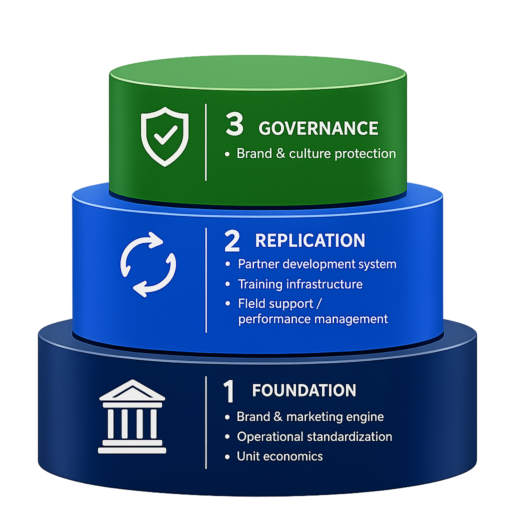

The foundation layer defines the business model and operational structure required for partners to succeed.

The replication layer focuses on scaling capability, execution, and performance across the partner network.
This is where organizations move from isolated success to consistent results across locations.

The governance layer ensures that brand standards and organizational culture are maintained as the network grows.
Organizations that successfully scale channel performance build strength across all three layers.
A strong foundation ensures the model works
Replication enables consistent execution across the network
Governance protects the brand as scale increases
When these layers are aligned, organizations can grow partner networks without losing control of performance, customer experience, or operational consistency.
Within this framework, training infrastructure plays a central role in the replication layer.
It is the system that enables organizations to consistently onboard, train, and support partners at scale.
Within the Channel Performance Framework, training infrastructure plays a central role in the replication layer.
It is the system that enables organizations to consistently develop partner capability and performance across distributed networks.
Organizations that successfully scale partner performance do not rely on ad hoc training programs or disconnected resources.
They build structured training infrastructure that allows knowledge, skills, and operational standards to be replicated across every partner, location, and role.
Training infrastructure is not a single program or tool.
It is a coordinated system that supports how partners are trained, certified, and supported over time.
This system connects training to real-world execution, ensuring that partners can consistently apply what they learn in their day-to-day roles.
A complete training infrastructure system typically includes several core use cases:
When training infrastructure is implemented effectively, organizations can:
accelerate partner onboarding and time to productivity
improve consistency across locations
reduce support costs
increase product knowledge and sales effectiveness
maintain operational standards across the network
Without training infrastructure, these outcomes are difficult to achieve at scale.
To support these use cases at scale, organizations need systems designed specifically for partner networks.
This is where technology plays a critical role.
Without training infrastructure, these outcomes are difficult to achieve at scale.
To support these use cases, organizations need a system designed specifically for partner networks.
This is where a learning management system (LMS) becomes the foundation of training infrastructure — enabling organizations to deliver, manage, and scale partner training across distributed networks.
Organizations can also extend their training infrastructure with AI-powered knowledge systems.
Lumina serves as a knowledge companion that allows partners to quickly find trusted answers based on company-approved resources.
This provides real-time support and complements structured training programs.
Together, these systems enable organizations to build a complete training infrastructure that supports replication at scale.
Building training infrastructure is essential for scaling channel performance.
But infrastructure alone does not guarantee results.
Many organizations invest in training systems, content, and programs — yet struggle to translate those efforts into measurable improvements in performance.
Jeff Walter developed the Surefire Training Impact™ methodology to solve this problem.
Traditional training approaches often focus on:
Course completion
Content delivery
Activity metrics
But these do not necessarily lead to improved performance in the field.
Partners may complete training, but still lack the ability to apply knowledge effectively in real-world situations.
Surefire Training Impact™ is based on a simple principle:
Training should be designed to drive measurable operational outcomes.
This means connecting training programs directly to:
Sales performance
Service quality
Customer experience
Operational execution
The Surefire Training Impact™ methodology includes several core models that help organizations design effective training programs:
When applied within a structured training infrastructure, the Surefire Training Impact™ methodology helps organizations:
Improve the effectiveness of training programs
Connect learning to performance outcomes
Increase consistency across partner networks
Ensure training investments produce measurable results
Together, training infrastructure and the Surefire Training Impact™ methodology provide both:
The system to scale training
The methodology to make it effective
If your organization relies on dealer, distributor, franchise, or service partner networks, training infrastructure may be the key to scaling performance across your channel.
Learn how LatitudeLearning helps organizations build structured partner training systems.