Few technologies have generated as much excitement, speculation, and uncertainty as artificial intelligence.
Across industries, organizations are investing heavily in AI initiatives. Software vendors are embedding AI capabilities into nearly every category of business application. Employees are experimenting with generative AI tools to improve productivity and accelerate routine tasks. Executives are being asked to make strategic decisions about technologies that seem to evolve faster than traditional business planning cycles can accommodate.
Yet amid the enthusiasm surrounding artificial intelligence, a surprisingly simple challenge continues to emerge.
Many people still do not understand what artificial intelligence actually is.
This challenge sits at the center of NuScienta‘s mission.
Founded as an educational initiative within the broader Data Products organization, NuScienta was created to address a growing gap between AI adoption and AI understanding. While organizations increasingly recognize that artificial intelligence will influence virtually every aspect of modern business, many leaders and employees remain uncertain about what the technology does, how it works, where it creates value, and what role it should play within their organizations. The result is a marketplace filled with curiosity, opportunity, excitement, and confusion.
NuScienta exists to bring clarity to that conversation.
Rather than approaching artificial intelligence as a highly specialized discipline reserved for engineers and data scientists, the organization views AI literacy as a foundational workforce capability. Its mission is not to teach everyone how to build artificial intelligence. Its mission is to help people understand artificial intelligence well enough to use it effectively, evaluate it responsibly, and participate confidently in a future where AI becomes increasingly integrated into everyday work.
This perspective represents a meaningful shift in how organizations think about learning and development. For years, conversations surrounding artificial intelligence have focused on the specialists who create the technology. NuScienta focuses on the much larger population of people who will ultimately use it.
The rapid rise of artificial intelligence has created a situation that is not entirely unique in the history of technology.
Organizations frequently adopt new tools faster than they fully understand them.
The introduction of personal computers created similar challenges. The rise of the internet required entirely new forms of digital literacy. Data analytics generated a growing need for data literacy across industries. Each technological wave created opportunities for organizations willing to invest in education and understanding.
Artificial intelligence is following a similar pattern, although perhaps at a much faster pace.
Throughout years of consulting engagements, the team behind Data Products repeatedly encountered situations where senior leaders, managers, and business professionals were being asked to make decisions about AI despite having limited exposure to its underlying concepts. In many cases, individuals understood that artificial intelligence was important, but struggled to explain what it actually meant. Conversations frequently revealed misconceptions about how AI systems operate, what they are capable of accomplishing, and where their limitations begin.
This challenge extended beyond executives.
Employees encountered similar uncertainty. Some viewed AI as a revolutionary force capable of transforming every aspect of work. Others viewed it primarily as a threat to existing jobs and responsibilities. Many were simply unsure where to begin. The conversation often became dominated by headlines, speculation, and hype rather than practical understanding.
The result was a growing disconnect between the technology itself and the people expected to use it.
Organizations could purchase AI-enabled solutions. They could hire consultants. They could launch initiatives and pilot programs. Yet successful adoption ultimately depended on people understanding what they were trying to accomplish and why.
NuScienta emerged from the recognition that education must come before transformation.
Before organizations can effectively adopt artificial intelligence, they must first understand it.
One of the most compelling themes behind NuScienta’s work is the belief that AI literacy is becoming a fundamental workforce skill.
This does not mean every employee must become a data scientist.
It does not mean every professional must learn machine learning algorithms, neural network architectures, or advanced programming techniques.
Instead, it reflects the reality that artificial intelligence is becoming increasingly embedded within the tools, systems, and processes people use every day.
Much like digital literacy became essential during the rise of personal computing, AI literacy is beginning to occupy a similar position within the modern workplace.
Employees need to understand how AI systems operate.
Managers need to understand where AI can improve performance.
Leaders need to understand opportunities and risks.
Organizations need workforces capable of making informed decisions about AI-enabled tools and technologies.
NuScienta’s educational philosophy is built around this idea.
The organization focuses on helping learners develop practical understanding rather than technical specialization. Educational experiences are designed to provide enough knowledge for individuals to engage intelligently with AI technologies within the context of their own roles and responsibilities. The objective is not to create AI engineers. The objective is to create informed professionals who can confidently navigate an AI-enabled world.
This distinction lowers barriers to participation and opens the conversation to a much broader audience. Artificial intelligence becomes something people can learn, understand, and apply rather than something they fear or avoid.
Many AI education programs focus heavily on technical implementation.
Learners are taught how to build models, write code, manage data pipelines, or develop machine learning solutions. These programs serve an important purpose, but they address only a small portion of the overall workforce.
Most professionals do not need to become AI engineers.
They need to become AI-literate.
NuScienta’s educational model reflects this reality.
Its courses are designed to help learners understand foundational concepts, evaluate opportunities, identify risks, and recognize practical applications. The emphasis is placed on comprehension rather than technical complexity. Learners are introduced to AI concepts in language that is accessible and relevant to their everyday work. Rather than overwhelming learners with technical terminology, the organization focuses on helping individuals connect AI concepts to real-world situations and practical business challenges.
This approach acknowledges an important truth about workplace learning.
People learn best when they understand why a concept matters to them personally.
A manager interested in improving team productivity approaches AI differently than a software developer building applications. A business owner evaluating growth opportunities approaches AI differently than a compliance officer assessing organizational risk. Effective education must account for these differences.
NuScienta’s learning experiences are designed around practical relevance. Learners are encouraged to think about their own responsibilities, workflows, and challenges while exploring how artificial intelligence might help them perform more effectively.
The result is an educational experience that feels approachable rather than intimidating.
Perhaps the most distinctive aspect of NuScienta’s educational philosophy is its emphasis on curiosity.
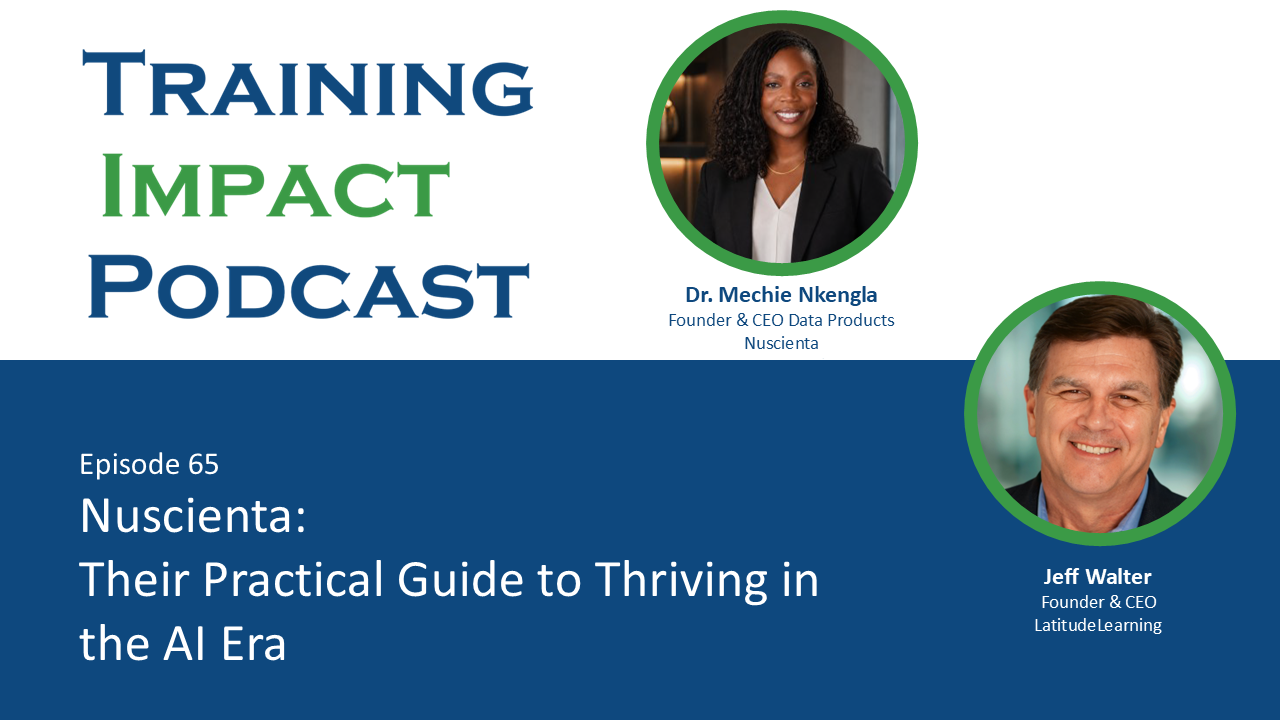
Throughout the podcast discussion, curiosity emerges repeatedly as the starting point for learning. Before someone can become proficient with artificial intelligence, they must first become willing to explore it. Curiosity creates the foundation upon which understanding is built.
This perspective aligns closely with established principles of adult learning theory. Adult learners are typically motivated by relevance, autonomy, and personal goals. They learn most effectively when they can connect new knowledge to existing experiences and immediately see its practical value.
NuScienta embraces these principles by encouraging exploration rather than perfection.
Learners are not expected to become experts overnight. They are encouraged to ask questions, experiment with tools, and gradually build confidence through experience. The objective is not mastery during the first interaction. The objective is engagement.
This philosophy is particularly important in the context of artificial intelligence because fear often becomes a barrier to participation. Many professionals worry that they lack the technical background necessary to understand AI. Others feel overwhelmed by the pace of innovation. Some are uncertain about where to begin.
Curiosity provides an entry point.
By encouraging learners to explore rather than fear the technology, NuScienta helps create an environment where understanding can develop naturally over time.
From a learning strategy perspective, NuScienta provides an excellent example of how organizations can support knowledge acquisition at scale.
Within the LatitudeLearning Training Program Roadmap, much of NuScienta’s work aligns closely with Stage 2: Knowledge Acquisition.
Before learners can apply skills, improve performance, or demonstrate competency, they must first develop foundational understanding. They must understand concepts, terminology, opportunities, limitations, and context. Knowledge acquisition creates the foundation upon which future skill development occurs.
NuScienta’s programs are designed precisely for this purpose.
Learners begin by exploring fundamental concepts. They develop a shared vocabulary. They gain exposure to practical examples and use cases. They learn how AI technologies differ from traditional software systems and how these differences influence workplace applications.
This knowledge foundation reduces uncertainty and prepares learners for deeper engagement.
At the same time, the organization incorporates important elements of Stage 1: Information Access. Educational resources are made available through scalable digital delivery, allowing learners to engage with content whenever curiosity emerges or organizational needs arise.
Together, these approaches create a learning model that supports both awareness and understanding, two critical prerequisites for successful adoption.
The implications of AI literacy extend far beyond traditional workforce development.
As organizations increasingly embed artificial intelligence into products, services, operational workflows, and customer experiences, the need for education begins to spread across entire business ecosystems. Employees are rarely the only audience affected by technological change. Customers, partners, distributors, suppliers, contractors, and franchise operators often face many of the same questions about emerging technologies.
This reality is creating new opportunities for organizations that view learning as a strategic capability rather than a departmental function. The same foundational education that helps an employee understand artificial intelligence can also help a customer adopt an AI-enabled product, a partner navigate new business processes, or a franchise operator implement new technologies consistently across locations. In many respects, the challenge mirrors the broader evolution of extended enterprise training, where organizations seek to deliver knowledge beyond their own workforce and into the larger networks that influence performance and business outcomes.
The questions may differ slightly from audience to audience, but the underlying need remains remarkably similar.
People need enough understanding to engage with new technologies confidently and effectively.
The growing importance of AI literacy also highlights a significant opportunity within customer education.
Many organizations now incorporate artificial intelligence into the products and services they deliver. As this trend continues, customer education becomes increasingly important. Successful adoption often depends on helping customers understand not only what a product does, but how AI contributes to the experience.
Organizations that assume customers automatically understand AI frequently encounter resistance, confusion, or underutilization of new capabilities.
Education helps close that gap.
In this respect, AI literacy shares many characteristics with modern customer training initiatives. Both seek to move learners beyond awareness and toward practical application. Both recognize that understanding drives adoption. Both acknowledge that education can play a critical role in long-term success.
NuScienta’s philosophy reinforces this principle by demonstrating that meaningful adoption begins with understanding.
Franchise organizations provide another compelling example of this challenge.
Many franchise systems are already exploring how artificial intelligence can improve operational consistency, marketing effectiveness, customer engagement, and business performance. Yet introducing new technologies across distributed networks requires more than implementation.
It requires education.
Franchise owners, managers, and frontline employees often possess varying levels of technical knowledge and experience. Building a shared understanding of artificial intelligence can create a stronger foundation for adoption and execution. In this way, NuScienta’s emphasis on literacy before application aligns closely with the principles that underpin effective franchise training programs.
Before organizations can expect consistent performance, they must first establish a consistent understanding of the concepts, tools, and expectations that drive that performance.
AI adoption is no different.
The impact of NuScienta’s work is often visible in ways that traditional training metrics struggle to capture.
The organization is not simply measuring course completions or certifications.
It is helping individuals move from confusion to confidence.
A business leader gains the ability to participate in strategic discussions about AI initiatives.
A manager develops a clearer understanding of how technology can support team performance.
A professional discovers practical ways to improve productivity through AI-enabled tools.
An organization becomes better prepared to evaluate opportunities and risks.
These outcomes create measurable value even before advanced technical skills are developed.
Understanding influences decision-making.
Decision-making influences adoption.
Adoption influences results.
By focusing on literacy first, NuScienta creates a foundation that supports long-term success rather than short-term experimentation.
Artificial intelligence may be one of the most transformative technologies of the modern era, but technology alone does not create progress.
People create progress.
Organizations create progress.
Learning creates progress.
NuScienta’s work is built on the understanding that AI adoption begins with AI literacy. Before organizations can fully leverage artificial intelligence, they must first help people understand it. Before employees can use AI effectively, they must develop confidence in their ability to interact with it. Before leaders can make informed decisions, they must understand the opportunities and limitations that accompany the technology.
Through accessible education, practical learning experiences, and a commitment to making artificial intelligence understandable, NuScienta is helping close the gap between technological innovation and human capability.
Whether the audience consists of employees, customers, partners, franchise operators, or broader business ecosystems, the underlying challenge remains remarkably consistent. People need the knowledge required to navigate change with confidence.
NuScienta is helping provide that foundation.
In doing so, the organization offers a compelling model for how learning can support the successful adoption of one of the most important technologies of our time.
For more information visit their website at https://nuscienta.com/