
Across distributed service networks, inconsistent technician performance drives rework, downtime, warranty costs, and customer dissatisfaction. Organizations are now using extended reality (XR) and AI to accelerate technician proficiency, standardize procedures, and deliver expert guidance at the point of work.
For organizations that rely on technicians, service centers, dealerships, or other field-based professionals, the central challenge is not access to information. Over the past two decades, digital learning platforms have made knowledge widely available. The greater challenge is skill development at scale. Watching a process is not the same as performing it. Reading a manual is not the same as diagnosing a problem under real-world conditions. For channel leaders responsible for readiness across multiple locations, this distinction is critical.
Design Interactive, a digital transformation specialist focused on human performance, addresses this challenge through extended reality and artificial intelligence. Its XRMentor(R) platform applies augmented, virtual, and mixed reality to accelerate skill acquisition, reduce errors, and compress time to proficiency across distributed workforces. The implications extend beyond internal teams to partner ecosystems that must maintain consistent standards across independent operations.
This case study examines how immersive technologies are reshaping partner readiness, performance consistency, and long-term workforce development within distributed service models.
Many industries rely on complex service and distribution ecosystems. Automotive dealerships, trucking service networks, industrial maintenance providers, and equipment manufacturers all operate through decentralized locations. These locations may be owned by franchisees, independent operators, or regional partners. Regardless of ownership structure, customers experience the brand through the technicians and service professionals who perform the work.
In such ecosystems, capability varies widely. New hires enter continuously. Experienced technicians retire. Equipment evolves. Certification requirements shift. Operational complexity increases. Maintaining consistent performance across 200 or 300 locations is fundamentally different from managing readiness within a single facility.
Channel Ecosystem Challenge Summary
Traditionally, knowledge distribution in these environments has relied on videos, manuals, PDF documentation, and instructor-led sessions. A new technician might watch a training video, attend a class, shadow a mentor, and gradually move toward independent execution. While effective in isolated settings, this approach becomes costly and inefficient at scale. Instructor time is limited. Travel budgets constrain reach. Local mentors vary in quality. The learning experience is uneven across the network.
Their work sits within this reality. By combining immersive practice environments with scalable digital deployment, it enables organizations to deliver consistent skill training across geographically dispersed locations. For ecosystems operating across indirect routes to market, this has direct implications for partner performance and brand integrity.
Three recurring challenges define distributed service ecosystems.
Key Operational Challenges
First, onboarding speed. When new technicians enter the workforce, organizations must bring them to a productive level quickly. Traditional pathways may require six months or more before individuals can perform certain tasks independently. During that time, they operate under supervision, limiting productivity and increasing labor costs.
Second, practice limitations. Watching a demonstration does not build tactile competence. Historically, scalable training stopped at passive consumption. The next step required physical equipment and human coaching, both expensive resources. As a result, many technicians reached the field having observed procedures but not practiced them repeatedly in a safe environment.
For example, a new technician may observe brake service procedures during training, but without sufficient repetitions, they may lack the fluency to perform safely and efficiently under real-world time pressure in the field.
Third, knowledge loss. As experienced professionals retire, they take with them years of implicit expertise. This “tribal knowledge” often resides in informal conversations and personal techniques rather than documented procedures. In partner ecosystems, where independent operators may develop localized best practices, this knowledge fragmentation compounds.
These challenges create downstream effects. Slower time to proficiency increases labor costs. Errors inflate parts replacement and rework expenses. Inconsistent performance undermines brand reliability. High turnover erodes institutional memory and increases hiring costs.
Design Interactive addresses these challenges by moving training from passive viewing to active engagement.
Extended reality sits on a continuum. Augmented reality overlays digital content onto the physical world, allowing technicians to see guidance while standing at real equipment. Virtual reality immerses learners in a simulated environment where they can practice tasks before performing them in live settings. Mixed reality blends both, enabling interaction between physical objects and digital models.
How XR Improves Technician Performance
In practice Instead of watching a brake replacement video, technicians practice virtually, receive tool guidance, experience multiple failure scenarios. The system animates components, guides tool usage, and introduces multiple failure conditions that may not be present on a single piece of equipment.
Once the learner transitions to augmented reality at the point of need, guidance becomes hands free and contextual. Instructions appear in sequence. Three-dimensional models demonstrate component movement. Lower-fidelity options provide step-based prompts without full animation. The system supports both high-detail simulation and practical execution.
The progression matters. Knowledge acquisition occurs through exposure. Skill acquisition develops through repetition. Performance confidence emerges through contextual execution. By structuring this sequence digitally, organizations can deploy consistent practice environments across hundreds of locations, strengthening technician readiness before errors occur in the field.
 One measurable outcome from XR deployment has been a significant reduction in time to productivity. In one example, onboarding timelines for a critical task decreased from approximately six months to 45 days. The reduction represents a substantial compression of the “speed to value” window.
For channel leaders, this metric is powerful. When a technician becomes qualified earlier, the organization gains additional months of productive output. The compounding effect extends across career progression. If foundational competencies are achieved faster, subsequent skill development accelerates as well.
Reduced time to value also influences compensation models. When employees demonstrate higher productivity earlier, wage progression can align with measurable performance. Rather than serving as a cost burden, increased pay reflects earlier value creation.
In distributed partner networks, this dynamic strengthens both performance and retention. Accelerated development increases perceived career opportunity. Organizations benefit from earlier contribution. Partners gain access to capable talent faster.
Beyond onboarding speed, immersive training has produced measurable operational improvements. In one documented scenario, a 20 percent reduction in parts and labor expenses was observed following implementation.
The mechanism is straightforward. When less experienced technicians receive contextual guidance and structured practice, decision quality improves. Fewer unnecessary parts are replaced. Diagnostic accuracy increases. Rework decreases.
XR Training and On-the-Job Support Have Resulted In:
In partner ecosystems, where margins can be tight and variability high, these improvements directly affect profitability. They also enhance customer experience. Correct first-time service reduces downtime and builds trust in the brand.
Importantly, the labor component of cost reduction is not derived from wage suppression but from capability distribution. When younger or less experienced technicians can handle more complex tasks sooner, organizations optimize workforce utilization. A deeper, more capable bench reduces dependency on a limited number of senior experts.
The original impetus behind XRMentor(R) was to capture tribal knowledge before it disappeared. As retirements accelerated across industries, organizations faced the risk of losing decades of expertise. Preventing expert knowledge loss is a strategic advantage: instead of undocumented techniques disappearing with retiring technicians, XR and AI enable experts to capture procedures, identify best practices, and convert them into standardized training modules that scale across the workforce.
Extended reality authoring tools allow subject matter experts to record procedures in immersive formats while performing them. These recordings can then be transformed into reusable training modules. Instead of relying solely on static documentation, organizations create interactive, contextualized learning assets.
Artificial intelligence expands this capability. By analyzing multiple expert recordings, AI can identify patterns and commonalities among high performers. It can surface variations in technique, highlight effective sequences, and generate structured step lists automatically.
This approach shifts knowledge management from documentation to dynamic replication. Experts are not merely replaced; their capabilities are scaled. For partner ecosystems, this means that high-performing techniques developed in one location can inform training across the entire network.
Credentialing in skilled trades traditionally requires physical evaluation. An assessor observes performance, validates competence, and grants certification. While effective, this model is resource intensive.
The integration of XR and AI introduces the possibility of automated evaluation. By analyzing user interactions within immersive environments or reviewing recorded performance, systems can provide feedback on errors, sequence adherence, and technique. In the near future, such systems may accelerate qualification cycles by identifying competency gaps immediately.
For channel networks operating at scale, streamlined evaluation reduces bottlenecks. Faster validation supports faster deployment. Structured digital records enhance compliance tracking. Over time, this may influence how credentialing bodies interpret skill demonstration in technology-enabled environments.
Technology alone does not guarantee readiness. The impact observed in immersive deployments stems from structured application. Organizations identify high-impact tasks, align modules with operational data, and integrate immersive tools into onboarding and qualification pathways.
Clear expectations reduce variability. Defined evaluation criteria ensure consistency. Structured modules support repeatability across locations. This disciplined framework transforms immersive technology from novelty to infrastructure.
Faster skill development improves retention by building technician confidence, increasing engagement, and making career progression more visible. For firms, where turnover is costly and disruptive, clearer growth pathways and earlier competency help stabilize the workforce and reduce replacement costs.
Within extended enterprise contexts, such as those described in discussions of, alignment between central standards and distributed execution is critical. Immersive systems support this alignment by embedding guidance directly into the work process.
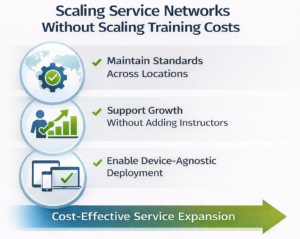 As partner ecosystems expand, complexity increases. More locations mean more variability. More hires mean more onboarding demand. More product complexity means higher diagnostic requirements.
Balancing growth with capability becomes a strategic challenge. Immersive training provides a lever for maintaining performance standards without proportionally increasing instructor headcount. By deploying modules across devices already in use, organizations reduce infrastructure barriers.
The long-term implication is that channel expansion must be accompanied by scalable enablement models. Without structured readiness systems, growth amplifies inconsistency. With immersive infrastructure, growth can scale with confidence.
Early development decisions influence long-term outcomes. When new technicians experience structured, engaging onboarding, their trajectory shifts. Faster competency builds confidence. Recognition of skill progression supports motivation.
Retention emerges not solely from compensation but from perceived growth opportunity. By accelerating development, organizations create visible pathways. Employees see progression within months rather than years.
For partner ecosystems, retention has multiplier effects. Lower turnover reduces hidden costs associated with recruiting and retraining. Experienced personnel maintain institutional memory. Customer relationships stabilize.
The link between training and retention may not always be tracked within the same department, but its impact is tangible. Immersive systems that compress learning cycles contribute to workforce stability.
Distributed service ecosystems depend on consistent execution across independent organizations. Traditional knowledge delivery methods have addressed information access, but left skill acquisition constrained by cost and scale.
Design Interactive’s application of extended reality and artificial intelligence reframes this challenge. By enabling active practice, accelerating time to proficiency, reducing errors, and capturing tribal knowledge, immersive systems strengthen partner readiness and operational consistency.
The implications extend beyond efficiency. Faster skill development enhances retention, optimizes labor utilization, and supports sustainable channel growth. Structured application ensures that technology reinforces standards rather than introducing variability.
As industries navigate workforce transitions and increasing complexity, immersive enablement infrastructure positions channel ecosystems for long-term resilience. Structured training, aligned expectations, and scalable practice environments create the conditions for consistent performance across every point of service delivery.
In distributed markets where brand reputation rests in the hands of independent operators, readiness is strategy. Immersive learning systems transform readiness from aspiration to measurable capability.
For learn more about Design Interactive, visit their website https://designinteractive.net/