

Scaling a distributed business system requires more than expansion. It requires alignment. At its core, sustainable growth depends on how well an organization can translate strategy into consistent execution across locations, partners, and markets. In franchise systems, this challenge becomes even more complex, as independent operators must interpret, adopt, and execute a shared model while navigating their own local realities.
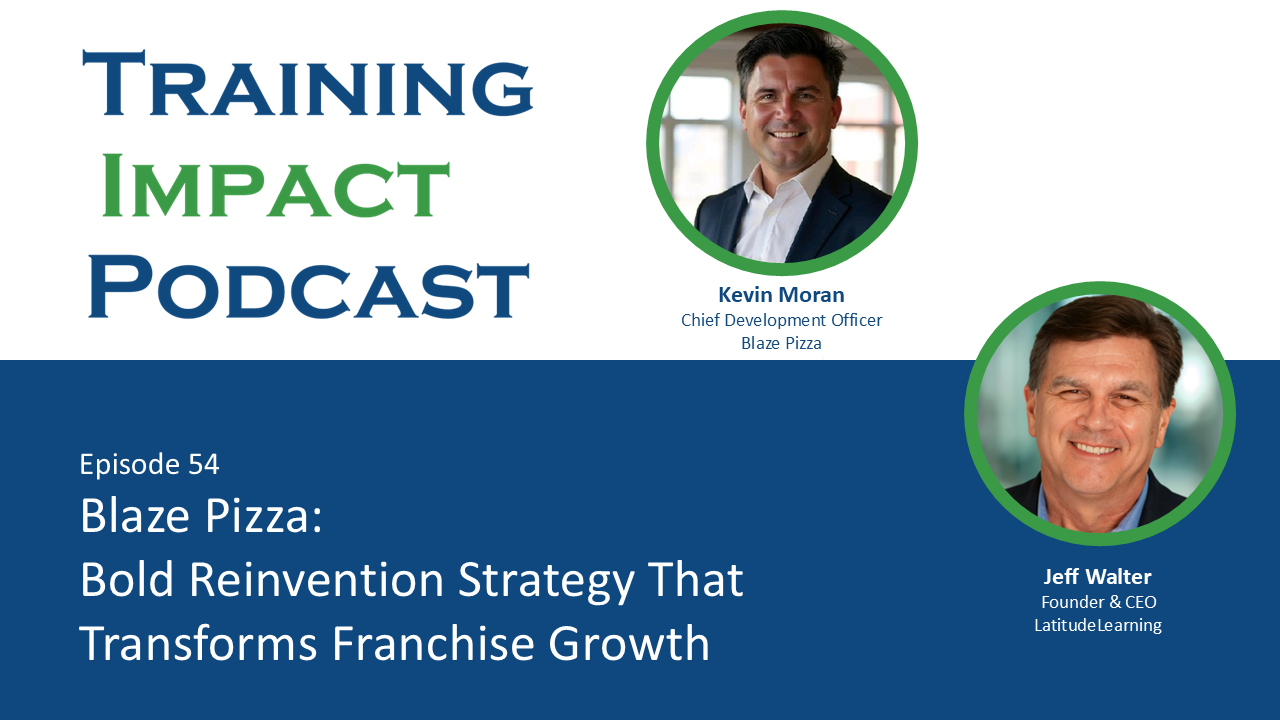
Blaze Pizza presents a compelling example of how disciplined enablement, structured evaluation, and continuous adaptation can create a more resilient and scalable system. The organization’s evolution reflects a deeper understanding of how franchise development, operational design, and partner readiness intersect. Rather than relying on static models, Blaze has moved toward a more flexible, data-informed approach that prioritizes fit, context, and long-term performance.
This case study explores how that shift influences not only growth strategy, but also the effectiveness of training, onboarding, and extended enterprise learning across the franchise network.
Blaze Pizza operates within the fast casual restaurant sector, a category defined by speed, customization, and a balance between quality and efficiency. The brand built its early success around a customizable pizza experience, offering consumers the ability to move through a line, select ingredients, and receive a finished product in minutes.
Over time, the organization expanded across domestic and international markets, working through a franchise model that relies on independent operators to deliver a consistent brand experience. This structure introduces inherent complexity. Franchisees must not only understand the product and operations, but also navigate real estate, local market dynamics, staffing, and customer expectations.
Leadership within the organization reflects this complexity. Development responsibilities extend beyond traditional sales functions to include real estate strategy, design and construction, compliance, and operational alignment. This integrated view of development ensures that growth decisions are informed by a complete understanding of how the business functions at every level.
The system itself operates as a network of interconnected components. Corporate leadership defines brand standards and strategic direction, while franchise partners execute within their markets. Success depends on how effectively these layers align, particularly as the organization expands into new geographies and customer environments.
As Blaze Pizza matured, several structural challenges began to surface. Many of these were not unique to the brand, but rather reflective of broader shifts in the industry.
One of the most significant challenges was the changing nature of customer behavior. The original model was built around an in-store experience, where customers moved through a line and engaged directly with the product creation process. However, the rise of digital ordering, third-party delivery, and changing consumer expectations began to alter that dynamic.
A growing percentage of transactions shifted to online channels. Customers were no longer exclusively interacting with the brand in physical spaces. This created operational friction, as traditional workflows struggled to accommodate both in-person and digital demand.
At the same time, the competitive landscape evolved. Concepts that were once differentiated became more common. The novelty of the build-your-own format diminished as similar models appeared across the industry.
Another challenge emerged in the form of operational rigidity. Standardized store designs and processes, while effective in early stages of growth, began to limit the brand’s ability to adapt to different environments. Urban markets, international locations, and high-traffic venues each presented unique constraints that could not be addressed through a single, uniform model.
These challenges extended into franchise development. As the system expanded, the need for more precise partner selection and alignment became increasingly important. Without a clear understanding of partner capabilities, organizations risked creating mismatches that would later impact training effectiveness, operational consistency, and overall performance.
In response to these challenges, Blaze Pizza undertook a comprehensive evaluation of its operating model. This process involved examining every aspect of the business, from store design and equipment to labor structures and customer flow.
Rather than focusing on incremental improvements, the organization approached the challenge as a broader transformation. The goal was to align the model with current market realities while maintaining the core elements that defined the brand.
A key insight from this process was the need for flexibility. Instead of forcing a single format across all locations, the organization began to explore multiple configurations tailored to specific environments. This included variations in store size, layout, and service model, allowing the brand to better match local conditions.
This shift also addressed financial considerations. By reducing the size and complexity of certain formats, the organization could lower capital requirements and accelerate the path to profitability for franchise partners. This, in turn, improved the overall attractiveness of the model.
Importantly, these changes were not implemented in isolation. They were part of a broader effort to create a system that could continuously learn and adapt.
To support this transformation, Blaze Pizza introduced a dedicated innovation environment known internally as a live testing location. This site functions as a fully operational restaurant while serving as a platform for experimentation.
Within this environment, the organization evaluates new approaches to equipment, workflow, technology, and customer experience. Rather than relying on theoretical models, changes are tested under real conditions, with real customers.
This approach provides several advantages. It allows the organization to observe how innovations perform in practice, identify unintended consequences, and refine solutions before broader implementation. It also creates a continuous feedback loop, where data and customer input inform ongoing improvements.
Equally important is the organization’s perspective on failure. Experiments that do not succeed are not viewed as setbacks. Instead, they are treated as valuable insights that prevent larger-scale mistakes. This mindset reinforces a culture of learning and supports more informed decision-making across the system.
From a training and enablement standpoint, this process has significant implications. By validating new approaches before introducing them to franchise partners, the organization ensures that training materials, operational guidelines, and support systems are grounded in proven practices.
Another critical element of Blaze Pizza’s approach is its emphasis on understanding franchise partners. Rather than treating all candidates as interchangeable, the organization evaluates individuals based on their specific strengths, experiences, and capabilities.
This evaluation process reflects a broader recognition that franchise success is not solely determined by financial investment. Operational expertise, market knowledge, and leadership ability all play a role in long-term performance.
By identifying these factors early, the organization can better align partners with the model. It can also tailor support and training to address specific gaps, creating a more effective onboarding experience.
This structured approach to evaluation mirrors the early stages of a learning pathway. Just as effective training programs begin with an assessment of current capabilities, franchise development benefits from a clear understanding of partner readiness.
In this context, evaluation is not simply a selection mechanism. It is the first step in a broader enablement process that continues throughout the lifecycle of the partnership.
The themes emerging from Blaze Pizza’s approach have direct implications for training and development, particularly within distributed systems.
When alignment is established early, training becomes more effective. Partners enter the system with a clearer understanding of expectations, and training programs can be designed to build on existing capabilities rather than compensate for misalignment.
This is particularly relevant in the context of extended enterprise learning, where training must be delivered across diverse audiences with varying levels of experience. Systems that support extended enterprise training emphasize the importance of role-based learning paths, contextual content, and scalable delivery mechanisms.
Within franchise environments, this translates into more targeted onboarding, more relevant ongoing training, and a stronger connection between learning and performance outcomes. It also reinforces the need for franchise training systems that can adapt to different partner profiles while maintaining consistency in core standards.
Misalignment, by contrast, creates challenges that training alone cannot resolve. When partners lack the foundational capabilities required for success, even well-designed programs struggle to deliver meaningful impact.
Blaze Pizza’s evolution highlights a broader shift in how organizations approach growth. Rather than prioritizing rapid expansion through uniform replication, the focus has moved toward sustainable scaling through adaptability.
This includes diversifying development strategies, exploring new formats, and aligning growth with market-specific conditions. It also involves recognizing that different markets require different approaches, both in terms of operations and customer engagement.
International expansion further reinforces this perspective. Entering new markets requires an understanding of cultural norms, consumer preferences, and regulatory environments. It also requires partnerships with local operators who can navigate these complexities.
In this context, growth becomes a function of alignment rather than volume. The ability to match the right model with the right partner in the right market becomes a defining factor in long-term success.
Franchise relationships are inherently long-term. Decisions made at the outset have lasting implications for both the organization and its partners.
Blaze Pizza’s approach reflects an understanding of this dynamic. By prioritizing alignment, structured evaluation, and continuous learning, the organization creates a foundation for stronger partnerships.
These relationships extend beyond initial onboarding. They involve ongoing support, adaptation to changing conditions, and a shared commitment to performance.
From a training perspective, this aligns with lifecycle-based approaches that extend beyond initial onboarding. Effective systems recognize that learning continues throughout the partnership, evolving alongside the business.
This perspective reinforces the importance of building infrastructure that supports not only initial training, but also ongoing development and performance improvement.
Blaze Pizza’s evolution offers a clear illustration of how disciplined enablement, structured evaluation, and adaptive strategy can strengthen a distributed system.
By moving away from rigid models and embracing flexibility, the organization has created a framework that supports both growth and consistency. Its emphasis on real-world testing, partner alignment, and continuous learning reflects a deeper understanding of how complex systems operate.
The implications extend beyond a single brand. For organizations operating within franchise, partner, or extended enterprise environments, the lessons are broadly applicable. Alignment at the outset shapes the effectiveness of training, the consistency of execution, and the sustainability of growth.
In an environment where change is constant, the ability to adapt while maintaining core standards becomes a defining capability. Blaze Pizza’s approach demonstrates how thoughtful enablement can create the conditions for long-term success.
For more information on Blaze Pizza, visit their website at www.blazepizza.com