
What separates training that gets completed from training that actually changes performance?
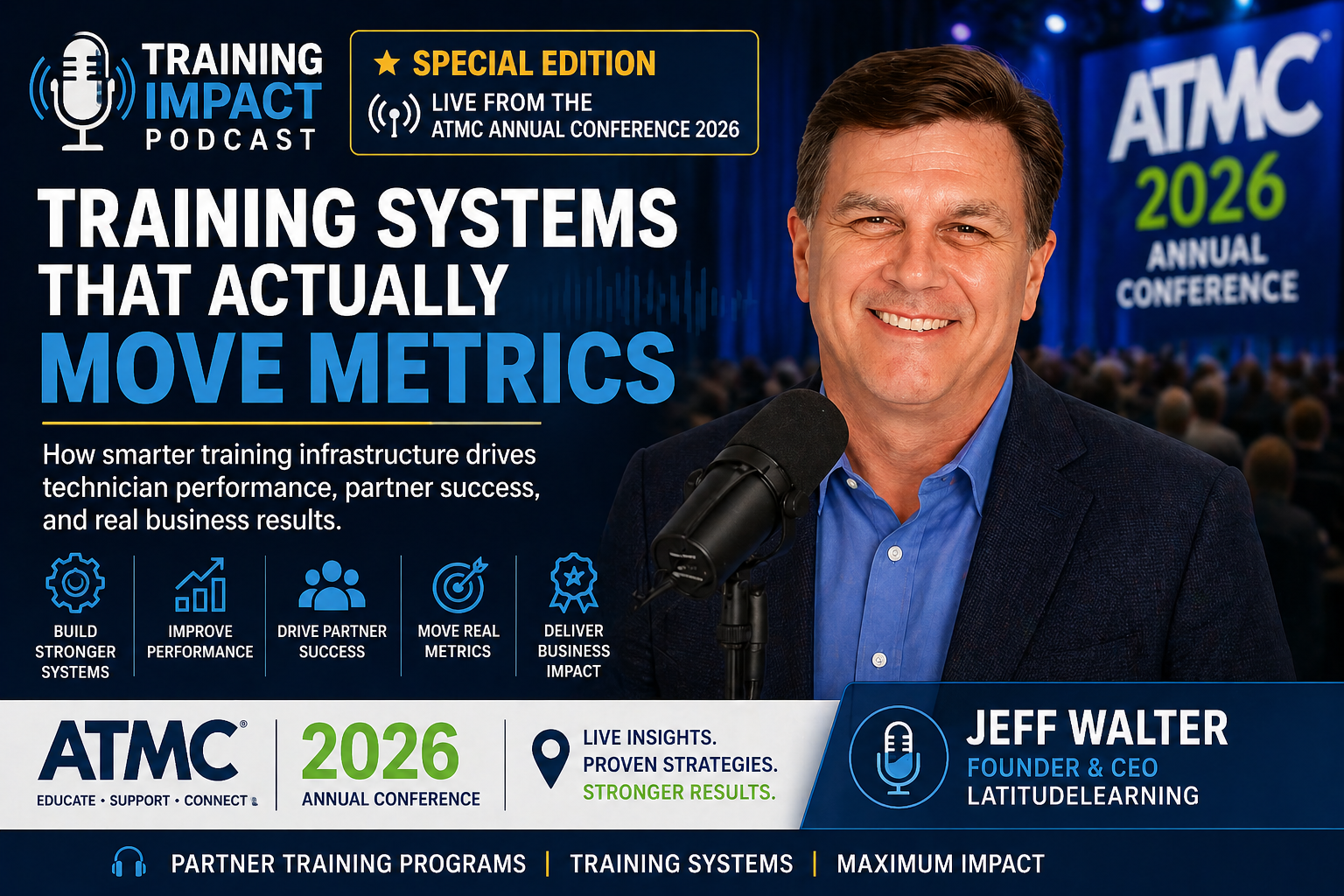
That question sits at the center of a special edition of the Training Impact Podcast, recorded live from the Annual ATMC Conference and featuring Jeff Walter, founder and CEO of LatitudeLearning. With more than two decades of experience helping organizations train employees, dealers, franchisees, channel partners, and distributed workforces, Jeff brings a practical and results-driven perspective to one of the most important conversations in learning and development today.
For many organizations, training is still measured by completions, attendance, certifications, or time spent learning. While those metrics are easy to report, they often fail to answer the one question executives care about most: did performance improve?
Jeff’s message is refreshingly direct. Training programs alone do not move business results. Training systems do.
For L&D leaders, training managers, enablement teams, and operations stakeholders, this conversation offers a roadmap for turning learning into a measurable business advantage.
Organizations today are under constant pressure to improve productivity, reduce errors, increase retention, and create consistent customer experiences. At the same time, teams are being asked to do more with less.
That means training can no longer exist as a standalone function focused only on content delivery. It must become part of the business operating model.
Jeff explains that when learning is treated as infrastructure instead of an event, it becomes scalable, repeatable, and tied directly to outcomes. This is especially important for businesses that rely on external audiences such as dealers, franchisees, customers, contractors, and partners.
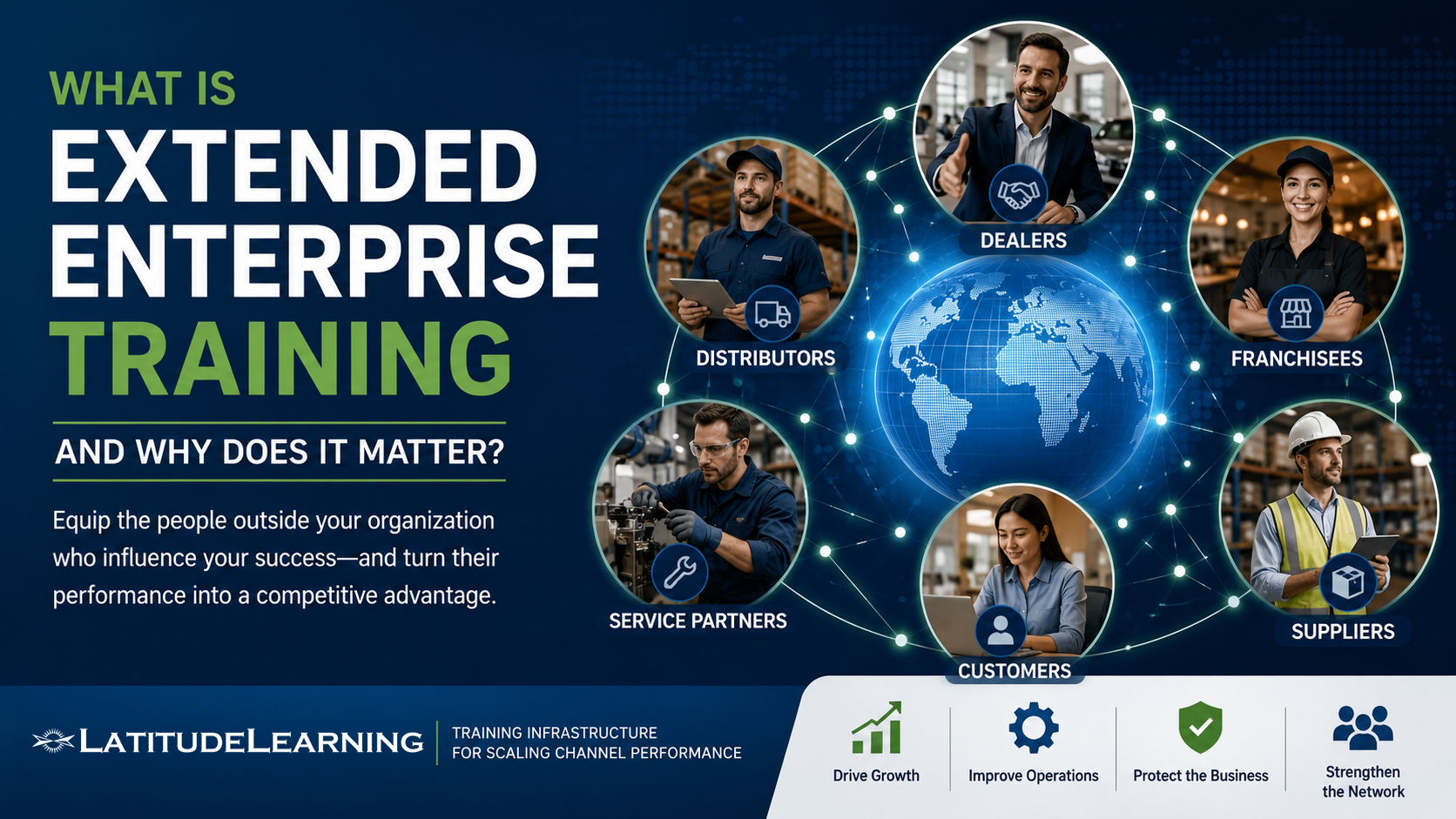
Many of these organizations are investing more heavily in LatitudeLearning concepts such as extended enterprise training, where learning reaches beyond internal employees to every stakeholder responsible for delivering results.
That shift makes this episode highly relevant for any leader responsible for growth, consistency, and performance.
Jeff has spent years helping organizations build learning strategies that support real business goals. Because of that experience, he sees a common problem across industries.
Too many training teams measure activity instead of impact.
They celebrate course completions, certification counts, and attendance numbers. But none of those automatically mean someone performs better on the job.
A technician may complete required modules and still struggle with efficiency. A franchise location may certify managers while customer satisfaction remains flat. A partner may finish onboarding while sales results fail to improve.
Jeff challenges leaders to move beyond vanity metrics and ask tougher questions:
When organizations begin measuring those differences, training becomes easier to defend, easier to fund, and easier to scale.
One of the most practical frameworks Jeff shares is his Learn, Do, Teach model.
It is simple, memorable, and highly actionable.
Learn
This is the traditional foundation of training. Courses, videos, playbooks, onboarding paths, certifications, and assessments all belong here.
Most organizations already invest heavily in this stage.
Do
This is where capability is built. Learners practice skills, apply concepts, complete scenarios, and demonstrate competence.
Jeff emphasizes that knowledge alone does not create performance. Practice does.
Teach
This is the multiplier stage. High performers coach peers, mentor newer employees, validate standards, and share best practices.
When organizations reach this point, learning spreads organically and expertise scales faster than any central team could deliver alone.
For learning leaders, this framework offers a useful planning tool. If your program focuses only on Learn, it may never create the results you expect.
A recurring theme in Jeff’s presentation is the difference between training events and training systems.
Training events are isolated moments. A webinar. A course launch. A certification push. A workshop.
Training systems are ongoing mechanisms that continuously develop capability and improve outcomes.
That includes:
This distinction is especially important for organizations managing distributed audiences. Businesses with customers, franchisees, and partners often need more than internal LMS workflows. They need scalable systems designed for different audiences and operational realities such as customer training and franchise training.
Jeff’s insight is that systems create consistency where one-time events cannot.
Jeff also outlines a five-stage roadmap that helps organizations understand where they are and what to improve next.
Stage One: Self-Directed Learning
Learners access resources when they need answers. This includes searchable content libraries and knowledge tools.
Today, AI is accelerating this model by making information easier to find in real time.
Stage Two: Knowledge Acquisition
This stage introduces structure. Organizations deploy onboarding programs, required learning paths, and certification frameworks.
It creates baseline consistency.
Stage Three: Skill Development
Now learners prove they can perform. This might involve simulations, demonstrations, supervised practice, or task sign-offs.
This stage is often where real value begins.
Stage Four: Individual Performance
Training is now tied to operational outcomes such as quality, productivity, speed, accuracy, satisfaction, or revenue.
This is where executive attention increases.
Stage Five: Organizational Performance
The highest level occurs when training systems scale performance across the entire network. Best practices spread faster, staffing becomes smarter, and high performers help elevate everyone else.
For leaders, this roadmap helps prioritize investments rather than trying to fix everything at once.
One of Jeff’s strongest points is that external learners require different systems than employees.
You cannot always manage a franchise owner, channel reseller, dealer technician, or customer the same way you manage internal staff.
They may have different incentives, limited time, varying technology access, or competing priorities.
That means learning experiences must be easy to access, clearly valuable, and directly tied to outcomes they care about.
This is why extended enterprise learning has become so important. Organizations that educate external audiences effectively often outperform those that focus only inward.
Jeff’s session is filled with practical guidance, especially for teams trying to improve credibility and results.
First, connect training to metrics that matter. If leadership values speed, quality, revenue, retention, or satisfaction, show how learning improves those outcomes.
Second, design learning by role. Different jobs need different paths, resources, and skill expectations.
Third, make practice part of the process. Capability grows through doing, not consuming content.
Fourth, build coaching into the system. Managers and top performers should help reinforce standards.
Fifth, review the system regularly. Great training evolves. It does not remain static.
These ideas are practical because they can start small and scale over time.
This episode is not only for L&D professionals.
Operations leaders, field managers, service executives, and enablement stakeholders will also find strong value here because training affects operational performance directly.
When people are prepared faster, mistakes decline. When standards are clearer, consistency rises. When capability grows, productivity improves. When confidence increases, customer experiences improve.
That makes training systems an operational lever, not just an HR function.
Jeff Walter’s special live session from the Annual ATMC Conference is a timely reminder that learning should be measured by what it changes, not what it delivers.
Courses matter. Content matters. Certifications matter.
But none of them matter as much as outcomes.
For organizations serious about growth, consistency, and performance, the future belongs to training systems that develop skills, reinforce excellence, and continuously improve business results.
That is the kind of learning strategy leaders can rally behind.
🎧 To explore the full conversation, listen to the Training Impact Podcast episode https://www.latitudelearning.com/ai-lms/portfolio/56-training-systems/