
Few industries have experienced more technological transformation over the past several decades than learning and development. Organizations now possess an extraordinary ability to distribute knowledge at scale. Learning management systems deliver training to global audiences. Universities provide degree programs online. Digital libraries, video platforms, certification programs, and knowledge repositories place information within reach of learners regardless of geography or time zone. More recently, artificial intelligence has introduced new possibilities for making information searchable, conversational, and increasingly personalized.
Viewed through the lens of access, these developments represent remarkable progress. Knowledge that was once available only through direct interaction with experts can now be delivered instantly to millions of learners. Employees can complete onboarding remotely. Customers can learn how to use products without speaking to a representative. Technicians can access guidance in the field. Organizations can distribute training programs to audiences that would have been impossible to reach only a generation ago.
Yet despite these advances, a persistent challenge remains.
People still need guidance.
The continued importance of guidance reveals an important distinction between information and learning. Information can be distributed efficiently. Learning is a far more complex process. Understanding develops through interpretation, application, reinforcement, and feedback. Learners do not simply absorb information. They interact with it. They question it. They test it against prior experiences. They struggle with uncertainty before arriving at clarity.
This is why mentorship has remained one of the most effective forms of learning throughout history.
Effective mentors do more than provide answers. They recognize misunderstandings before they become obstacles. They adapt explanations to fit the experiences of individual learners. They ask questions that challenge assumptions. They reinforce critical concepts and provide encouragement when progress feels slow. Most importantly, they guide learners through a developmental process that extends beyond the delivery of information.
Organizations have long understood the value of mentorship. The challenge has always been scale.
A company can distribute a course to ten thousand learners. Providing ten thousand learners with meaningful access to mentors, coaches, or subject matter experts is considerably more difficult. Expertise is finite. Time is limited. The demand for guidance often exceeds an organization’s ability to provide it.
Virtuoso emerged from this challenge.
Rather than beginning with artificial intelligence and searching for an application, the company began by examining a learning problem that has existed for decades. If mentorship consistently produces stronger learning outcomes, how might technology help make mentorship more accessible without sacrificing the qualities that make it effective?
From the beginning, the objective was not to create another content platform or another conversational assistant. The vision was to create structured learning experiences that could provide learners with guidance, feedback, comprehension validation, and ongoing support while preserving visibility for instructors and organizations.
Artificial intelligence became part of the solution.
Mentorship remained the mission.
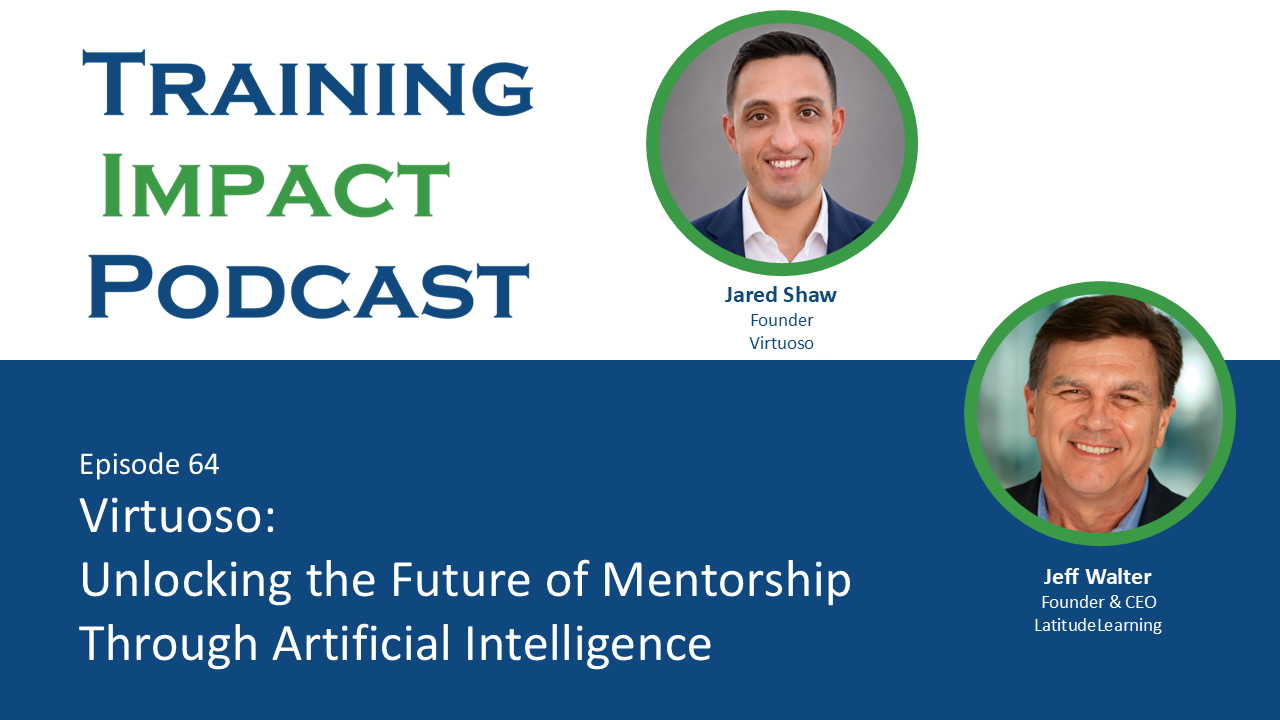
The origins of Virtuoso can be traced to founder Jared Shaw’s own experiences as a learner.
As a professional drummer, Shaw spent years developing expertise through a combination of practice, instruction, and mentorship. Like many learners seeking to improve their craft, he benefited from experienced practitioners who could demonstrate techniques, answer questions, identify mistakes, and provide guidance that accelerated development.
As digital learning expanded, access to expertise improved dramatically. Learners gained the ability to study with accomplished musicians, respected instructors, and recognized experts from around the world. High-quality instructional content became increasingly available, often delivered with production values that rivaled professional entertainment.
Despite these advances, however, something important seemed to be missing.
The interaction ended when the lesson ended.
A learner could watch an expert explain a concept. They could replay demonstrations repeatedly and study every detail. They could take notes, practice independently, and revisit lessons whenever necessary. Yet when confusion emerged, the experience often reached its limits. Follow-up questions remained unanswered. Areas of uncertainty persisted. Learners seeking additional clarification frequently found themselves searching for more content rather than receiving guidance.
The issue was not a lack of expertise.
The issue was a lack of interaction.
This distinction became increasingly significant because many of the most important learning moments occur after information has been delivered. Understanding develops through conversation. Learners test assumptions. They discover gaps in their knowledge. They seek examples that connect abstract concepts to real-world experiences. These interactions help transform information into capability.
As Shaw continued exploring this challenge, it became clear that the problem extended far beyond music education.
The same pattern appeared in workforce development. It appeared in customer education. It appeared in certification programs, technical training, academic instruction, and professional development. Across industries and disciplines, learners consistently benefited from interaction with knowledgeable guides who could provide context, reinforcement, and feedback.
The challenge was not access to information.
The challenge was access to mentorship.
The emergence of artificial intelligence introduced new possibilities for addressing this challenge.
For the first time, technology could engage learners in dynamic conversations. Questions could be answered instantly. Explanations could be tailored to individual needs. Learners could interact with information rather than simply consuming it.
These developments generated significant enthusiasm throughout the learning industry, and understandably so. The prospect of scalable interaction represented an important step forward compared to traditional digital learning experiences.
Yet as the capabilities of conversational AI expanded, another realization began to emerge.
Conversation alone does not necessarily produce learning.
A learner can spend hours interacting with an intelligent system without developing meaningful competence. Questions may drift toward unrelated topics. Important concepts may never be explored. Learners may receive accurate answers while still failing to develop the understanding required to apply knowledge effectively.
Experienced educators have long understood that effective learning requires more than responsiveness. It requires progression. Concepts build upon one another. Reinforcement strengthens understanding. Assessment provides evidence of readiness. Feedback helps learners identify misconceptions before they become habits.
In other words, effective learning requires structure.
This insight became central to Virtuoso’s development.
Rather than treating artificial intelligence as a conversational endpoint, the company began exploring how AI could operate within learning experiences specifically designed to guide learners toward defined outcomes. The objective was not simply to provide answers. The objective was to support understanding.
That distinction would ultimately shape the platform’s most important innovation.
At the center of Virtuoso’s approach is its patent-pending VirtuVision technology.
VirtuVision was developed around a principle that has guided effective instruction for generations: meaningful learning occurs through structured progression. Learners benefit when concepts are introduced deliberately, reinforced through interaction, validated through comprehension checks, and connected to practical application.
Rather than functioning as an unrestricted chatbot, VirtuVision guides learners through structured instructional experiences aligned with specific learning objectives. Learners engage in dialogue, receive feedback, demonstrate understanding, and progress through sequenced learning pathways designed to build competence over time.
This approach reflects an important distinction between information retrieval and education.
Information retrieval helps learners find answers.
Education helps learners develop understanding.
VirtuVision was designed to support the latter.
By combining conversational interaction with structured lesson sequencing, the platform seeks to preserve the flexibility of artificial intelligence while maintaining the instructional discipline necessary for effective learning. Learners remain active participants in the process, but their experiences are guided toward meaningful outcomes rather than left entirely to chance.
This emphasis on structure also creates opportunities for organizations seeking to transform existing knowledge assets into more engaging learning experiences. Training manuals, operating procedures, technical documentation, presentations, recorded webinars, and subject matter expertise can become the foundation for guided instructional journeys rather than static repositories of information.
Equally important, Virtuoso was designed with implementation in mind. Rather than requiring organizations to build learning experiences from scratch, the platform enables existing materials to be rapidly transformed into structured, interactive learning journeys. Early pilot participants have consistently highlighted this ease of use as a key benefit, allowing instructors and organizations to focus less on content creation and more on supporting learner success.
The result is a learning experience that feels less like searching for answers and more like working with a knowledgeable guide.
One of the most intriguing aspects of Virtuoso’s approach is the way it interprets personalization.
Traditional adaptive learning systems typically focus on what learners know. Content is adjusted based on assessment results, demonstrated proficiency, or identified knowledge gaps. These approaches can improve efficiency, but they often remain centered on information rather than instruction.
Mentors operate differently.
They think about people.
Experienced mentors consider interests, experiences, motivations, and learning preferences. They adapt explanations accordingly. They search for examples that resonate with individual learners. They recognize that two people may require entirely different pathways to arrive at the same understanding.
Virtuoso seeks to bring elements of this dynamic into digital learning environments.
The platform is designed not only to adapt content but also to adapt communication. Learning objectives remain consistent. Outcomes remain unchanged. What evolves is the way concepts are presented, reinforced, and connected to the learner’s unique context.
In this respect, Virtuoso moves beyond conventional notions of adaptive learning and toward a model that more closely resembles individualized instruction.
The significance of this shift extends beyond engagement. Learning becomes more meaningful when concepts connect to existing experiences. Understanding deepens when instruction feels personally relevant. Retention improves when ideas are anchored to familiar contexts.
These principles are not new.
They are characteristics of effective mentorship.
What is new is the possibility of delivering aspects of those experiences at a scale previously impossible to achieve.
Conversations surrounding artificial intelligence frequently focus on automation and replacement. Organizations often ask how technology can reduce costs, eliminate manual effort, or substitute for human labor.
Virtuoso approaches the opportunity differently.
The platform is not designed to replace instructors, trainers, coaches, or mentors. Instead, it seeks to extend their reach.
Human expertise remains central to learning. Experience, judgment, encouragement, and relationship-building continue to play critical roles in development. Artificial intelligence cannot replicate every aspect of mentorship, nor is it intended to do so.
What it can do is help sustain learning between moments of direct human interaction.
Learners can continue practicing after coaching sessions end. Employees can prepare for instructor-led training. Customers can receive guidance while navigating certification programs. Teams can reinforce concepts long after formal instruction has concluded.
In each case, technology serves as a bridge rather than a replacement.
This philosophy reflects a broader shift occurring throughout learning and development. As organizations move beyond questions of content distribution, increasing attention is being directed toward capability development, performance improvement, and the role of guidance in the learning process.
Virtuoso represents one interpretation of that future.
The learning industry has spent decades solving the challenge of access. Today, information is more available than at any point in history. Yet the need for guidance remains.
Perhaps this should not be surprising.
Learning has always been a fundamentally human process. People learn through interaction. They learn through feedback. They learn through exploration, reflection, and dialogue. Mentorship remains powerful not because it delivers information, but because it helps learners make sense of information.
The challenge has never been proving that mentorship works.
The challenge has been making it accessible.
Virtuoso’s vision is rooted in the belief that technology can help address that challenge. By combining structured learning design, conversational interaction, personalized guidance, instructor visibility, and its patent-pending VirtuVision technology, the company is exploring how mentorship-inspired learning experiences might be delivered at a scale that traditional models cannot easily achieve.
Whether applied to workforce development, customer education, professional certification, academic instruction, or partner enablement, the underlying objective remains remarkably consistent.
The goal is not simply to provide information.
The goal is to help people learn.
For more information on Virtuoso, visit their website at https://virtuvision.app/