

IGNITE Humans helps organizations build human-centered learning systems that improve leadership, customer experience, coaching, and lasting behavioral change across distributed organizations.

IGNITE Humans: Building Learning Systems That Develop Better People and Better Business Performance

Overview

Every organization wants better performance, yet many continue to rely on the same approach to learning: create more content, require more training, and expect better results. Learning management systems become filled with courses, employees complete required modules, and certifications accumulate. Yet customer experiences remain inconsistent, managers coach differently from one location to another, and frontline employees often struggle to apply what they have learned when it matters most.
Training Case Study: Business Name
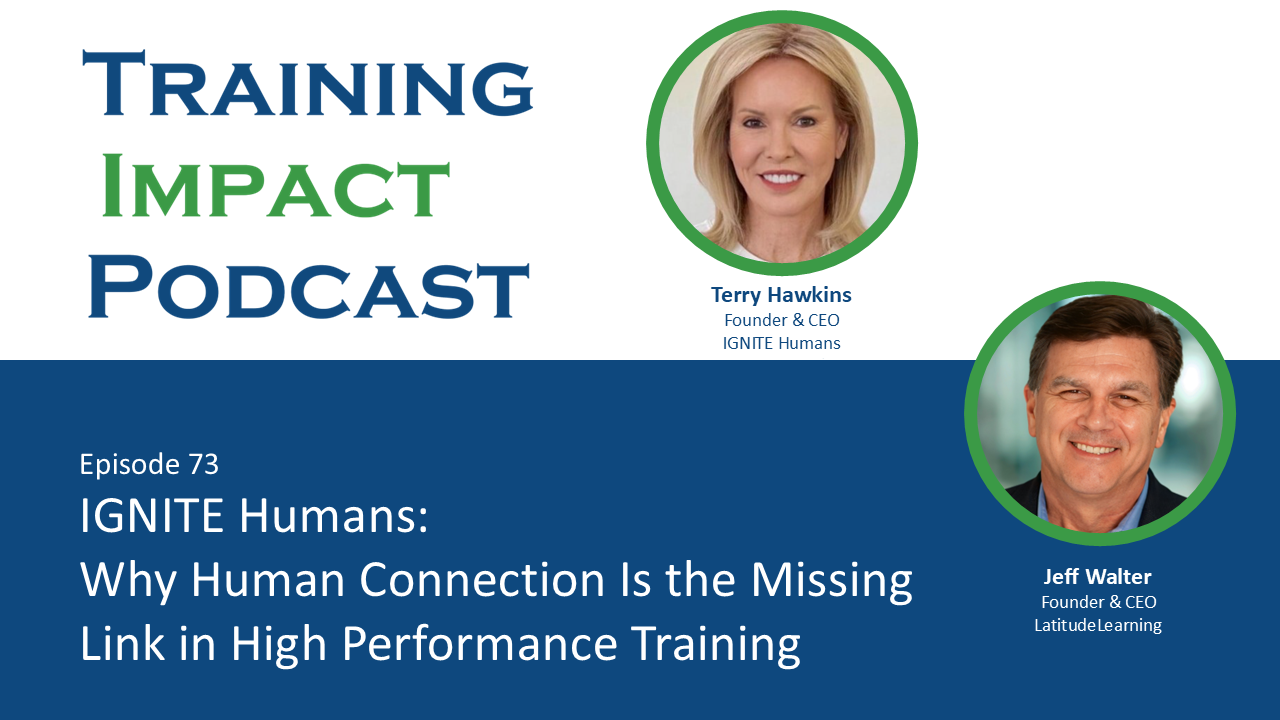
Click to Watch My Interview with Terry Hawkins

IGNITE Humans was founded on a different belief. Lasting business performance is not created by delivering more information. It is created by developing people.

Rather than viewing learning as a series of events or a library of courses, IGNITE Humans designs learning systems that help organizations build confidence, strengthen communication, improve decision making, and develop the interpersonal skills that influence every customer interaction. Knowledge remains essential, but it becomes only one part of a much larger process focused on changing behavior.

This philosophy has resonated with organizations whose brands depend on people consistently delivering exceptional experiences. From franchise organizations and retail businesses to professional services firms and customer-facing enterprises, IGNITE Humans helps organizations create learning cultures where coaching, reflection, and continuous improvement become part of everyday work instead of isolated training initiatives.

The result is a model that moves beyond compliance and course completion to create measurable improvements in leadership, customer experience, and organizational performance. Rather than asking whether learners completed the training, IGNITE Humans asks a more important question: What will they do differently tomorrow because of what they learned?

The Challenge: Why Training Often Fails to Change Behavior

Organizations today have more learning resources than ever before. Employees can access digital courses, virtual classrooms, videos, assessments, and knowledge bases with only a few clicks. Despite this unprecedented access to information, many businesses continue to experience the same operational challenges.

Customer experiences vary widely between locations. Managers provide inconsistent coaching. New employees learn procedures but struggle to adapt when situations become unpredictable. Leadership teams invest heavily in training without seeing corresponding improvements in performance.

These challenges are rarely caused by a lack of information.

More often, organizations mistake knowledge transfer for learning.

Knowing the correct answer on an assessment is very different from confidently resolving a customer complaint, coaching an employee through conflict, or making sound decisions during a stressful situation. Real performance depends on judgment, communication, emotional awareness, and the ability to apply knowledge under changing circumstances.

This challenge becomes even greater for organizations operating across franchise systems, dealer networks, partner organizations, and distributed workforces. While corporate teams can establish standards and document procedures, they cannot personally supervise every employee or every customer interaction. Success depends upon thousands of individuals making consistent decisions while representing the organization’s values.

For these organizations, learning becomes much more than an HR initiative. It becomes a strategic business capability.

Businesses investing in comprehensive franchise training recognize that operational consistency depends not only on documented processes but also on developing the people responsible for executing them. The same principle applies to organizations delivering customer training and educating dealers, suppliers, contractors, or other external audiences through extended enterprise training. Every learner represents the brand, making behavioral consistency just as important as technical competence.

IGNITE Humans approaches this challenge by shifting the conversation away from training events and toward learning systems that continuously reinforce the behaviors organizations want to see every day.

The IGNITE Humans Approach

Rather than asking how to deliver more training, IGNITE Humans begins with a different question.

What behaviors create success?

That shift fundamentally changes how learning is designed.

Instead of building courses and hoping they influence performance, the organization first identifies the behaviors, conversations, and decisions that define success within a role. Learning is then structured to help individuals repeatedly practice those behaviors until they become natural habits rather than conscious efforts.

This philosophy reflects a simple but powerful idea. People rarely change because they receive more information. They change because they repeatedly apply new ways of thinking until those behaviors become part of who they are.

Learning as a Continuous Process

One of the defining principles behind IGNITE Humans is that learning does not end when a course is completed.

Traditional training often treats learning as a single event. Employees attend a workshop, complete an online course, or pass an assessment before returning to work with little opportunity to reinforce what they have learned.

IGNITE Humans views learning as an ongoing cycle.

New knowledge must first be understood, then applied within realistic situations, reinforced through coaching, reflected upon, and continuously improved through experience. Each repetition strengthens confidence while helping learners develop better judgment and decision-making skills.

This continuous approach recognizes that expertise develops through experience rather than exposure. Reading about difficult conversations does not prepare someone to have one. Completing a leadership course does not automatically produce an effective leader. Those capabilities develop through repeated practice supported by meaningful feedback and reflection.

The Five Cs Learning Loop

At the heart of this philosophy is the Five Cs Learning Loop, a framework that transforms learning from information transfer into behavioral development.

The process begins with content, providing learners with the knowledge they need to understand a concept or process.

Comprehension ensures learners genuinely understand what they have learned instead of simply memorizing information.

Context places that knowledge into realistic situations where learners experience how concepts apply during everyday work.

Contemplation encourages reflection, allowing individuals to evaluate their own experiences, recognize opportunities for improvement, and develop greater empathy for the people they serve.

Finally, learning compounds through repetition. Each experience builds upon the previous one until new behaviors become consistent, confident, and sustainable.

Rather than measuring success by course completion alone, the Five Cs emphasize whether learning continues influencing performance long after formal instruction has ended.

Systems Create Consistency

Another distinguishing characteristic of IGNITE Humans is its emphasis on systems.

High-performing organizations rarely rely on individual talent alone. They create repeatable frameworks that guide decision making while allowing employees enough flexibility to respond authentically to each unique situation.

IGNITE Humans teaches systems rather than scripts.

A script tells someone exactly what to say.

A system helps people understand how to think.

This distinction is especially valuable in customer-facing environments, where authenticity often matters just as much as consistency. Employees who understand the principles behind a conversation are far better equipped to respond naturally than those who simply memorize responses.

By developing systems that support good decision making, organizations create greater consistency across franchise locations, regional offices, partner organizations, and customer-facing teams without sacrificing individuality.

Building Better Humans Creates Better Businesses

Perhaps the most distinctive aspect of the IGNITE Humans philosophy is its belief that professional growth begins with personal growth.

Technical knowledge remains essential, but lasting performance also depends on empathy, self-awareness, emotional regulation, communication, and the ability to understand another person’s perspective. These qualities influence every leadership conversation, coaching interaction, customer experience, and workplace relationship.

Rather than treating these capabilities as soft skills, IGNITE Humans positions them as business skills.

When people become better listeners, stronger communicators, and more thoughtful decision makers, organizations experience stronger cultures, more effective leadership, and higher levels of customer trust. These improvements cannot be achieved through technology alone. They emerge when learning systems intentionally develop the human capabilities that influence performance every day.

This philosophy closely aligns with the early stages of the LatitudeLearning Training Program Roadmap. Organizations first establish consistent systems and shared expectations, then build knowledge through structured learning experiences that emphasize application, reflection, and reinforcement. Together, these approaches transform learning from a one-time event into a continuous driver of organizational performance.

Scaling Learning Across Distributed Organizations

One of the greatest strengths of the IGNITE Humans methodology is that it scales effectively across organizations where consistency is essential but direct oversight is impossible. Franchise organizations, dealer networks, professional services firms, hospitality brands, and customer education programs all face a similar challenge. They must deliver a consistent experience while empowering individuals to make decisions in unique situations.

Traditional training often attempts to solve this problem with increasingly detailed procedures and scripts. While those tools can create consistency, they rarely produce confidence. Employees may know what they are supposed to say but struggle when conversations take an unexpected turn.

IGNITE Humans approaches the challenge differently.

Rather than scripting every interaction, the organization develops the thinking behind the interaction. Learners understand the system they should follow, the principles guiding their decisions, and the behaviors that define success. This allows them to respond naturally while remaining aligned with organizational expectations.

For organizations delivering franchise, partner, or customer education, this distinction becomes especially valuable. Learning extends beyond employees to include business owners, contractors, dealers, suppliers, and customers who all represent the brand in different ways. While their responsibilities may differ, the need for consistent communication, sound judgment, and authentic customer experiences remains the same.

This human-centered approach allows organizations to scale learning without creating robotic interactions. As new locations open, new partners join the network, or customer education programs expand, the organization already has a repeatable framework for developing people rather than simply distributing information.

Results and Business Impact

IGNITE Humans measures success differently than many learning organizations.

Instead of focusing primarily on participation rates, course completions, or assessment scores, the organization looks for evidence that learning has changed behavior. The goal is not simply to help people know more, but to help them perform differently.

One example illustrates this philosophy particularly well.

While supporting an airline food service program, employees were encouraged to move beyond simply taking orders and instead engage passengers in genuine conversations about the products they offered. Rather than relying on scripted sales techniques, they learned a repeatable system for understanding customer needs and communicating with confidence. The results were significant. Flights consistently sold out of onboard food inventory because customers responded to authentic conversations instead of transactional interactions. The improvement was driven not by memorized sales language but by employees who understood how to create meaningful customer experiences.

The organization’s impact extends well beyond measurable business metrics.

Former learners frequently describe how the principles they developed continue to influence their work years after completing formal training. Improved communication, greater self-awareness, and stronger emotional intelligence become habits that shape leadership, coaching, customer relationships, and even personal interactions outside the workplace.

This reflects one of the core beliefs behind the IGNITE Humans philosophy. Learning creates its greatest value when it becomes part of everyday thinking rather than something people consciously remember from a classroom.

The same principles also influence organizational culture.

Rather than attempting to define culture through mission statements alone, IGNITE Humans helps organizations create cultures through shared behaviors. Managers coach using common frameworks. Leaders reinforce consistent expectations. Employees develop confidence because they understand both the process they should follow and the purpose behind it.

Over time, these repeated behaviors become the culture itself.

For organizations managing distributed workforces, this creates an important competitive advantage. Consistency no longer depends upon constant supervision. Instead, it is built into the way people think, communicate, and make decisions every day.

Conclusion

Organizations have never had greater access to learning technologies, digital content, and training resources. Yet technology alone cannot create better leaders, stronger cultures, or more meaningful customer experiences.

IGNITE Humans demonstrates that sustainable performance begins with developing people.

By combining structured learning systems with coaching, reflection, empathy, and self-awareness, the organization helps businesses create environments where learning becomes part of everyday work rather than an isolated event. Knowledge is reinforced through practice, behaviors become habits, and individuals gain the confidence to make better decisions in real-world situations.

For franchise organizations, customer education programs, partner networks, and any business that depends on people representing its brand, this philosophy offers an important reminder. The most effective learning programs are not measured by how much information they deliver. They are measured by the behaviors they inspire and the performance they sustain.

As organizations continue searching for ways to strengthen culture, improve customer experiences, and prepare people for increasingly complex roles, IGNITE Humans provides a practical model for turning learning into a long-term driver of business success.

For more information about IGNITE Humans and its approach to human-centered learning, visit https://www.ignitehumans.com/

Key Takeaways and Practical Insights

Discover how IGNITE Humans builds human-centered learning systems that drive lasting behavioral change through coaching, empathy, self-awareness, and continuous learning to improve performance, culture, and customer experience.

What makes the IGNITE Humans approach different from traditional corporate training?

IGNITE Humans focuses on changing behavior rather than simply transferring knowledge. Its learning systems combine structured processes, coaching, empathy, self-awareness, and continuous practice so that learners consistently apply new skills in their daily work instead of merely completing training.

Which organizations benefit most from the IGNITE Humans methodology?

The approach is particularly valuable for organizations that depend on consistent human performance across multiple locations or teams, including franchise systems, retail organizations, professional services firms, hospitality businesses, customer education programs, and extended enterprise networks.

How does the methodology improve organizational culture?

Rather than attempting to define culture through statements or values alone, IGNITE Humans develops repeatable behaviors that become reinforced through coaching, leadership, and everyday work. Over time, these shared behaviors naturally shape organizational culture.

Why are empathy and self-awareness emphasized alongside technical skills?

Technical expertise enables people to perform tasks correctly, while empathy and self-awareness help them adapt those skills during real human interactions. Together, these capabilities improve customer experiences, strengthen leadership, and support better decision making under pressure.

How does this approach align with modern learning and development best practices?

The methodology closely reflects established adult learning principles by emphasizing active participation, real-world application, coaching, reflection, continuous improvement, and learner-centered development. It also aligns with the foundational and knowledge acquisition stages of the LatitudeLearning Training Program Roadmap, making it highly applicable to organizations seeking scalable, performance-focused learning strategies.