
The automotive industry is changing faster than most people realize. Vehicles are more complex, more computerized, and more interconnected than ever before. At the same time, employers across the country are facing a persistent technician shortage. Bridging that gap between education and industry is not theoretical work. It is practical, operational, and deeply human.
In a recent Training Impact Podcast episode, Virginia Oden, Assistant Vice President of the ASE Education Foundation, shared how her organization is helping close that gap through accreditation, industry collaboration, and structured program support. The conversation provides a masterclass in what workforce aligned training really looks like when it is executed with discipline and purpose.
For learning and development leaders, training managers, and operations executives, this episode is more than an automotive story. It is a blueprint for how structured standards, advisory engagement, and credible signals can elevate training programs across any distributed network.
Virginia Oden did not begin her career in automotive education. Her background spans more than 20 years in recruitment across higher education, healthcare, and automotive retail. Her time working for a large family-owned auto group in Oklahoma became the inflection point.
In that role, she saw firsthand the importance of building strong relationships with career and technical education programs. She wanted instructors to call her when they had a top student ready to enter the workforce. That required trust, communication, and sustained engagement with local CareerTech programs.
Her involvement deepened as she observed instructors leaving industry roles, often at significant pay cuts, to train the next generation of technicians. She saw state of the art facilities being built and understood the impact industry participation had on those programs. Later, she joined the Oklahoma Department of CareerTech, where she worked directly with instructors transitioning from industry into classrooms across multiple transportation disciplines.
That experience prepared her for a national role. Today, she works with field managers across the country, serving as a connector between schools and employers. Her job is not simply administrative oversight. It is relationship cultivation, problem solving, and ensuring that the dialogue between industry and education remains active and productive.
For organizations operating complex training ecosystems, her career arc highlights a powerful lesson. The most effective training leaders often understand both sides of the equation. They know what employers expect, and they know what educators face operationally.
The ASE Education Foundation operates under the broader umbrella of ASE Auto Service Excellence, which certifies technicians across automotive, collision, truck, and parts disciplines. The Education Foundation was established roughly 40 years ago at the request of industry leaders who recognized that certification alone was not enough. If technicians were to meet evolving industry expectations, the training programs preparing them needed structure and alignment.
The Foundation accredits automotive, collision, and truck programs at both high school and postsecondary levels. It also certifies instructors and administers entry level knowledge based assessments. The goal is simple but ambitious. Ensure that students graduating from career and technical programs are prepared for today’s industry needs.
That preparation is not generic. It is grounded in defined competencies and validated standards. Accreditation becomes a structured way to align local programs with national expectations.
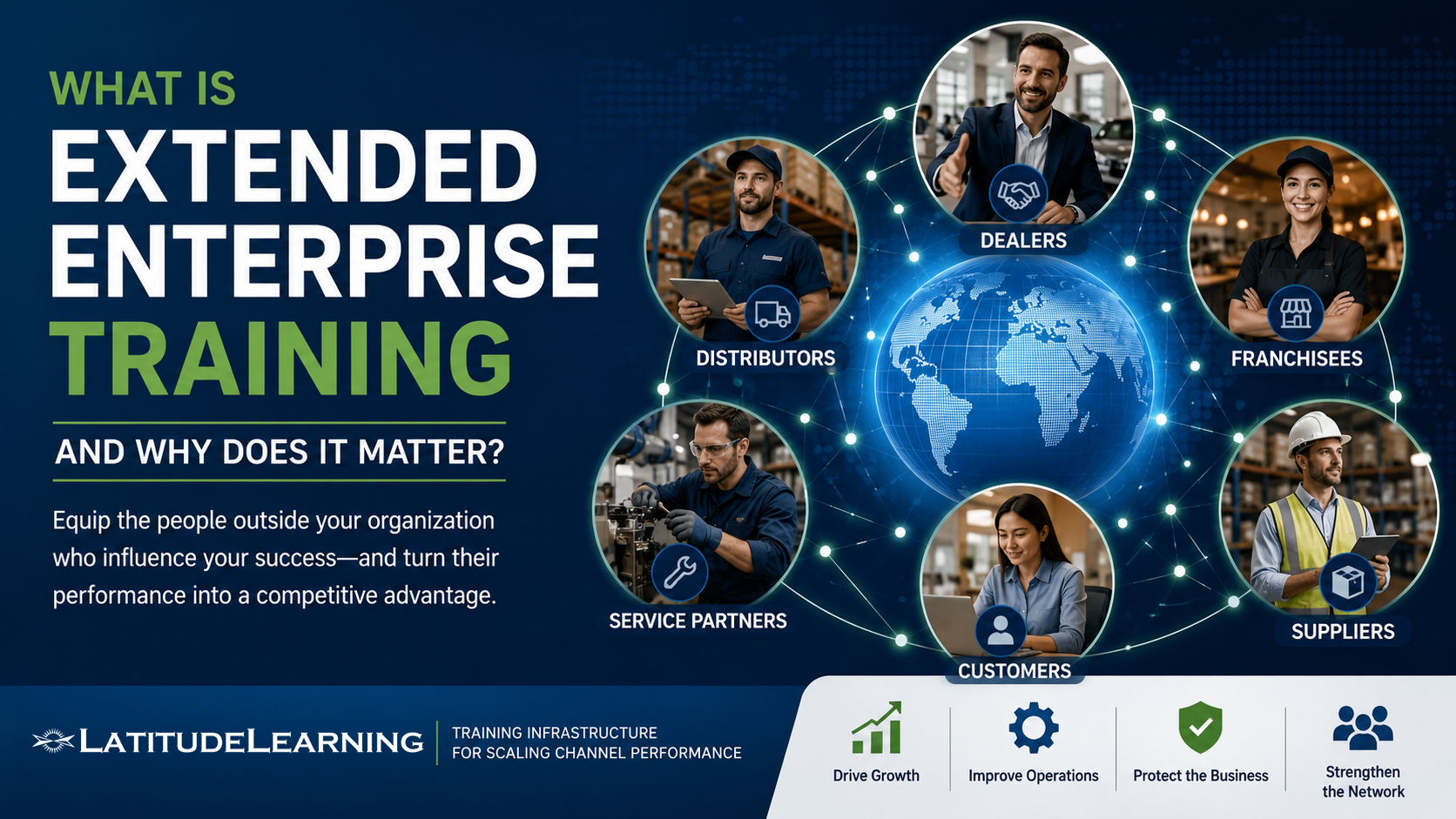
For L&D leaders outside the automotive space, this mirrors principles found in distributed learning ecosystems often described as extended enterprise training. Multiple independent entities must operate under shared performance benchmarks. Without standards and oversight, variability becomes the default.
One of the most compelling parts of the discussion centered on the communication challenges between education and industry. Each group uses its own terminology, acronyms, and mental models. Administrators may not have direct industry experience. Service managers may not fully understand the time constraints or funding limitations schools operate under.
For example, employers often assume a two year program equals two full years of hands on shop time. In reality, instructional hours are far more limited once holidays, breaks, and scheduling realities are considered. Without explicit conversations, expectations drift apart.
Virginia emphasized the importance of advisory boards as structured communication bridges. While federal Perkins funding requires some level of industry engagement, the Foundation goes further. Accredited programs must hold at least two advisory meetings per year. These meetings are not ceremonial. They are operational.
In the fall, programs review what was implemented based on prior recommendations. In the spring, they discuss student placement and budget planning. These conversations surface practical issues such as equipment updates, curriculum adjustments, and employer needs.
The advisory board model offers a powerful takeaway for training leaders in any sector. When training programs serve external stakeholders, structured dialogue is not optional. It is essential. The same principle applies in distributed franchise training networks and complex customer training environments where alignment between field execution and training standards determines consistency.
One of the most insightful moments in the conversation centered on accreditation as a credible signal. Virginia described how, as a recruiter, she prioritized visiting accredited programs because she knew they met a national benchmark. Time is limited. Accreditation reduces uncertainty.
This concept extends beyond automotive education. Credentials and certifications function as market signals. They communicate that a baseline standard has been achieved and externally validated.
For schools, accreditation supports instructors by reinforcing program legitimacy with administrators and employers. For employers, it provides confidence that graduates possess foundational competencies. For students, it strengthens employability.
Importantly, accreditation does not diminish non accredited programs. Rather, it offers structured support and a framework for continuous improvement. It acts as glue when leadership changes or advisory boards evolve.
For L&D leaders managing multi location operations, the lesson is clear. Standards matter. External validation reinforces internal credibility. Structured oversight reduces variability and increases trust.
Another powerful theme in the discussion was the evolution of the technician role. Vehicles are no longer mechanical machines alone. They are sophisticated computer systems on wheels. Diagnostics require critical thinking, data interpretation, and technical reasoning.
Virginia shared an example of a diesel student walking through a complex diagnostic problem using structured reasoning. A colleague from outside the industry expressed surprise that such critical thinking occurred in a diesel program. That reaction reflects a broader misconception.
Automotive work today requires science, technology, engineering, and math competencies. Algebra and electrical principles are embedded in everyday diagnostics. Technicians apply Ohm’s Law and systems analysis routinely.
This shift mirrors changes across many skilled trades. Routine, repetitive tasks have been engineered out. What remains are complex problems requiring judgment and analytical skill. Training programs must reflect that reality.
For organizations designing technical training, this reinforces the importance of structured knowledge acquisition. Foundational understanding must precede performance. Competency cannot rely on repetition alone.
The companion case study titled ASE Education Foundation: Building a National Operating System for Automotive Technician Excellence explores this structure in greater depth. It outlines learner types, accreditation standards, and best practices aligned with the LatitudeLearning Training Program Roadmap, particularly Stage 2 knowledge acquisition principles. That deeper exploration highlights how foundational clarity enables scalable performance across distributed programs.
The episode also addressed the broader cultural narrative surrounding career and technical education. For decades, many students were steered toward four year degrees as the default path. Meanwhile, skilled trades continued to evolve and grow in complexity.
Virginia pointed out that automotive careers offer stability, intellectual challenge, and long term opportunity. Technicians are lifelong learners. Instructors are required to complete ongoing technical training each year to stay current. Collaboration and mentorship are embedded in shop culture.
For L&D professionals, this underscores an important truth. The future of work will require structured pathways that integrate technical skill, critical thinking, and continuous learning. Career and technical education is not an alternative path. It is an essential component of workforce strategy.
Although the episode focuses on automotive education, the implications extend far beyond a single industry.
First, structured advisory engagement drives alignment. Regular, documented dialogue prevents drift between training and operational realities.
Second, accreditation and standards create credible signals. They reduce uncertainty and increase stakeholder confidence.
Third, foundational knowledge precedes performance. Complex roles require structured preparation, not informal exposure.
Fourth, communication between training and operations must be intentional. Without translation between educational and industry perspectives, misalignment persists.
For training managers overseeing distributed teams, dealer networks, or partner ecosystems, these lessons are directly applicable. The structure that supports automotive technician education can inform how any organization approaches scalable workforce development.
Virginia Oden’s work demonstrates that closing the skills gap requires more than recruiting campaigns or marketing initiatives. It requires system design, sustained relationships, and a commitment to standards that protect learner success.
🎧 To explore the full conversation, listen to the Training Impact Podcast episode featuring Virginia Oden of ASE Education Foundation.
📄 Download the companion case study: ASE Education Foundation: Building a National Operating System for Automotive Technician Excellence
🌐 Learn more about ASE Education Foundation on their website: https://www.aseeducationfoundation.org/