When Michael Rochelle of Brandon Hall Group™, joins the Training Impact Podcast, the conversation naturally moves beyond trends and into structural realities. This perspective, shaped by Brandon Hall Group research and executive dialogue, reflects a broader shift in how organizations approach enablement strategy.
With decades of experience in research, advisory services, and executive strategy, Michael sits at the intersection of workforce transformation, learning innovation, and organizational performance. Through Brandon Hall Group’s research and its Human Capital Management Excellence Conference, he has a front-row seat to how leading organizations are evolving their learning strategies.
In this episode, he brings that Brandon Hall Group perspective directly to learning and development leaders, training managers, and operations executives. The discussion is not theoretical. It is grounded in what organizations are actually doing, where they are struggling, and where the biggest opportunities lie.
At the center of the conversation, Brandon Hall Group research reinforces a clear message: non-employee training is not employee training. Treating it as such creates real business risk.
Michael describes a fascinating dual reality he observed at the latest conference. On one hand, some organizations are pushing aggressively into AI. On the other, many are still in early readiness phases. Even within the same company, one department may be far along while another is just beginning.
For training leaders, this matters because AI adoption is not a single switch. It is an organizational journey. Governance, readiness, and alignment are uneven. Yet the pressure to “get in” remains high.
Michael highlights that nearly half of organizations are still in the early stages of AI readiness. What stood out to him was not just the statistics, but the stories. Some teams are experimenting boldly. Others are hesitant. And in many cases, organizations have not fully decided what AI means for them strategically.
For L&D leaders, this is a critical takeaway. Moving forward with AI requires intention. Jumping in without clarity may create fragmentation rather than transformation.
One of the most powerful moments in the episode comes when Michael contrasts employee training with extended enterprise learning.
Employee learning often operates under compliance. You must complete this course to do your job.
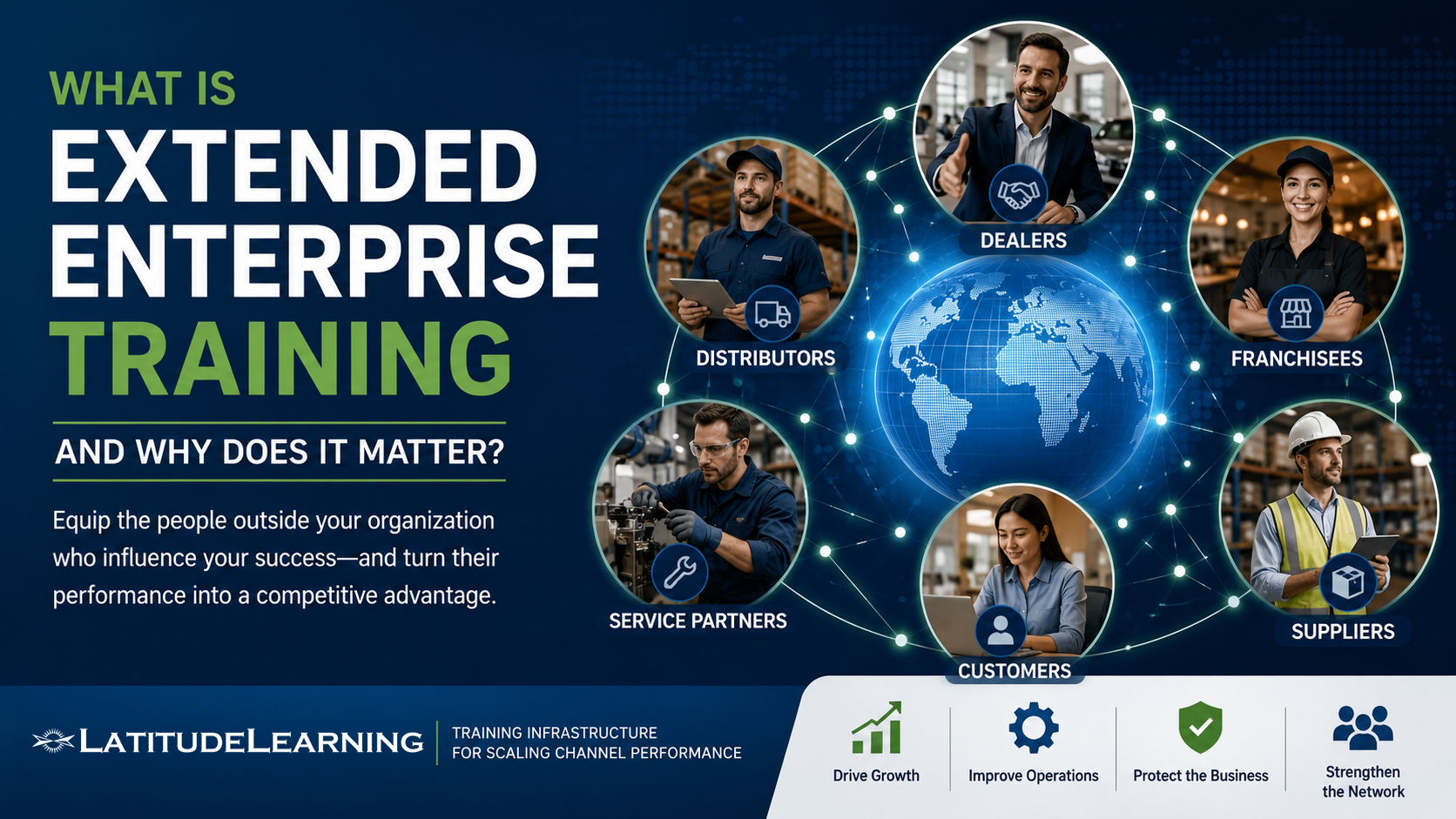
Channel partners, resellers, franchisees, dealers, and customers operate differently. They do not have to learn. And if they disengage, the business impact is immediate.
Customer satisfaction scores decline. Net promoter scores follow. Product usage drops. Expansion revenue stalls.
This distinction is central to any conversation about extended enterprise environments require marketing-minded learning design. The training must attract, not mandate. It must be useful, not simply available.
For training managers overseeing customer education or partner enablement, this reframing is essential. Engagement is earned.
The episode also challenges a long-standing assumption in learning design.
Michael uses a phrase that resonates deeply: information is not content.
Many organizations believe they have everything they need because they possess manuals, documentation, and sales collateral. But handing someone a PDF is not training. It is reference material.
Breaking a large manual into smaller modules does not automatically make it effective. Smaller pieces of broccoli are still broccoli if the learner does not want it.
For franchise systems and dealer networks working to scale consistently, this is particularly relevant. Operational manuals may be robust. But unless they are translated into contextualized, engaging experiences, they do not drive behavior.
In franchise environments where replication is critical, training becomes the engine of scale. That is why conversations around franchise training focus so heavily on structured onboarding, learner segmentation, and consistent experience.
The goal is not to reduce content. It is to reframe it.
Michael outlines three areas where AI has transformative potential for customer and channel education.
First, content creation and reformation. Instead of simply uploading static documents, organizations can use AI to transform raw information into study guides, interactive modules, and practical exercises. The technology allows faster production and experimentation.
Second, analytics and sentiment insight. In extended enterprise environments, lag indicators are dangerous. Waiting for declining product usage to reveal disengagement is too late. AI offers the potential for faster feedback loops and deeper insight into how partners feel about training and the product itself.
Third, and perhaps most important, learner experience improvement. If the platform is difficult or uninspiring, partners disengage. AI can help personalize pathways, adapt delivery styles, and reduce friction.
For L&D teams managing customer training initiatives, these three levers represent significant opportunity. But Michael emphasizes that AI alone is not enough.
One of the most practical insights from the episode centers on sentiment.
When using AI to generate learning, many organizations focus on structure and output. Few focus on emotional context. Michael argues that sentiment should be the starting point.
Who is the learner? What is their mindset? What pressures are they under? What is their attention span? What biases or blockers might they bring?
Feeding demographic data into AI is insufficient. Behavior and circumstance matter. A 27-year-old partner in a startup market behaves differently than a seasoned operator in a mature region.
Michael encourages training leaders to go beyond profiles and articulate behavioral patterns and situational context. Only then can AI truly personalize the experience.
For organizations following the LatitudeLearning Training Program Roadmap, this aligns directly with the emphasis on role clarity, learner segmentation, and contextualized delivery. Training must reflect the real environment in which the learner operates.
Another powerful theme emerging from Brandon Hall Group discussions is storytelling.
Michael observes that effective books use narrative threads to anchor abstract ideas. Training rarely does the same.
Instead of starting with documentation, he suggests starting with case studies, testimonials, and real-world experiences. Interview partners. Capture their stories. Use AI to synthesize those narratives into learning journeys.
This approach does more than increase engagement. It affirms the learner’s decision to adopt the product or brand. As Brandon Hall Group research increasingly reflects, learning that reinforces identity drives stronger long-term adoption.
For enablement teams, this is actionable advice. Before building the next course, gather five partner stories. Let those stories shape the structure.
The conversation then moves into scaling.
Drawing on patterns observed across Brandon Hall Group research, Michael makes a critical distinction. Replication does not mean identical training under every circumstance. It means replicating the experience of successful onboarding and support.
Opening a franchise in one city is not the same as opening in another. Selling into one market is not the same as another. Yet organizations often deliver one-size-fits-all training.
AI makes contextual variation possible. Adjust examples. Adjust emphasis. Adjust scenarios. Maintain core standards while tailoring to environment.
For operations leaders, this reflects what Brandon Hall Group has increasingly identified as scalable personalization. Training can be consistent in principle yet adaptive in execution.
One of the more provocative ideas in the episode is integrating learning into the sales cycle.
Instead of separating sales demonstrations from education, organizations can use training assets as part of the selling narrative. Show how easy the product is to learn. Use snippets of onboarding modules as proof of operational maturity.
When learning platforms become part of the sales journey, they signal readiness and support. This shifts training from a back-end function to a front-end differentiator.
For L&D leaders, this requires collaboration with sales and marketing teams. But the payoff is significant. Education becomes revenue-aligned.
As much as the episode explores AI, it ends with a strong reminder about human intelligence.
Michael emphasizes the value of in-person collaboration and the “wisdom of crowds” effect that conferences create. As AI accelerates efficiency, the risk of isolation increases.
For training professionals, this serves as a balancing principle. Use AI to scale. Use human connection to refine, challenge, and contextualize.
High-performing learning organizations will blend both.
Brandon Hall Group has spent decades researching human capital strategy, learning innovation, and workforce performance. That research foundation informs every insight shared in this episode.
This episode offers strategic perspective and practical insights. For readers who want a more structured, operational deep dive, the companion case study titled Brandon Hall Group: Redefining Channel Enablement Through AI and Human Intelligence expands on these themes.
The case study explores training structure, learner types, and best practices aligned with the LatitudeLearning Training Program Roadmap. It examines how organizations overcome content challenges, scale onboarding, and balance personalization with governance.
Together, the podcast and case study provide both inspiration and blueprint.
If you are an L&D leader, training manager, or enablement executive, this episode offers more than theory. It challenges how you think about scale.
Non-employee training demands a fundamentally different mindset than employee learning. Information alone is insufficient. Documentation must be transformed into contextualized, engaging experiences that partners choose to consume.
Artificial intelligence becomes powerful not simply because it accelerates production, but because it enables personalization and agility. Effective design must account for sentiment, behavior, and circumstance, not just demographics.
Storytelling strengthens engagement and reinforces brand alignment. Replication does not mean identical experiences. It means consistently effective experiences tailored to context.
And throughout it all, human intelligence remains the anchor. Technology amplifies strategy, but it does not replace judgment.
For organizations committed to scaling through structured partner enablement, this conversation provides both clarity and a clear call to act.
The insights shared by Brandon Hall Group reinforce that channel enablement is no longer a support function but a strategic growth engine.
🎧 To explore the full conversation, listen to the Training Impact Podcast episode featuring Michael Rochelle of Brandon Hall Group.
📄 Download the companion case study: Brandon Hall Group: Redefining Channel Enablement Through AI and Human Intelligence
🌐 Learn more about Brandon Hall Group on their website: https://brandonhall.com/