Overview: Customer Experience as an Operational Discipline
Most organizations describe customer experience as culture, hospitality, friendliness, or customer service philosophy. Deliver Service Now Institute approaches it differently.
The organization teaches that customer experience is operational.
It is not accidental. It is intentionally engineered through systems, repeatable processes, emotional connection, and operational consistency that shape how customers perceive a business at every interaction.
Deliver Service Now Institute helps organizations build those systems.
Drawing from operational principles refined through years of Disney-inspired service design and real-world business implementation, the institute helps organizations transform ordinary customer interactions into memorable experiences that improve customer loyalty, retention, and profitability. Rather than relying on generic customer service messaging or motivational training, the organization focuses on operationalizing experience itself.
That distinction matters.
Many organizations assume customer experience is primarily driven by personality or branding. Deliver Service Now Institute teaches that sustainable customer experience is created through disciplined operational design. Every interaction becomes intentional. Every process becomes an opportunity to reinforce trust, professionalism, consistency, and emotional connection.
This operational philosophy makes the organization particularly relevant in environments where customer perception directly impacts performance outcomes. The methodology closely reflects the realities of modern extended enterprise training, where customer-facing teams, franchise networks, service providers, and distributed operational organizations must consistently deliver aligned experiences across large ecosystems.
At its core, the institute’s philosophy can be summarized in one foundational idea:
Operational systems create emotional outcomes.
Deliver Service Now Institute emerged from years of operational experimentation, customer experience design, and service business innovation.
The organization’s foundational philosophy was heavily influenced by operational systems observed inside Walt Disney World, where customer experience is engineered through highly structured operational consistency. Attractions, restaurants, transportation systems, guest services, and employee interactions all function through carefully designed procedures intended to create repeatable emotional outcomes.
One of the most important lessons shaping the institute’s methodology is the idea that systems do not suppress employees. They enable them.
When operational activities become habitual and repeatable, employees gain mental capacity to focus on the human side of customer interaction. Instead of constantly thinking about routine execution, employees can focus on engagement, personalization, professionalism, and emotional connection.
The organization also adopted Disney’s philosophy of continuous operational refinement, often referred to internally as “plussing.” Rather than treating systems as static, processes are continually improved through observation, feedback, and operational learning.
Those principles were later applied within several service businesses, including a carpet cleaning franchise, an oriental rug washing company, and a mold remediation business. These businesses became practical laboratories for testing customer experience systems in real operational environments.
The results were significant.
Instead of competing aggressively on low-cost service models, the businesses differentiated through professionalism, operational theater, emotional connection, and trust-building customer interactions.
Technicians followed carefully designed customer entry procedures. Vehicles were parked in the street rather than customer driveways to avoid potential oil stains. Employees wore clean uniforms, carried backup uniforms, used custom entry mats, visibly cleaned their shoes before entering homes, and presented customers with small gifts before performing any work.
The operational details mattered because they shaped emotional perception.
One simple customer gift program reportedly increased mid-tier package sales by 26 percent, generating approximately sixty-five to seventy thousand dollars annually in additional revenue.
Over time, the businesses evolved into largely self-managing operations, requiring minimal weekly oversight. Those operational successes eventually became the foundation for Deliver Service Now Institute, which now helps organizations improve customer retention, operational consistency, loyalty, and profitability through systems-driven customer experience design.
Deliver Service Now Institute primarily serves organizations where customer interaction directly influences growth, retention, profitability, and brand perception.
Its clients frequently include franchise organizations, home service companies, insurance agencies, financial advisory firms, customer-facing operational businesses, and service-oriented organizations seeking stronger differentiation and customer loyalty.
Many operate in highly competitive industries where products and services are increasingly commoditized.
That commoditization creates enormous pressure.
When businesses compete only on price, profitability becomes increasingly difficult to sustain. Deliver Service Now Institute helps organizations escape commodity positioning by creating customer experiences that generate emotional value and perceived differentiation.
Most client organizations are not struggling with technical competence. Instead, they are struggling with operational consistency, customer retention, brand perception, and long-term loyalty.
Many organizations feel operationally busy while remaining financially stagnant. They continuously acquire new customers while lacking systems that maintain long-term customer relationships.
This challenge becomes especially significant in distributed operational environments where consistency directly influences brand reputation. In many ways, the institute’s methodology aligns closely with the operational realities addressed through modern franchise training systems, where organizations must balance standardized operational execution with local adaptability and field-level innovation.
Clients often seek guidance on designing repeatable customer experience systems that employees can consistently execute across locations, teams, and operational environments.
Organizations engaging Deliver Service Now Institute are rarely seeking superficial customer service improvements.
Most are attempting to solve deeper operational and financial challenges.
One of the primary client goals is improving customer retention.
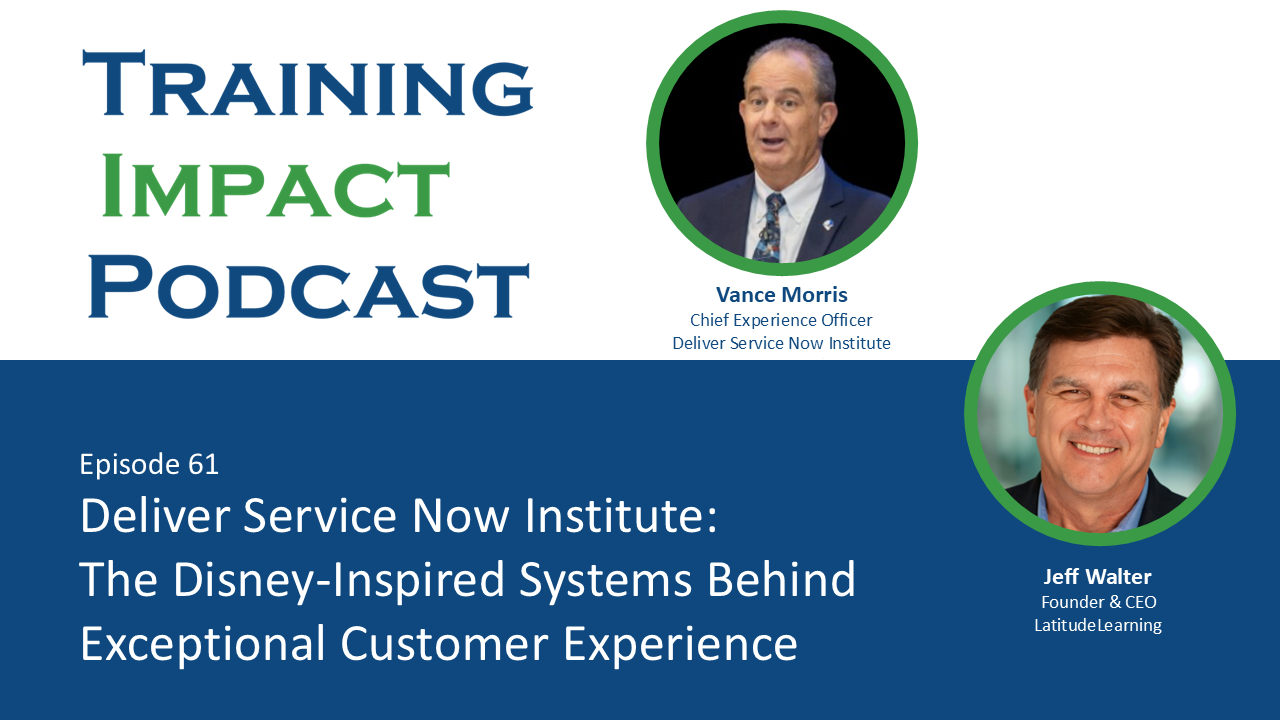
The institute consistently emphasizes the economics behind retention versus acquisition. During the Training Impact Podcast discussion, one example highlighted how acquiring a new customer cost approximately $136, while retaining an existing customer cost only $23 annually.
That distinction fundamentally changes profitability.
Repeat customers also spend more because trust has already been established. Existing customers are more receptive to cross-selling, upselling, premium offerings, and referrals because they already possess confidence in the organization.
As a result, client organizations seek systems that create emotional connection rather than purely transactional interactions.
Businesses working with the institute also aim to improve professionalism, strengthen brand differentiation, reduce price sensitivity, increase customer loyalty, improve operational consistency, and create stronger referral behavior.
Many organizations additionally recognize the growing importance of educating customers themselves. Businesses increasingly understand that operational performance improves when customers clearly understand expectations, services, processes, and outcomes. That operational alignment mirrors many of the same principles found within scalable customer training programs, where organizations intentionally educate customers to improve satisfaction, retention, adoption, and long-term relationship quality.
Ultimately, client organizations want systems that create trust.
In an increasingly digital and AI-driven marketplace, trust has become one of the most valuable competitive differentiators available to customer-facing organizations.
The learning audiences participating in Deliver Service Now Institute programs are highly practical operational learners.
These are not academic learners seeking abstract theory.
They are business owners, franchise operators, frontline service employees, technicians, receptionists, supervisors, managers, and operational leaders seeking measurable business improvement.
Most are adult learners balancing operational responsibilities alongside training participation. Their motivation centers on improving customer outcomes, operational consistency, profitability, and organizational growth.
The institute’s methodology strongly reflects adult learning theory and experiential learning principles. Rather than relying heavily on abstract instruction, programs emphasize observation, implementation, operational analysis, repetition, and real-world application.
This becomes particularly visible within the organization’s Disney immersion experiences.
Participants spend time learning customer experience concepts in classroom settings before immediately observing those same principles functioning inside Walt Disney World itself. Participants analyze how attraction operations, retail systems, guest interactions, and service workflows create emotional outcomes through operational consistency.
The learning experience becomes immediate, contextual, and highly practical.
Participants do not simply hear about customer experience systems.
They observe them functioning in live operational environments.
This methodology aligns closely with Stage 1 and Stage 2 concepts within the LatitudeLearning Training Program Roadmap.
Stage 1 emphasizes foundational operational consistency, role readiness, and process standardization. Deliver Service Now Institute reinforces these concepts through scripted interactions, repeatable customer touchpoints, and clearly defined operational systems.
Stage 2, Knowledge Acquisition, becomes particularly visible through the institute’s emphasis on operational philosophy built around “what, how, and why.”
Organizations frequently teach employees what to do and how to do it. The institute teaches that true engagement and operational improvement emerge when organizations also explain why processes exist.
That “why” creates ownership.
Employees who understand purpose become more invested in improving systems rather than merely complying with procedures.
The organizations engaging Deliver Service Now Institute face several recurring operational and strategic challenges.
One of the largest is commoditization.
Many businesses operate in industries where customers perceive little meaningful difference between competitors. As a result, organizations often compete aggressively on price rather than value.
The institute teaches that customer experience becomes the differentiator that allows organizations to escape commodity pricing models.
Another major challenge involves operational inconsistency.
Organizations may want to provide exceptional customer experiences but fail to operationalize those intentions into repeatable systems. Without structured processes, customer experiences vary dramatically depending on the employee, location, or operational situation.
Franchise organizations face an additional challenge balancing operational discipline with adaptability.
The institute strongly emphasizes the importance of listening to successful operators in the field rather than becoming excessively rigid. One example discussed during the podcast involved Cinnabon’s adaptation to changing consumer preferences. A successful franchise operator had already begun selling smaller cinnamon rolls years before corporate leadership formally embraced the concept.
The lesson was significant.
Consistency matters.
Systems matter.
But adaptability matters too.
Organizations that resist field-level innovation often struggle to evolve alongside changing customer expectations.
Technology adoption and AI-generated communication create another growing challenge. As businesses increasingly automate communication and content creation, customers place greater value on authenticity and genuine human interaction.
Deliver Service Now Institute teaches that authenticity has become a form of competitive currency.
Organizations capable of creating emotional connection stand out more clearly in environments overwhelmed by automated messaging and generic digital communication.
Deliver Service Now Institute applies several evidence-based learning and operational principles throughout its programs and consulting engagements.
Experiential learning plays a central role.
Rather than relying solely on presentations or documentation, the institute emphasizes implementation, observation, operational analysis, and practical application. Participants are encouraged to evaluate customer touchpoints, redesign interactions, and apply concepts immediately within operational environments.
Continuous improvement also serves as a foundational philosophy. Borrowing from Disney’s concept of “plussing,” organizations are encouraged to continually refine systems rather than treating processes as permanent or static.
The institute also places significant emphasis on emotional learning and customer psychology.
Customers are not simply purchasing products or services.
They are purchasing emotional experiences, professionalism, trust, and identity.
This perspective becomes especially important within service industries where technical differentiation may otherwise appear limited.
Deliver Service Now Institute also focuses heavily on operational micro-moments.
Small details such as answering phones, greeting customers, offering refreshments, or entering a customer’s home become opportunities to shape emotional perception.
One engagement involved an insurance agency struggling to differentiate itself within a crowded marketplace. The organization redesigned the company’s phone greeting to reinforce personality and emotional differentiation, helping position the business as “the agency that rocks.”
The greeting immediately differentiated the organization while reinforcing brand identity and attracting customers aligned with the organization’s culture.
Importantly, the institute consistently emphasizes simplicity.
Operational systems must remain simple and repeatable in order to scale effectively. Overly complex systems often create inconsistency, confusion, and operational failure.
The operational systems promoted by Deliver Service Now Institute generate both measurable financial outcomes and long-term customer loyalty improvements.
The service business examples discussed throughout the Training Impact Podcast provide several strong illustrations.
By redesigning technician arrival procedures and introducing simple customer gifts, one organization generated a 26 percent increase in mid-tier package sales.
More importantly, the organization achieved substantial pricing power.
While competitors aggressively competed on low-cost service offerings, the business maintained pricing approximately 40 percent higher than nearby competitors delivering similar technical services.
Customers willingly paid premium prices because the experience itself created additional perceived value.
Retention systems also dramatically improved profitability.
Rather than constantly chasing new customers, the organization focused heavily on maintaining emotional connection with existing customers through newsletters, postcards, emails, and recurring communication touchpoints.
The business implemented a six-touch monthly retention strategy that included physical newsletters, promotional postcards, and weekly emails.
Importantly, the newsletters were not primarily promotional.
They existed to deepen emotional connection.
The newsletters included entertaining stories, personal updates, and family moments that helped customers feel emotionally connected to the organization itself. Over time, customers developed strong familiarity and trust that competitors struggled to replicate.
That emotional familiarity created extraordinary retention.
Customers no longer viewed the organization as a commodity service provider.
They viewed it as a trusted relationship.
Deliver Service Now Institute demonstrates that customer experience is not accidental.
Exceptional customer experiences are engineered through operational systems, emotional intelligence, continuous improvement, and intentional process design.
The organization’s methodology illustrates how businesses can improve customer loyalty, strengthen retention, increase profitability, and escape commodity pricing by focusing on operational consistency and authentic emotional connection.
Perhaps most importantly, the institute reframes systems and processes as tools that enable stronger human interaction rather than suppress it.
That philosophy becomes increasingly important in an AI-driven world where automation continues to expand while trust, authenticity, and emotional connection become even more valuable.
For franchise organizations, service businesses, customer-facing enterprises, and distributed operational networks, Deliver Service Now Institute offers a compelling example of how operational systems, learning strategy, customer psychology, and experience design can combine to create sustainable business advantage.
As the organization emphasizes throughout its methodology:
“You won’t profit unless you implement.”
For more information on the Deliver Service Now Institute, visit their website https://deliverservicenow.com/