
- Our LMS
- Lumina AI
- Resources
- Company
- Pricing
- Contact Us
- Demo

Thryv operates at the intersection of technology, operations, and enablement for small businesses navigating growth without losing control. As businesses expand, complexity rarely arrives all at once. It accumulates quietly through disconnected tools, inconsistent workflows, and unclear expectations. Owners often find themselves reacting to problems created by the very systems meant to help them scale. What begins as a collection of helpful tools can slowly transform into a fragmented operational environment that demands constant attention.
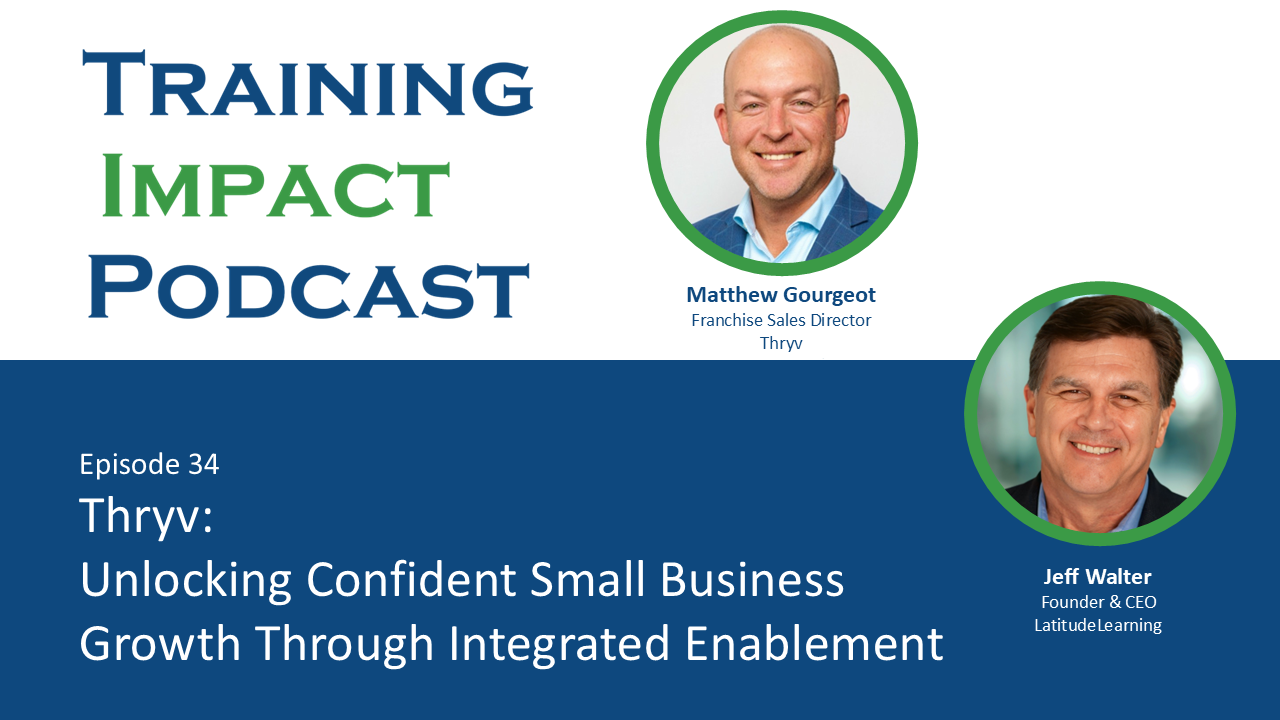
What distinguishes Thryv’s approach is the recognition that growth requires alignment before acceleration. Software alone does not create confidence. Training in isolation does not create consistency. Sustainable performance emerges when tools, workflows, and behaviors are intentionally aligned across the business. Thryv is built around this principle, treating enablement as an integrated system rather than an afterthought layered on once problems appear.
This case explores how Thryv addresses the operational realities small businesses face by supporting clarity, readiness, and consistency across environments that increasingly resemble an extended enterprise, where owners, staff, and customers all interact with the same operational ecosystem through different roles and responsibilities. In these environments, performance is shaped not only by individual effort, but by how effectively systems guide behavior over time.
Small businesses operate under constraints that large organizations rarely experience. Owners frequently manage marketing, sales, operations, customer relationships, and staffing decisions simultaneously. While large enterprises distribute responsibility across departments, small businesses concentrate decision-making in a few individuals who are constantly balancing urgency against strategy.
As digital tools have become more accessible, many small businesses have adopted platforms incrementally. Scheduling software is added to manage appointments. Marketing tools are being introduced to attract new customers. CRM systems appear to track relationships. Billing platforms are layered in to manage cash flow. Each tool solves a specific problem, but they are rarely designed to function as a cohesive system. Over time, the business becomes dependent on multiple platforms that do not share context or reinforce consistent workflows.
The result is fragmentation. Data becomes siloed across systems. Processes vary by person rather than design. New employees learn through observation and repetition rather than structured guidance. As customer volume increases, informal practices begin to fail. Growth amplifies inefficiency instead of reducing it, forcing owners to spend more time managing operations than shaping the future of the business.
Thryv enters this environment with a focus on integration and clarity. Rather than asking businesses to adapt to software, the platform is designed to support how work actually gets done. Core operational functions are connected, and workflows are structured to reinforce consistent behavior across the organization. This emphasis shapes how Thryv approaches onboarding, adoption, and long-term use, positioning the platform as an operational backbone rather than a collection of disconnected features.
One of the most common challenges small businesses face is the gap between adopting technology and changing behavior. Tools may be implemented, but daily work continues unchanged. Employees may understand what a system is supposed to do, yet lack clarity on how it fits into their responsibilities or how it should be used consistently. Over time, usage becomes uneven, confidence erodes, and the perceived value of the system declines.
Another challenge lies in how systems are introduced. Small businesses rarely have the luxury of extensive training periods. Onboarding is often compressed, leaving owners and staff to fill in gaps while continuing to operate. Early misunderstandings harden into habits that are difficult to reverse. What begins as a temporary workaround becomes the default way of working.
As the business grows, these issues compound. What once worked through memory and manual effort becomes unsustainable. Owners step back into operational roles to fix breakdowns, pulling focus away from strategy and growth. These challenges are not the result of poor effort or lack of commitment. They are the predictable outcome of growth without structured enablement.
Thryv addresses these challenges by emphasizing readiness, sequencing, and clarity. Technology is introduced within the context of real workflows, not as an abstract solution. From the earliest stages, businesses are guided to understand how customer communication, scheduling, marketing, and billing connect to one another and support daily operations.
Onboarding is treated as a foundational phase where expectations and habits are established. Rather than focusing on activation alone, Thryv supports businesses in defining how work should flow. Owners gain visibility into how systems reinforce behavior. Employees gain clarity on what is expected of them and how their actions fit into the broader operation. Everyone understands not just what the system can do, but how it should be used.
This approach mirrors enablement strategies commonly found in franchise training environments, where consistency depends on aligning expectations before scaling execution. When foundational behaviors are established early, performance becomes more predictable as the organization grows.
As businesses expand, this early clarity pays dividends. Processes scale without constant reinvention. New hires are introduced into defined workflows rather than informal practices. Technology reinforces behavior instead of competing with it, reducing the need for constant oversight and correction.
A defining aspect of Thryv’s philosophy is the belief that early alignment determines long-term outcomes. Small businesses vary widely in maturity, goals, and operational complexity. Thryv’s enablement approach acknowledges these differences by guiding owners to adopt capabilities that match their current stage rather than forcing uniform usage across all customers.
This sequencing reduces friction. Foundational workflows are stabilized before more advanced functionality is introduced. Owners gain confidence incrementally, building competence alongside growth. This progression resembles effective learning pathways, where understanding and application develop together rather than all at once.
By addressing readiness early, Thryv minimizes the need for correction later. Businesses are less likely to abandon systems or revert to manual workarounds because expectations were established intentionally from the beginning. Enablement becomes proactive rather than reactive, supporting growth instead of chasing it.
Training within the Thryv ecosystem is embedded within real work rather than separated from it. Guidance is contextual and practical, supporting immediate application. Owners and employees learn by doing, with support that reinforces correct usage at the moment it matters.
This approach respects the realities small businesses operate under. Time is limited, and learning must deliver immediate value. When training aligns with workflows, it becomes reinforcement rather than interruption. Adoption improves because learning is inseparable from execution. Systems feel supportive instead of burdensome.
This dynamic extends beyond internal operations to how businesses support their own customers. When systems are used consistently, customer interactions become more predictable and reliable. Businesses that invest in structured customer education often see improved adoption, reduced support friction, and stronger long-term relationships, supported through intentional customer training strategies that reinforce expectations and usage over time.
What makes this approach particularly effective is that Thryv does not treat enablement as a one-time intervention. Small business behavior changes gradually, shaped by repetition, reinforcement, and context. Early adoption moments matter, but long-term success depends on whether systems continue to guide behavior once novelty fades and operational pressure returns.
Thryv’s design embeds structure into everyday workflows, allowing learning to occur continuously rather than episodically. Each interaction reinforces prior understanding, reducing reliance on memory, improvisation, or individual interpretation. Over time, this creates operational muscle memory. Processes become habitual. Expectations stabilize. The business no longer depends on constant oversight to maintain standards because the system itself reinforces them.
As businesses mature, this embedded enablement becomes increasingly valuable. Turnover, growth, and changing customer demands introduce constant disruption. Without structured reinforcement, even well-trained teams regress. Thryv’s approach helps prevent this erosion by ensuring that learning is not confined to onboarding or support interactions. Instead, it is sustained through the same workflows that drive daily execution. This allows businesses to absorb change without sacrificing consistency, a critical capability for long-term performance.
As small businesses scale, the benefits of early alignment become increasingly visible. Growth no longer feels chaotic. Customer volume increases without proportional increases in confusion. Employees operate with clearer expectations. Owners spend less time resolving operational issues and more time guiding the business forward.
Thryv supports this transition by maintaining continuity across growth phases. The same principles that guide early adoption continue to apply as complexity increases. The platform serves as a shared reference point for how work gets done, reducing reliance on tribal knowledge and individual interpretation.
This consistency creates operational confidence. Businesses are able to scale without constantly reworking processes. Growth becomes additive rather than disruptive. Systems support ambition instead of constraining it.
Thryv’s relationship with small businesses is inherently long term. The platform is designed to evolve alongside the business, supporting changing needs without requiring reinvention. This perspective influences how enablement, support, and product development are approached.
By investing in clarity and alignment early, Thryv reduces the need for ongoing correction. Businesses that understand how to use the platform effectively are more likely to deepen their engagement over time. Trust builds as outcomes improve, shifting the relationship from transactional to strategic.
This lifecycle view aligns with best practices in extended enterprise enablement, where sustained performance depends on ongoing support rather than one-time onboarding. The value of enablement compounds as businesses grow, reinforcing loyalty and long-term success.
Thryv’s approach to small business growth is grounded in a practical understanding of how complexity emerges and how it can be managed. Rather than relying on technology alone, Thryv focuses on alignment, structured enablement, and workflows that support consistent behavior.
By treating onboarding as foundational, workflows as intentional, and training as integrated, Thryv creates the conditions where small businesses can scale with confidence. Performance improves not because owners work harder, but because systems work better.
In an environment crowded with tools and promises, Thryv stands out by addressing the root causes of operational strain. Its emphasis on clarity, consistency, and long-term enablement positions the platform as more than software. It becomes a trusted operational partner for small businesses navigating growth.
To learn more about Thryv, visit https://www.thryv.com/.