
Every difference below traces back to one root cause: traditional LMS platforms assume a single organization with known employees. LatitudeLearning assumes what’s actually true for extended enterprises — a network of independent organizations, multi-role learners, and performance that has to be earned in the field, not just logged in a course.
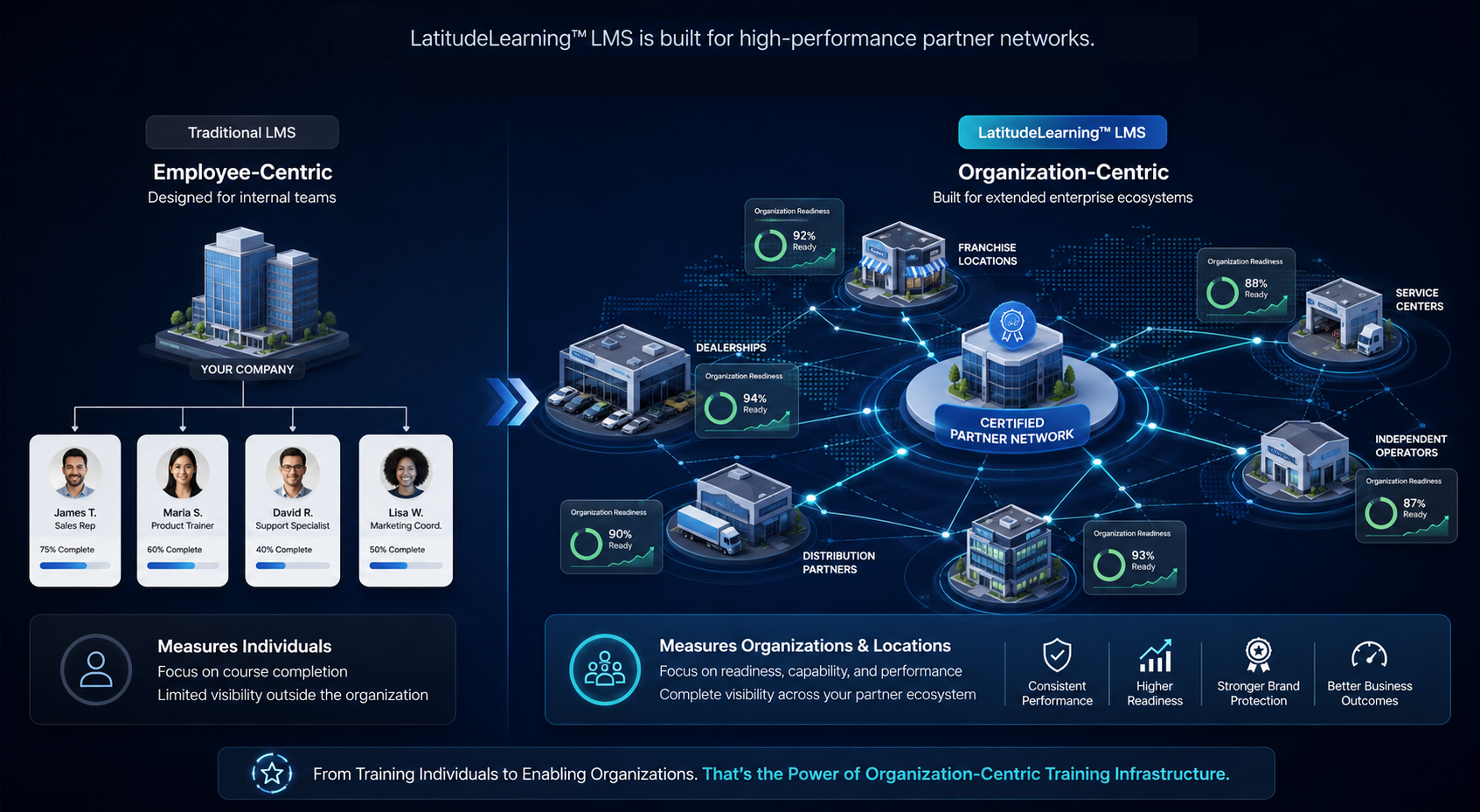
Employee LMS platforms are built around one clean assumption: every learner is a known individual on your payroll, tracked by an HR system that already knows their name, manager, and role. That assumption doesn’t hold in an extended enterprise.
LatitudeLearning treats the partner organization — the dealership, the franchise location, the service center — as the core structural unit, not just the individual learner. A location’s readiness matters as much as any one person’s completion record. This is why LatitudeLearning can answer a question employee LMS platforms structurally can’t: “Is this dealership actually staffed and ready, not just individually trained?”
In practice, this means:
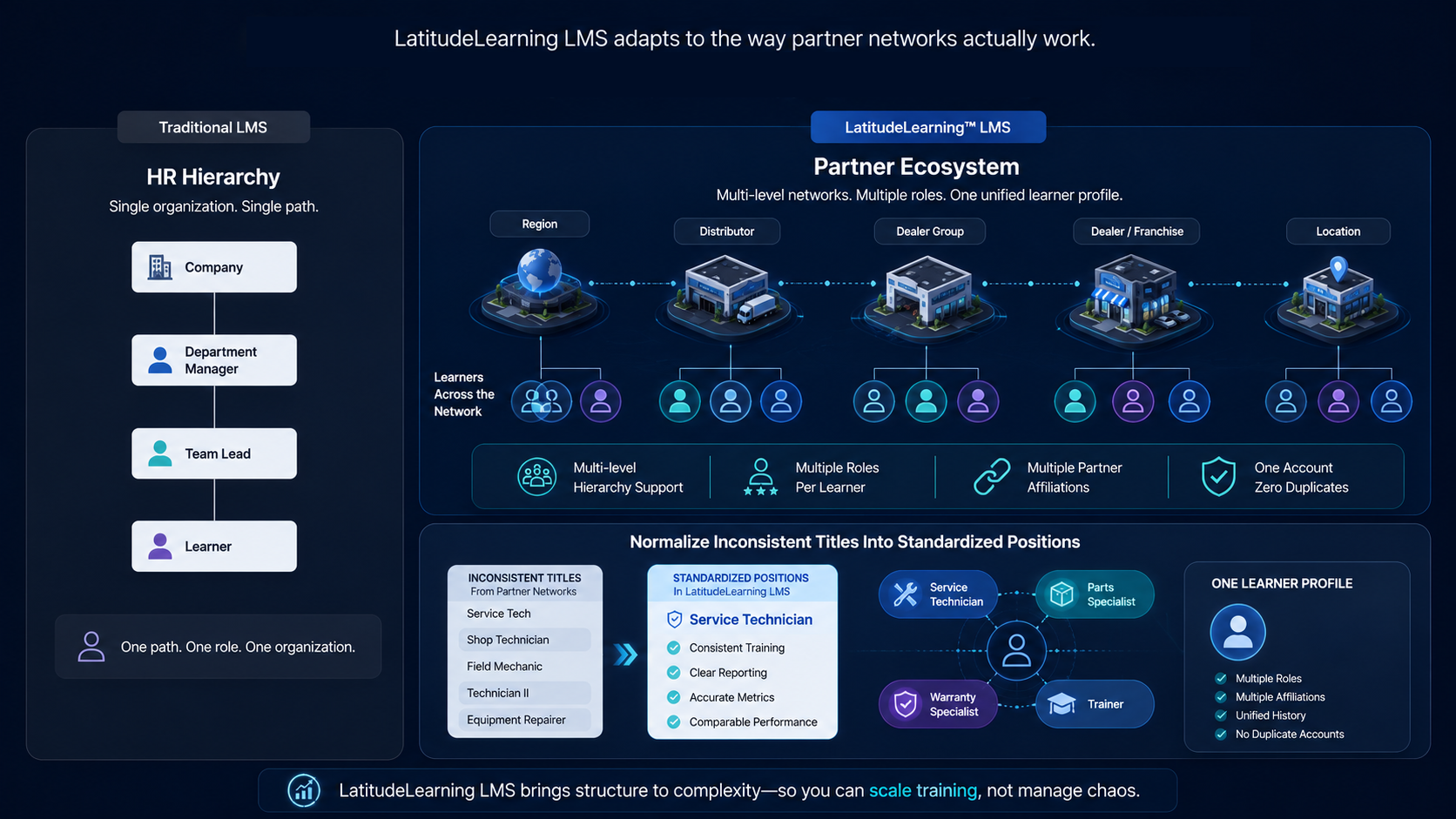
Employee LMS platforms sync to an HRIS and inherit a clean reporting line: one manager, one department, one org chart. Partner networks don’t work that way. A single learner might sell for one dealership and service another. A regional distributor might oversee a dozen independently owned locations. Partner titles rarely match your internal taxonomy — one partner’s “Service Advisor” is another’s “Front Desk Lead.”
LatitudeLearning was built to organize learners the way partner networks actually operate:
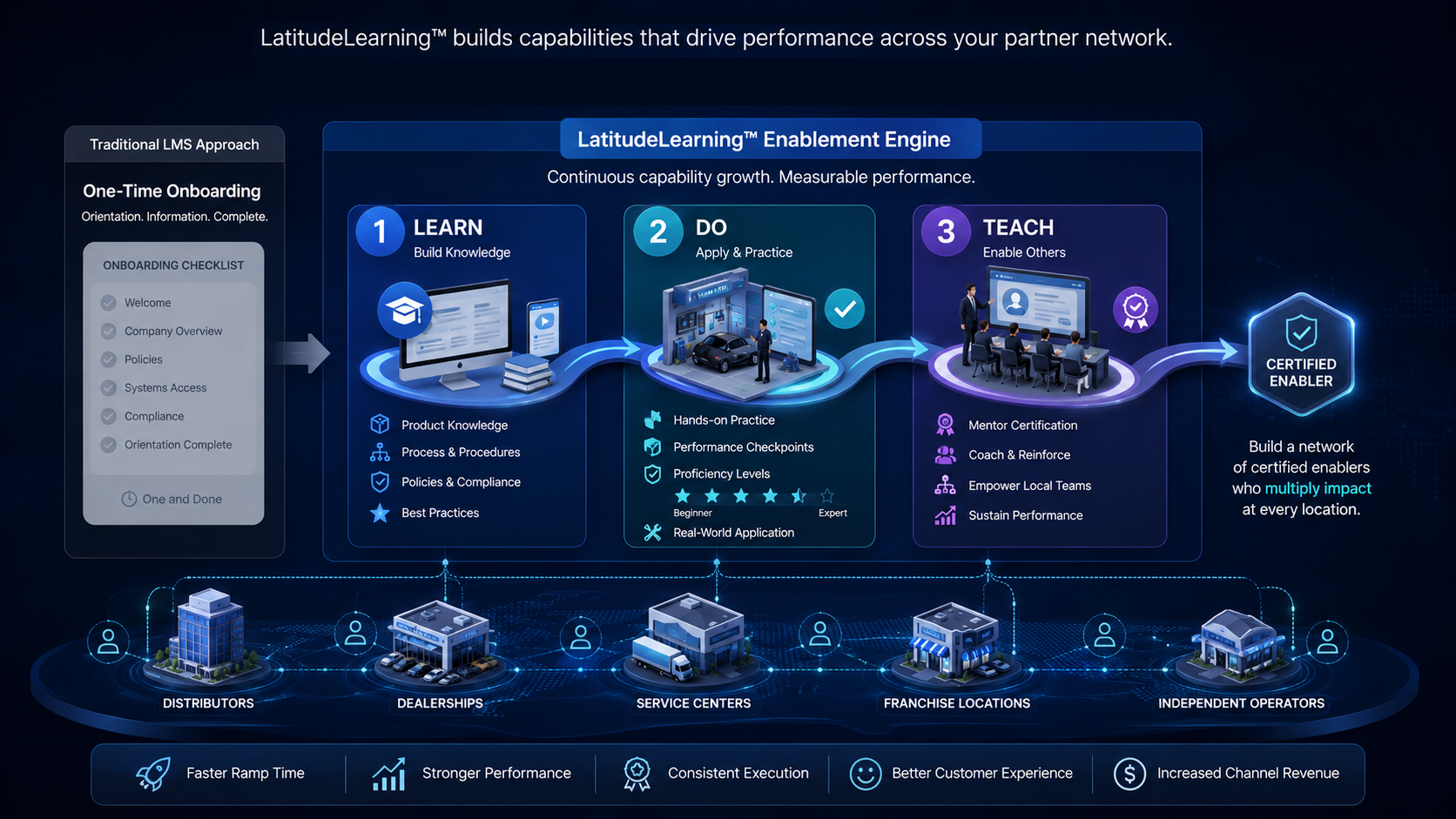
Employee LMS tools are optimized for the first 90 days: get someone oriented, compliant, and productive, then move on. Partner training can’t stop there — partners need continuous enablement long after their first course.
LatitudeLearning is built around a structured mastery progression — Learn → Do → Teach — that carries partners from foundational knowledge, through supervised practice, to becoming certified mentors who train others in their own location. This turns training from a one-time event into an engine that keeps producing capability across the network, without your central team having to personally coach every learner at every location.
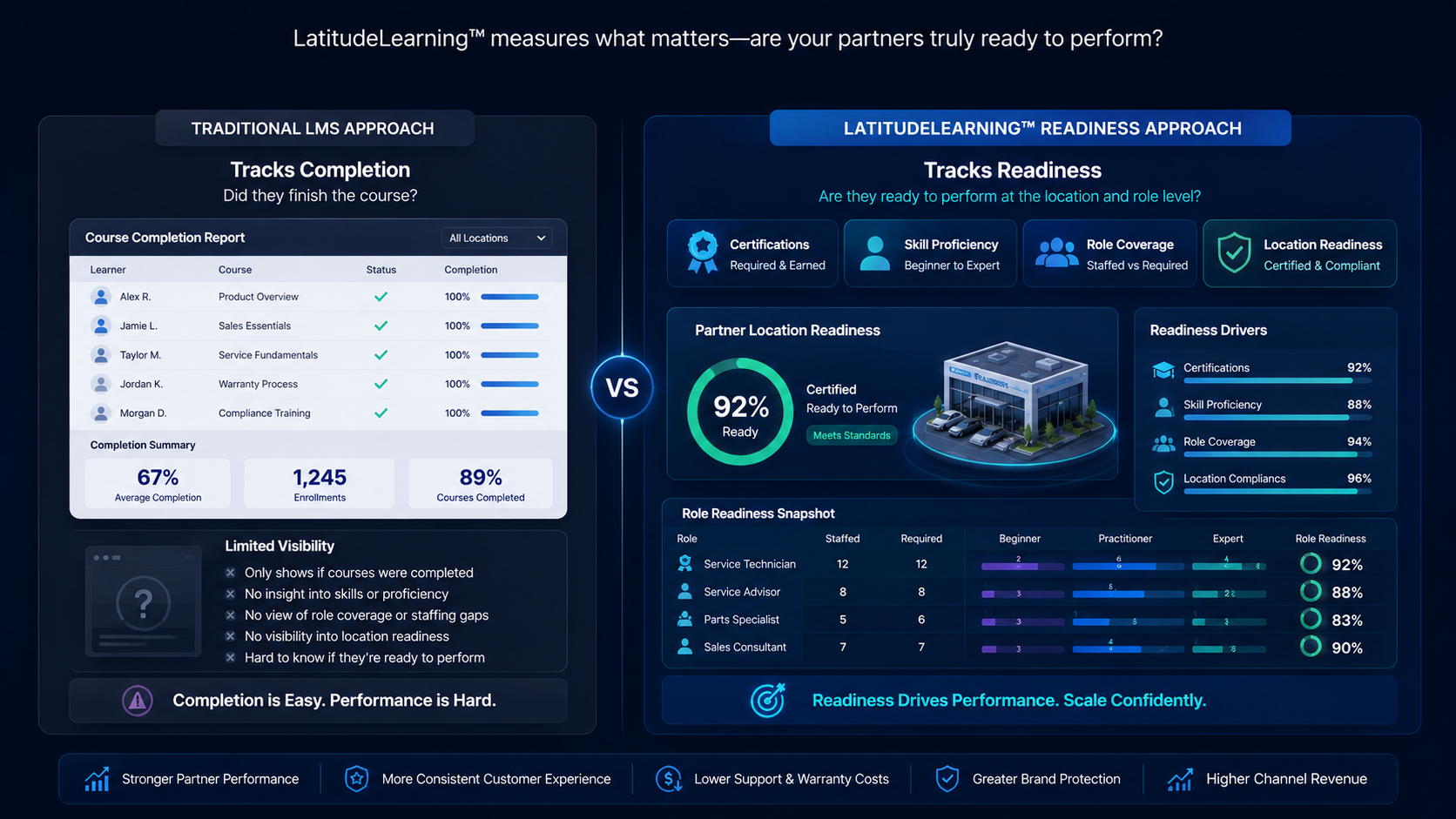
“Did they finish the course?” tells you almost nothing about whether a partner can actually perform. LatitudeLearning measures readiness — the combination of certifications, skill levels, and staffing thresholds that tell you whether a location is genuinely prepared to represent your brand.
This means LatitudeLearning can support requirements traditional LMS platforms simply have no structure for, such as a certified location needing a minimum number of certified staff in specific roles before it earns certified status — not just a percentage of completed courses.
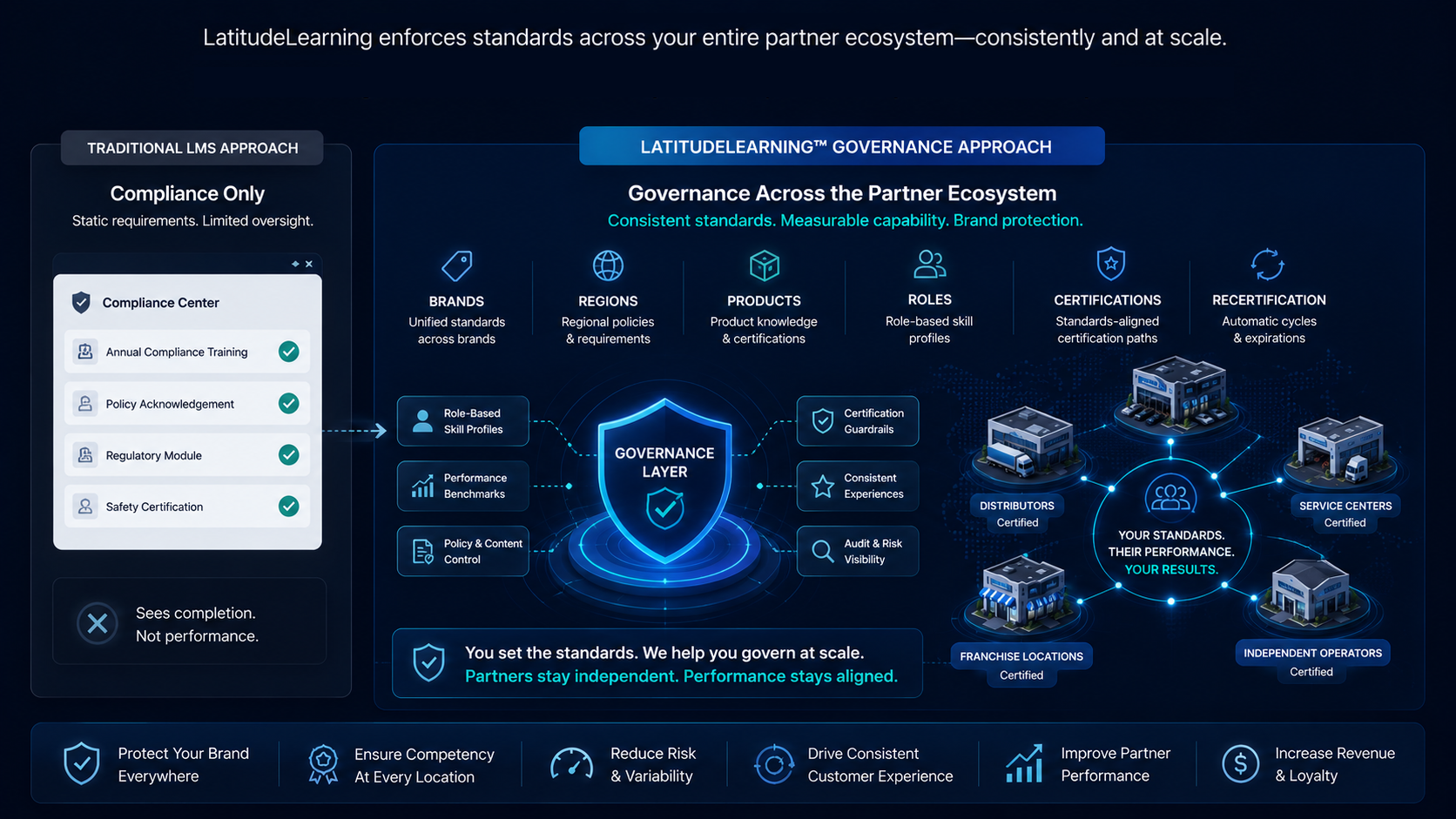
Compliance training answers, “Did we check the box?” Governance answers a harder question: “Can we trust this partner network to represent our brand consistently, at scale, without our direct oversight?”
Because you don’t directly manage partner staff, certification is often your only consistent measure of competency across independently owned organizations. LatitudeLearning layers certifications within role-based skill profiles and ties them to the Learn-Do-Teach progression, so governance holds up even as your network grows across products, regions, and brands.
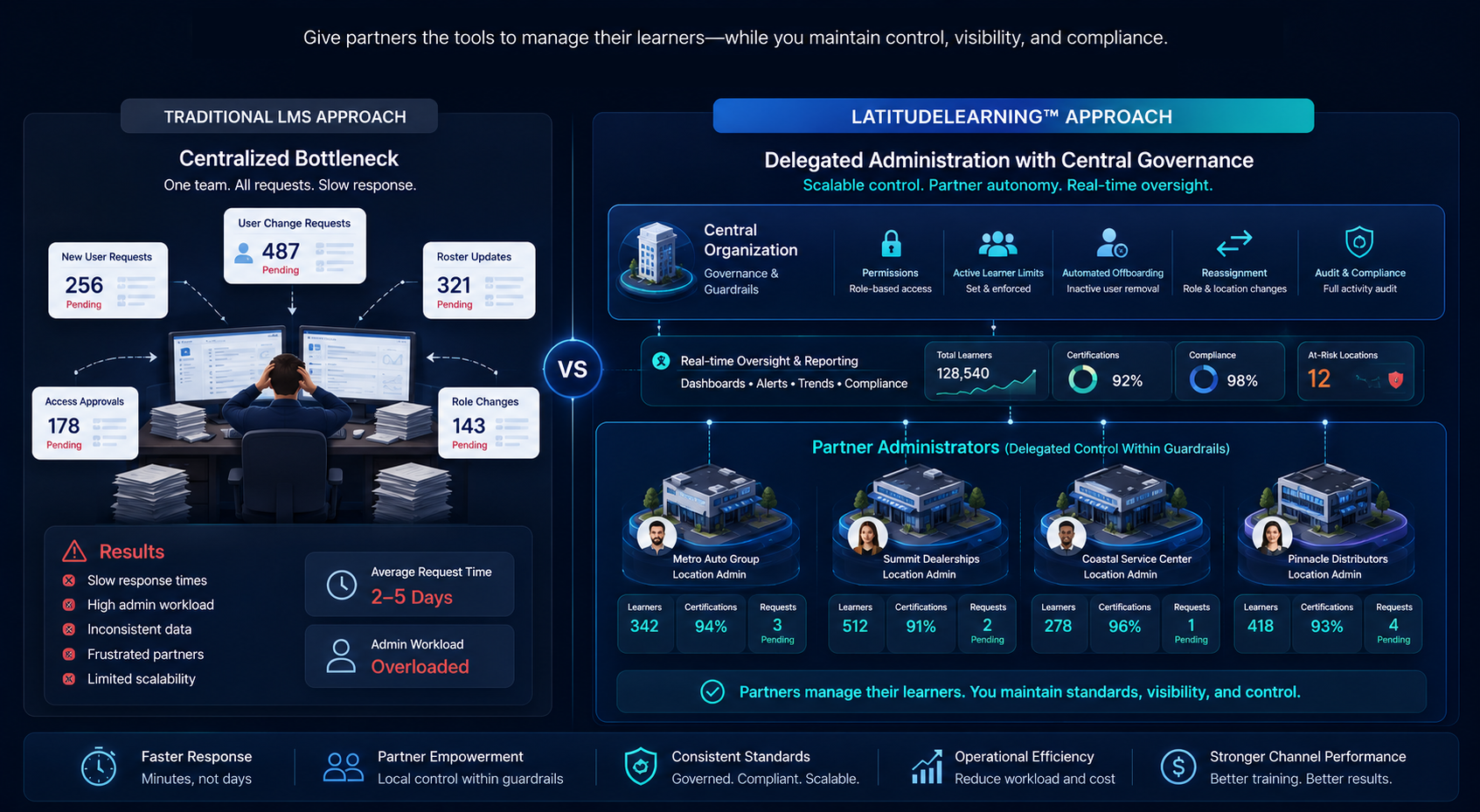
A single internal team can manage a few hundred employees by hand. It cannot manually manage thousands of partner locations without becoming the bottleneck for your entire training program.
LatitudeLearning is built for delegated administration: your central team sets the guardrails — structure, permissions, and limits — while each partner manages its own roster within those boundaries. Partners add, update, and deactivate their own learners. Your team maintains oversight without personally processing every user change across the network.
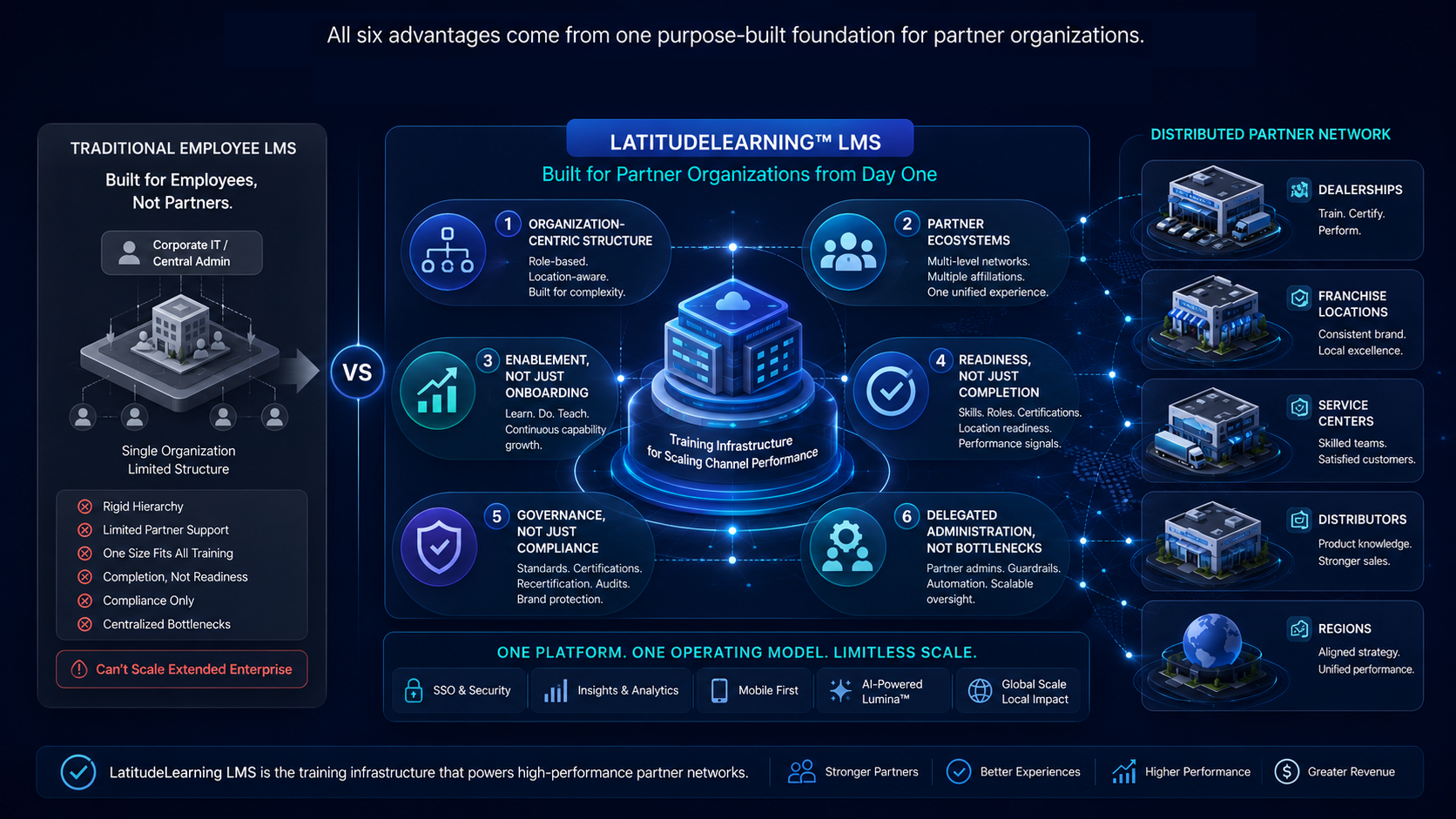
Every difference above comes from the same starting point: LatitudeLearning was designed around independent partner organizations from day one, not adapted from an employee training tool. That foundation is what makes organization-centric structure, partner ecosystems, enablement, readiness, governance, and delegated administration possible at the same time, in the same system.
We don’t just provide software—we provide the frameworks.
Explore:
These resources are designed to help organizations move from training activity to performance systems.

Most employee LMS platforms have no concept of an independent partner organization, multi-role learners, or delegated administration. You can technically add partner users, but you’ll hit duplicate accounts, manual bottlenecks, and no way to measure readiness at the location level.
It means the partner location — not just the individual learner — is a trackable, certifiable unit. You can measure and certify a dealership’s overall readiness, not just whether individual employees finished courses.
Delegated administration is a defined permission layer: partners manage their own learner rosters within limits and rules your central team sets (staffing caps, approval workflows, audit visibility). It’s not just handing over admin rights — it’s controlled, scalable self-service.
It’s the mastery progression LatitudeLearning is built around: Learn (foundational knowledge), Do (supervised practice and skill-building), and Teach (certified partners become mentors who train others in their own location). It’s how enablement scales without growing your central training team.

No — governance includes compliance but goes further. Compliance asks whether required training was completed. Governance asks whether you can trust the network to perform consistently at scale, which requires layered certifications tied to real operational roles, not just checkbox modules.
LatitudeLearning is purpose-built for distributed partner networks — dealers, distributors, franchisees, and service partners — rather than adapted from a system originally designed for internal employee training. It organizes learners around independent partner organizations, not a single company’s HR hierarchy.
Employee training assumes a known workforce, a single reporting structure, and centralized administration. Partner training involves independently owned organizations, multi-role and multi-affiliated learners, and administration that has to be shared with partners themselves. An LMS built for employees has no structural way to represent any of that.
Look for organization-level tracking (not just individual learner tracking), support for multi-role and multi-affiliated learners, delegated administration, staffing-level certification rules, and reporting that ties training to readiness and performance rather than just completion rates. A platform missing any of these will hit structural limits as a partner network grows.