
For decades, educators and learning professionals have searched for ways to close the gap between knowing and doing. Learners often leave classrooms with impressive test scores yet struggle when faced with complex, ambiguous problems that require collaboration, critical thinking, communication, and decision making. The challenge is not a lack of information. It is creating learning experiences that mirror the realities people encounter outside the classroom.
That challenge sits at the heart of this Training Impact Podcast conversation with Miriam Bogler, founder of Project Pals. A longtime educator and advocate for authentic project-based learning, Bogler has spent years exploring how students learn most effectively when they investigate meaningful problems rather than simply absorb information. Her work combines proven instructional practices with emerging artificial intelligence capabilities to make project-based learning more practical, scalable, and accessible for teachers.
Although Project Pals focuses on education, the ideas discussed throughout the conversation extend far beyond K-12 classrooms. Learning and development leaders, training managers, franchise organizations, and customer education teams all face remarkably similar challenges. How do you move learners beyond memorization? How do you build confidence through experience instead of passive instruction? And how can technology support deeper thinking instead of simply delivering more content?
Bogler describes authentic project-based learning as much more than assigning students a presentation or asking them to summarize what they have learned. Real project-based learning begins with an open-ended question that requires investigation. Learners research, collaborate, divide responsibilities, test ideas, revise their thinking, and ultimately present evidence supporting their conclusions. The learning happens throughout the journey rather than at the final presentation.
That distinction is important because it reflects the way work actually happens. Business challenges rarely belong to a single discipline. Solving customer problems may require technical expertise, communication skills, financial understanding, collaboration, and project management. Employees rarely receive neatly packaged assignments with one correct answer. Instead, they investigate, adapt, iterate, and learn together.
Bogler argues that education should reflect that same reality. Instead of teaching isolated subjects disconnected from practical application, learners should understand how different knowledge areas combine to solve meaningful problems. This investigative approach helps learners appreciate why they are learning concepts in the first place while building the confidence needed to apply them in unfamiliar situations.
For organizations designing customer training, partner enablement, or franchise education, this philosophy aligns closely with the principles behind effective extended enterprise training. Success depends not only on delivering knowledge, but on helping learners apply that knowledge in environments that closely resemble their everyday responsibilities.
Artificial intelligence often enters conversations about education through concerns about cheating or automation. Bogler offers a refreshingly different perspective.
Rather than treating AI as a system that produces answers, she envisions it as a Socratic coach. Instead of solving problems for learners, AI asks questions that guide learners toward discovering solutions themselves.
Within Project Pals, AI supports each stage of the project process. It helps learners develop stronger driving questions, organize investigations, create team agreements, define project goals, conduct research, and reflect on their findings. Throughout each step, the technology deliberately avoids giving away answers. Instead, it encourages learners to think more deeply, ask better questions, and develop their own conclusions.
This distinction fundamentally changes AI’s role in learning.
When AI simply generates content, it can replace thinking. When AI guides inquiry, it amplifies thinking.
For learning leaders experimenting with AI, this represents an important mindset shift. Rather than asking how AI can create courses faster, organizations may benefit from asking how AI can facilitate richer conversations, better coaching, and stronger critical thinking throughout the learning process.
One of the most compelling ideas to emerge from the conversation is that project-based learning develops far more than subject matter expertise. Throughout a project, learners must communicate, negotiate priorities, divide responsibilities, manage timelines, resolve disagreements, and continuously share what they are discovering with the rest of the team. Those activities are often treated as secondary skills, yet they closely resemble the work people perform every day in professional environments.
Bogler explains that successful projects depend on every team member contributing meaningful work while also understanding how the other pieces fit together. Learners cannot simply complete their own assignment in isolation. They must regularly teach one another what they have learned so the group can move collectively toward a solution. That process transforms collaboration from a soft skill into a practical necessity. It also reinforces learning, because explaining concepts to teammates requires a much deeper understanding than simply recalling information for a test.
This principle has important implications for workplace learning. Many corporate training programs are still designed around individual completion. Employees complete an online course, pass a knowledge assessment, and move on to the next assignment with little opportunity to discuss what they learned or apply it alongside their peers. While this approach efficiently delivers information, it often falls short of preparing people for the collaborative nature of modern work.
Organizations rarely solve important business challenges through individual expertise alone. Customer onboarding, franchise operations, product launches, service delivery, and continuous improvement all require people from different backgrounds to contribute their knowledge toward a common objective. Effective training should mirror that reality. By incorporating collaborative investigations, guided discussions, and team-based problem solving, organizations can help learners build not only technical competence but also the communication and decision-making skills that ultimately determine organizational performance.
This is one reason the Project Pals philosophy resonates beyond education. It recognizes that learning is not simply about acquiring knowledge. It is about developing the habits, relationships, and shared understanding that enable people to solve increasingly complex problems together. Whether the learners are elementary school students investigating environmental science or experienced professionals designing better customer experiences, the underlying process remains remarkably similar. People learn more deeply when they actively explore meaningful questions, challenge one another’s thinking, and work together toward solutions they genuinely understand.
One of the most engaging moments in the conversation explores how project-based learning principles could influence workplace training.
Instead of presenting employees with policies and procedures, what if learners first worked together to design those processes themselves? Rather than memorizing a checklist, they would investigate the business problem, identify operational challenges, propose solutions, and then compare their recommendations with the organization’s established best practices.
This approach transforms compliance into understanding.
It also creates ownership. Employees are no longer passive recipients of information. They become active participants in discovering why processes exist and how they contribute to organizational success.
This philosophy has significant implications for organizations delivering customer training or franchise training. When learners understand the reasoning behind operational standards, they are more likely to apply those standards consistently while also contributing ideas that improve future performance.
Perhaps the biggest takeaway from this episode is that effective learning is not measured by how much information is delivered. It is measured by how effectively learners develop the ability to solve problems independently.
That shift requires more than new technology. It requires thoughtful instructional design.
Organizations that build successful learning ecosystems recognize that knowledge acquisition is only one component of performance improvement. Learners also need opportunities to collaborate, experiment, receive feedback, reflect on their decisions, and gradually build confidence through authentic experiences.
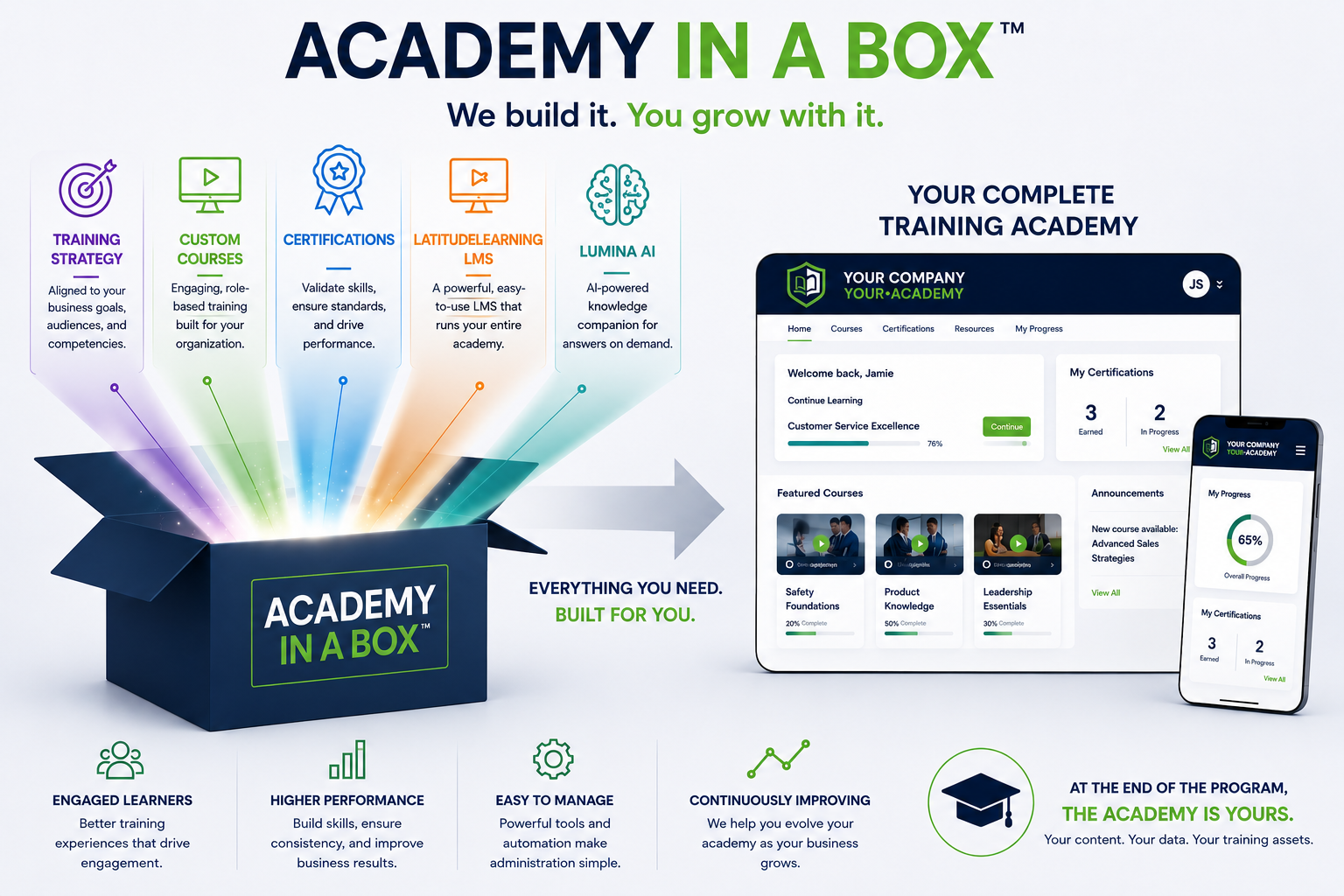
These principles closely align with the LatitudeLearning Training Program Roadmap, which emphasizes designing structured learning experiences that connect business objectives, learner journeys, and measurable performance outcomes. While every organization has unique audiences and operational goals, the underlying objective remains remarkably consistent: creating learning experiences that improve real-world performance rather than simply increasing information consumption.
Readers interested in exploring how these concepts translate into practical training strategies should also read the companion case study, Project Pals: A Breakthrough Approach to Project-Based Learning with AI. The case study expands on the organizational structure, learner types, implementation strategies, and best practices that support scalable learning programs while connecting Project Pals’ philosophy with the broader framework outlined in the LatitudeLearning Training Program Roadmap.
Project Pals demonstrates that meaningful learning has never been about delivering more content. It has always been about creating environments where learners ask better questions, collaborate more effectively, and develop the confidence to solve increasingly complex problems. As artificial intelligence continues reshaping learning and development, that lesson may prove even more valuable than the technology itself.
🎧 To explore the full conversation, listen to the Training Impact Podcast episode featuring Miriam Bogler of Project Pals.
📄 Download the companion case study: Project Pals: A Breakthrough Approach to Project-Based Learning with AI
🌐 Learn more about Project Pals on their website: https://projectpals.com/