
A product launch is coming. A new group of franchisees needs onboarding. Dealers need certification. Service partners need updated procedures. A new compliance requirement has to reach hundreds of locations.
The immediate reaction is often the same: create the training, get people through it, and move on.
That approach may solve an immediate training need. It does not create a partner training strategy.
Organizations that depend on dealers, distributors, franchisees, resellers, service providers, contractors, suppliers, or other external partners face a longer-term challenge. They need people outside their corporate structure to develop and maintain the capabilities required to perform consistently over time.
That takes more than courses.
It takes a system.
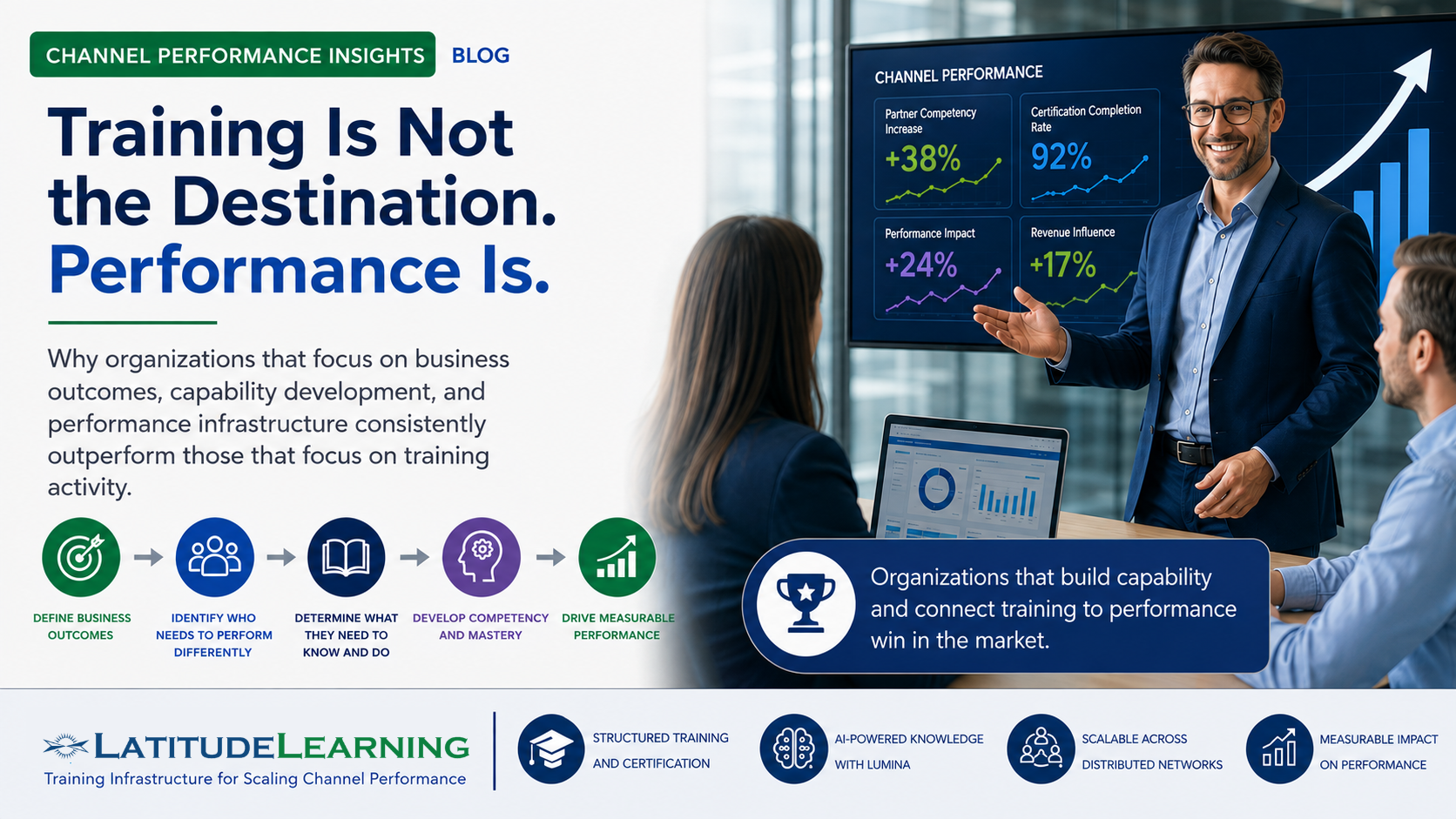
This is one of the central ideas behind Surefire Training Impact™: training is not the destination. Performance is. Training develops capabilities. Those capabilities influence how people perform. Improved performance can then influence the business outcomes the organization cares about.
Building that connection takes endurance.
An endurance athlete does not prepare for a long race by completing one hard workout. Performance is built through a sustained process of preparation, practice, measurement, adjustment, and improvement.
Partner training works much the same way.
You may have individual finish lines along the way. A franchisee completes onboarding. A technician earns a certification. A dealer becomes qualified to sell a new product. A distributor’s sales team completes product training.
Those are meaningful accomplishments, but the training program continues.
Products change. Processes evolve. People leave and new people arrive. Partners add locations. New regulations emerge. Business priorities shift. Skills that were adequate last year may not be enough for what the network needs to accomplish next year.
The Surefire Training Impact™ book makes continuous improvement a core operating principle. It calls for ongoing feedback, analysis of training data, regular reviews and refreshes, pilots and iteration, evolving incentives, and continued alignment with current business priorities. It makes the point clearly: the program launched in year one should not be the same program being operated in year three.
A partner training strategy therefore cannot be built around the assumption that training is something you finish.
It must be built to evolve.
Endurance training begins with a destination. The athlete knows what event they are preparing for before deciding how to train.
Partner training should work the same way.
Before asking what courses need to be created, ask a more important question:
The answer will be different for every organization.
A manufacturer may need technicians to perform repairs more consistently. A franchisor may want new locations to reach operating standards faster. A distributor network may need stronger product knowledge. A company launching a new product may need dealers prepared to sell and service it. Another organization may be trying to strengthen compliance or improve the consistency of the customer experience.
The Surefire Training Impact™ framework groups potential partner-training benefits around four broad business needs: driving growth, improving operations, protecting the business, and strengthening the network.
These are potential destinations, not guaranteed results of training.
That distinction matters.
Training develops knowledge and capabilities. Those capabilities can influence behavior and performance. Better performance can, in turn, influence outcomes such as sales, service quality, operational consistency, customer satisfaction, compliance, or costs.
A strong partner training strategy makes those relationships explicit instead of assuming that course completion equals business impact.
The endurance challenge becomes even more apparent when you consider who has to be trained.
Partners rarely operate inside one neat organizational structure.
A manufacturer may support thousands of people across hundreds of dealerships or distributors. A franchisor may have independently owned locations with different managers and staffing patterns. A partner ecosystem may span brands, countries, languages, products, roles, and levels of experience.
Unlike employees, these learners often do not report directly to the organization providing the training.
That creates a fundamental operational challenge.
The organization still needs people across the network to understand products, follow processes, maintain standards, develop skills, and perform effectively, but it may have limited direct authority over how those people spend their time.
The current Surefire framework identifies channel partners, operational partners, suppliers, and customers as distinct audiences whose knowledge and capabilities can influence organizational success.
This is why partner training has to be treated as a sustained business discipline.
People will enter and leave the network. Roles will change. Locations will open. Products will be introduced. Certifications will expire. Skills will need reinforcement.
The program must keep moving even while the network underneath it changes.
When an organization needs to improve partner performance, creating a course feels tangible.
There is a subject-matter expert. There is content. There is a launch date. Eventually there is a completion report.
But a collection of courses is not the same thing as training infrastructure.
Think about what has to happen around the content.
The right people must get access. Training has to reach the appropriate audiences. Requirements may differ by role, organization, location, brand, product, or geography. Progress needs to be tracked. Certifications may need to be awarded and renewed. Skills may need to be practiced and assessed. Managers may need visibility. Content has to remain current. The organization needs to determine whether the program is actually helping people perform.
And then the process repeats.
Surefire Training Impact™ provides two complementary structures for managing that journey. The Training Program Roadmap™ describes a five-stage progression from Self-Directed Learning through Knowledge Acquisition, Skill Development, Individual Performance, and Organizational Performance. The Surefire Training Workstreams™ define the operational disciplines needed to build, operate, and continuously improve the program.
The distinction is useful:
The Roadmap shows where the program needs to go. The Workstreams help make the journey operational.
Together, they reinforce a larger point: sustainable partner performance requires an infrastructure, not a sequence of disconnected training events.
A sprint mentality tends to emphasize activity.
How many people enrolled? How many completed the course? How quickly did we launch it?
Those metrics are useful. They tell you whether training is reaching people and whether learners are progressing through it.
They do not necessarily tell you whether people can perform.
Surefire Training Impact™ addresses that gap through Learn. Do. Teach.™, which describes the progression from knowledge to competency to mastery.
Learn builds the knowledge required to perform.
Do requires people to apply that knowledge and demonstrate competency.
Teach extends mastery by enabling capable people to coach, mentor, and develop others.
For an endurance-minded partner training strategy, this changes the question.
Instead of asking only, “Did our partners take the training?” the organization begins asking, “Have we developed the capabilities our partners need to perform?”
That is a much higher standard.
It also makes training more valuable. Knowledge matters because it prepares someone to act. Competency matters because it demonstrates the ability to perform. Mastery matters because capability can begin spreading through the network rather than depending entirely on a centralized training team.
A static partner training program eventually becomes an outdated one.
Products change. Competitors change. Processes change. Customer expectations change. Business objectives change.
Your partner training strategy needs a mechanism for responding.
This is where endurance becomes more than a metaphor. Long-term programs require pacing and adaptation.
Training leaders should regularly examine what partners need now, where performance gaps exist, what content remains useful, which certifications still matter, where learners are struggling, and whether the program remains aligned with current business priorities.
The Surefire Training Impact™ approach specifically calls for feedback from learners, partner administrators, and field managers; examination of usage and outcome patterns; predictable content refresh cycles; pilots before broad rollout of new approaches; and sharing practices developed by top-performing partners.
Continuous improvement should therefore be designed into the program rather than treated as a cleanup exercise every few years.
The objective is not change for the sake of change.
It is keeping partner capabilities aligned with what the business needs the network to accomplish.
For organizations that depend on distributed networks, partner capability is an ongoing operational requirement.
Dealers have to remain ready to sell and service products. Franchise locations have to continue executing brand standards. Distributors need current product knowledge. Service partners need the right technical skills. New people must be developed as experienced people leave.
This is why LatitudeLearning’s broader strategic position focuses on training infrastructure for scaling channel performance rather than treating the LMS as simply a place to host courses. The need is larger than content delivery. Distributed networks require a repeatable system for organizing learners, developing capabilities, managing requirements, measuring progress, and continually adapting the program as the network changes.
Surefire Training Impact™ provides the strategic framework for thinking about that system.
Begin with the business outcomes you want to influence. Determine whose performance matters. Define what those people need to know and do. Build knowledge, competency, and mastery. Address the challenges of the distributed network. Advance the maturity of the program. Build the operational disciplines required to sustain it. Then connect training more deliberately to performance.
There will be milestones along the way, but there is no single course, launch, certification, or technology implementation that represents the final destination.
Because the real destination is performance.
And performance has to be developed, maintained, measured, and improved over time.
That is why a serious partner training strategy is an endurance sport.
Explore the Surefire Training Impact™ framework and see how training can become infrastructure for developing capability and scaling performance across your partner network.