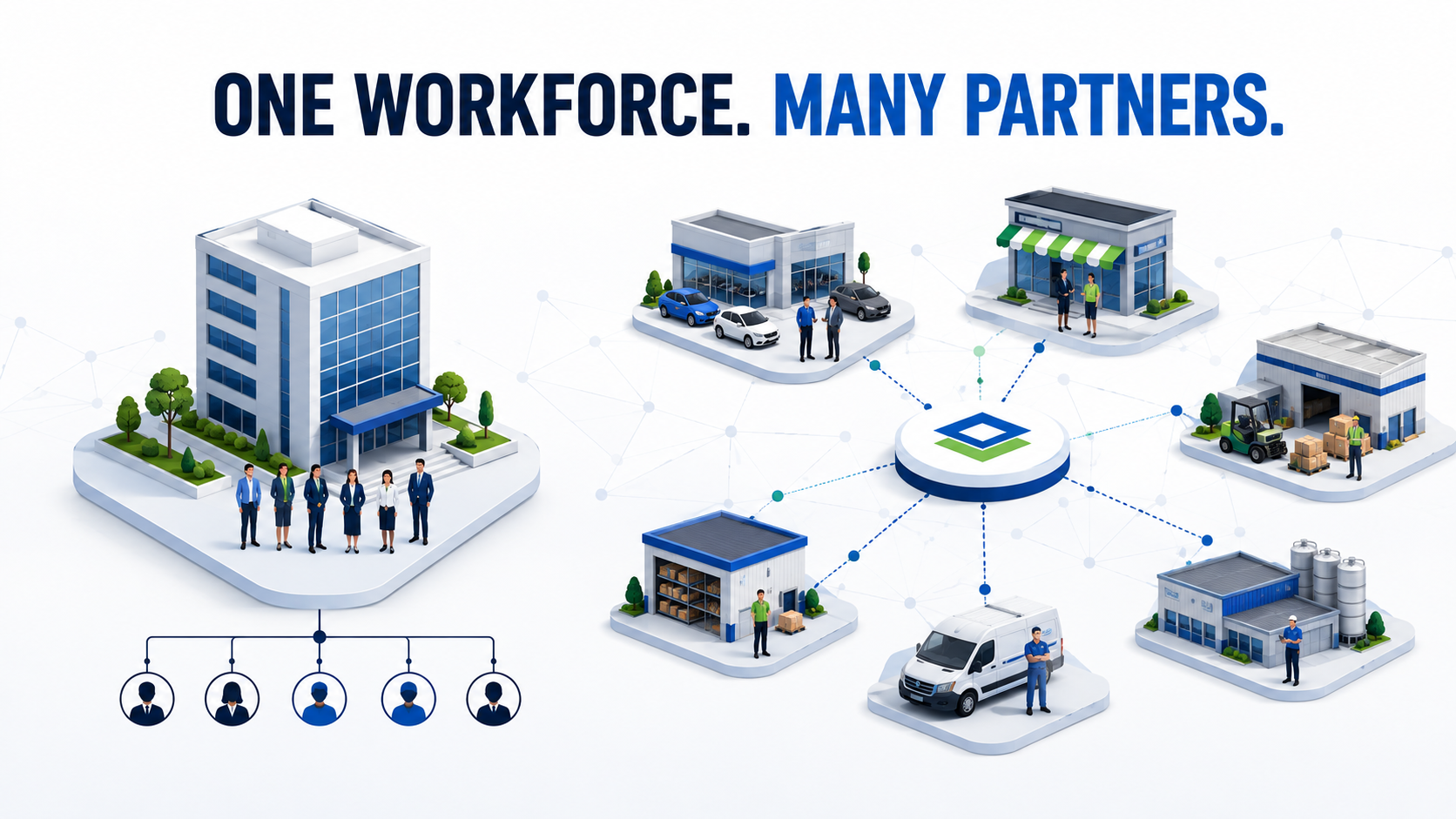

Employee training and partner training may use some of the same tools. Both can include courses, videos, assessments, learning paths, certifications, and reports. Both are designed to help people develop the knowledge and skills needed to perform.
That surface-level similarity can be misleading.
Employee training generally operates within a single organization, under a defined management structure, with known employees and established systems. Partner training must reach people across independent businesses, locations, roles, brands, and relationships. The organization providing the training may depend on these people’s performance without employing them or managing their day-to-day work.
That difference changes how training must be designed, delivered, administered, encouraged, and measured.
Understanding partner training vs employee training is therefore more than a matter of terminology. It is the starting point for building training infrastructure that can support performance across a distributed network.
Employee training begins with a significant structural advantage: the organization knows who its learners are.
Employees are hired into established positions. Their job titles, departments, managers, locations, and employment status are usually recorded in an HR system. That information can be used to create learner accounts, assign required courses, establish reporting relationships, and remove access when an employee leaves.
The organization also has direct authority over participation. Managers can require employees to complete onboarding, compliance, safety, product, or professional-development training. If an employee misses a deadline, the manager can intervene.
Employee training is commonly designed around individual requirements:
These are important questions, but they assume that the learner is part of a known organizational structure.
Partner training does not have that same starting point.
Partner training serves people outside the company’s corporate workforce. These audiences may include franchisees, dealers, distributors, resellers, agents, service providers, contractors, suppliers, or customers.
They can directly influence sales, service quality, product adoption, compliance, customer experience, brand consistency, and operational performance. Yet they do not necessarily appear in the company’s HR system, report to its managers, or work exclusively with its products.
A manufacturer may know that a dealership is authorized to sell and service its products without knowing every salesperson and technician working there. A franchisor may have a contractual relationship with a franchise owner but limited visibility into every person hired by that owner. A distributor may employ people who represent several competing product lines.
This means partner training must account for two interconnected levels of performance.
The first is the individual. Does the salesperson understand the product? Can the technician complete the repair? Can the franchise manager execute the required process?
The second is the organization or location. Does the dealership have enough certified technicians? Does the franchise location have the capabilities required to operate consistently? Does the supplier facility have qualified people covering the necessary quality functions?
Employee training is often centered on the development of a person. Partner training must develop people while also helping the organization determine whether an external location or business has the collective capability to perform.
Employees usually complete training because it is part of their job. Their employer can establish requirements, deadlines, and consequences.
External learners operate under a different relationship. The company providing the training may establish contractual requirements or certification standards, but it generally cannot manage every learner directly.
A reseller representative may have several vendors competing for attention. A franchise employee may be balancing training against immediate operational demands. A service technician may see little reason to complete another course unless it clearly helps with the work. A customer will participate only when the training makes the product easier or more valuable to use.
Partner training must therefore earn attention.
The program needs to make the value of participation clear. That value can come from faster onboarding, greater product confidence, access to partnership benefits, certification, recognition, improved service capability, or eligibility to perform certain work.
Incentives can also support engagement. Depending on the network, these might include recognition, badges, rebates, co-marketing funds, product access, enhanced partner status, or other business benefits.
This does not mean every partner training program needs an elaborate reward system. It means external participation cannot be treated as if a corporate manager were standing nearby to enforce it. Relevance, convenience, communication, and perceived value become essential parts of the training strategy.
Employee training is frequently organized around a relatively stable model: one employee, one position, one location, and one reporting structure.
Partner networks rarely remain that simple.
A person working for a small dealership might serve as the location manager, lead salesperson, and backup technician. A franchise owner might oversee several locations. A service professional may support multiple dealers. A distributor representative may sell several brands and require different training for each one.
Turnover adds another complication. The company providing the training may not know immediately when someone joins or leaves a partner organization. If learner access depends entirely on a centralized training team, account creation and removal can quickly become an administrative bottleneck.
Partner training therefore requires processes that can answer questions such as:
These are not simply system-administration questions. They affect whether training reaches the right people and whether the resulting data provides a trustworthy view of network capability.
Employee training programs can often use third-party content for broadly applicable subjects such as workplace communication, leadership, software skills, cybersecurity, or regulatory compliance.
Partner training usually depends more heavily on proprietary knowledge.
Partners need to understand the organization’s products, services, brand standards, operating procedures, sales methods, technical requirements, quality expectations, and customer-service practices. Much of this content cannot be purchased from a general course library because it reflects how a specific company expects its network to operate.
This creates an ongoing content responsibility. Products change. Procedures evolve. Regulations are updated. New customer expectations emerge. Training that was accurate a year ago may no longer prepare a partner to perform correctly today.
Partner training content must therefore be treated as a maintained business resource, not a one-time publishing project. Subject-matter experts, training teams, product leaders, operations teams, and field organizations may all need to contribute to its development and upkeep.
The central question is not simply, “What courses should we offer?” It is, “What do people across this network need to know and do to perform their roles effectively?”
That shift reflects the Surefire Training Impact™ principle that training is not the destination. Training develops capabilities, those capabilities influence performance, and improved performance can influence business outcomes.
Inside a company, managers can observe employees, provide feedback, and intervene when performance falls below expectations. Direct oversight provides a degree of confidence that course records alone cannot offer.
Companies have less visibility into the daily work of external learners. That makes certification especially important in partner training.
Certification can establish that a salesperson has acquired the knowledge required to represent a product, a technician has demonstrated the competency to perform authorized service, or a franchise manager understands the operating standards associated with the role.
Certification can also extend beyond individuals. A dealership might need a defined number of certified salespeople and technicians to maintain its status. A franchise location might be considered ready only when the manager and required team members have completed their respective development paths.
In this environment, credentials become a practical form of trust. They provide a consistent way to communicate what has been achieved across businesses that have different managers, staffing models, and internal practices.
Certification should not be confused with course completion. A meaningful credential should reflect the knowledge or competency the organization needs to validate. More advanced programs may combine assessments, practice, observation, recurring requirements, or demonstrated performance.
The deeper design of competency development and certification will be explored later in the Surefire series. The important distinction here is that partner networks need reliable validation because the company cannot depend exclusively on direct managerial oversight.
Employee training reports commonly focus on individual activity: enrollments, completions, scores, learning hours, and compliance status.
Partner programs need those measures too, but they are not enough.
A company may report that 5,000 partner learners completed product training and still be unable to answer whether its dealer locations are ready to sell the product, whether technicians can service it correctly, or whether franchise units are consistently executing operating standards.
Partner training measurement must eventually move from activity to capability and performance.
At the individual level, the organization may examine certification status, demonstrated skills, readiness, or role-specific proficiency. At the partner level, it may evaluate whether a location has the required mix of trained people or whether trained and certified partners perform differently from those that are not.
Depending on the program’s purpose, relevant performance measures might include sales, service quality, warranty costs, operational consistency, compliance, product adoption, customer satisfaction, or partner retention.
Training should not automatically be credited with causing improvements in these outcomes. Many factors influence business performance. The goal is to examine whether the capabilities developed through training are associated with stronger performance and whether the evidence supports continued improvement or investment.
This is one of the most important differences in partner training vs employee training. The ultimate question is not merely whether external learners completed training. It is whether the network is developing the capabilities needed to perform.
Employee training and partner training are not competing disciplines. Many organizations need both, and some learning practices can support each.
The mistake is assuming they are structurally identical.
Partner training must operate without the same level of authority, visibility, organizational consistency, and learner information available inside the corporate workforce. It must support people who may hold multiple roles, work across locations, represent several brands, or move through the network without appearing in a central HR system.
It must motivate participation, maintain proprietary content, validate capability, assess location readiness, and connect training with partner performance.
Those requirements call for more than a collection of courses. They require training infrastructure designed around the realities of a distributed network.
The Surefire Training Impact™ framework helps organizations build that infrastructure by beginning with desired business outcomes, identifying who needs training, determining what those people need to know and do, developing competency and mastery, and creating the systems needed to support performance at scale.
To explore the broader discipline, read What Is Extended Enterprise Training and Why Does It Matter?.
Training is not the destination. Performance is.