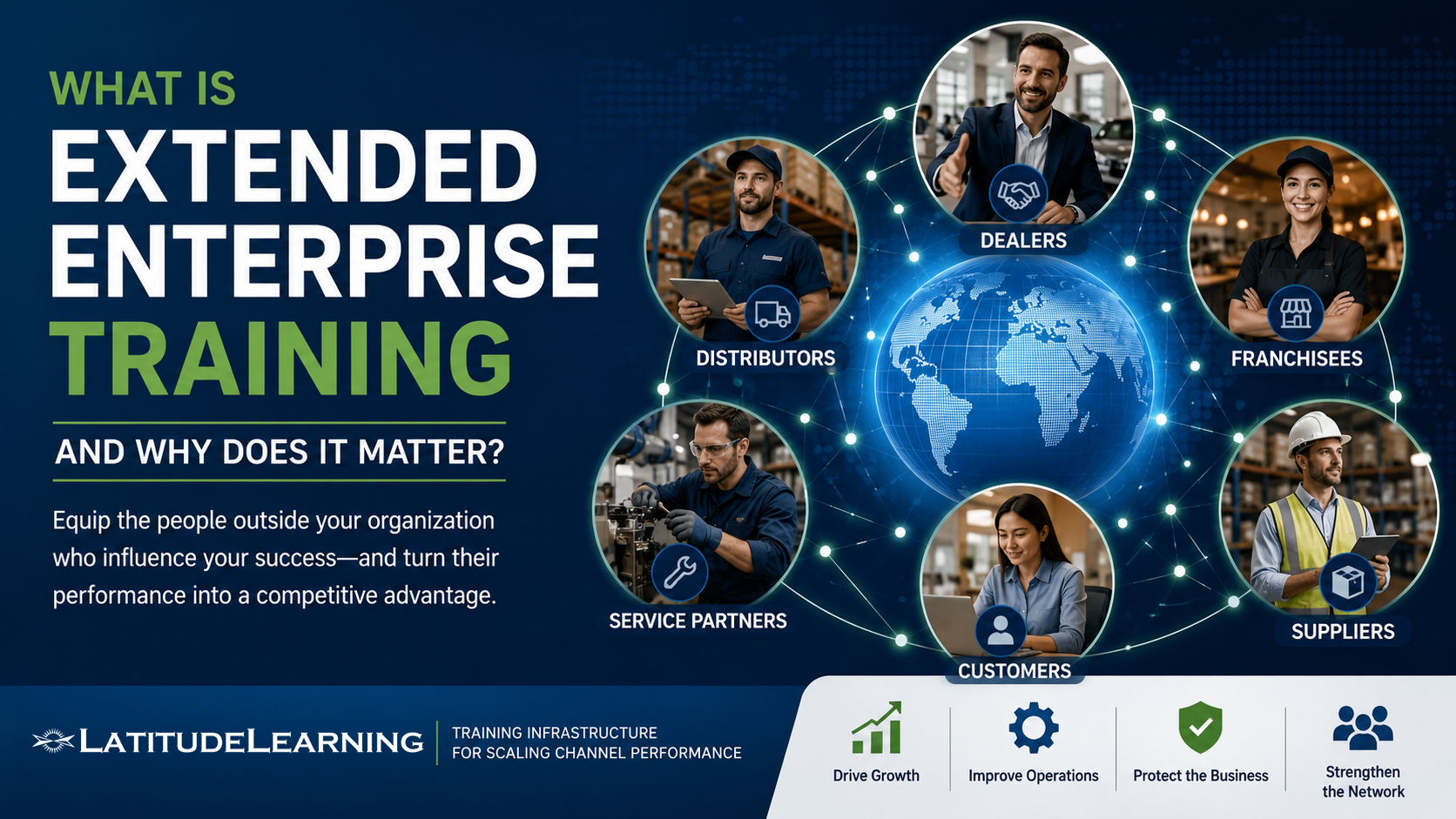

Your company may employ thousands of people, but many of the people who determine how customers experience your business may never appear on your payroll. A dealer salesperson recommends your product. A distributor brings it into a new market. A franchise owner represents your brand in a local community. A technician services the equipment. A supplier provides a critical component. A customer decides whether your product delivers enough value to keep using it.
These people are part of your extended enterprise. Extended enterprise training is the structured development of people outside your traditional workforce whose knowledge, skills, and performance can influence your organization’s success. The goal is not simply to give external audiences access to courses. It is to equip the broader network with the capabilities needed to sell, service, support, supply, represent, or use your products and services effectively.
For organizations that depend on distributed networks, that makes extended enterprise training much more than an L&D initiative. It becomes part of the infrastructure supporting how the business operates and scales.
Extended enterprise training is training designed for people outside an organization’s traditional employee population who still play an important role in business performance. The Surefire Training Impact™ framework broadly identifies these audiences as channel partners, operational partners, suppliers, and customers. Channel partners can include dealers, distributors, resellers, franchisees, service providers, agents, and retailers, while operational partners may support logistics, technology implementation, customer support, and other day-to-day functions.
The common factor is their relationship to the organization. These audiences are outside the traditional workforce, but what they know and what they can do still matters to the business. That makes developing their capabilities a strategic concern rather than simply an extension of employee learning.
Consider a manufacturer that sells through independent dealers. Its corporate employees may design the product, establish pricing, create marketing programs, and define service standards, but the customer may never interact with those employees. Instead, the customer talks to a salesperson at a dealership and later may rely on a technician employed by that same independent business to maintain or repair the product.
Those external people become part of the manufacturer’s ability to deliver on its promise to the customer. Extended enterprise training helps develop the capabilities required to do that consistently across the network.
There is no single extended enterprise structure. A manufacturer’s extended enterprise might contain hundreds or thousands of dealers, distributors, installers, technicians, resellers, and service organizations. A franchisor’s network may consist of independently owned franchise locations, multi-unit operators, managers, and front-line teams responsible for executing the brand’s operating model.
A technology company might depend on resellers, implementation partners, consultants, customer administrators, and end users. Other organizations may need to train suppliers, contractors, agents, brokers, operational partners, or customers. The appropriate training audience depends on how the organization goes to market, delivers its products and services, and supports its customers.
What each audience needs to learn can also be very different. Dealer salespeople may need product knowledge and sales skills, while service technicians may need technical knowledge and demonstrated service competency. Franchise operators may need to understand operating processes and brand standards. Suppliers may require quality, regulatory, process, sustainability, or technology training. Customers may need onboarding, product-use training, troubleshooting resources, updates, or certification. These differences are reflected in the audience-specific training requirements identified within Surefire Training Impact™.
This is why defining the audience is an important part of extended enterprise training. Rather than beginning by asking who should have access to training, organizations should begin with a more useful business question: Whose performance influences the outcomes we care about?
Extended enterprise training matters because many organizations depend on people they do not directly manage. A manufacturer, for example, can invest heavily in engineering, production, inventory, marketing, and a new product launch, but the results can still be influenced by whether dealer salespeople understand how to position the product and whether service technicians know how to maintain it.
The same principle applies to franchise systems. A franchisor can develop a successful operating model and establish detailed standards, but customers ultimately experience that model through independently operated locations. If owners, managers, and employees interpret or execute those standards differently, performance and customer experience can vary throughout the network.
Suppliers create another type of dependency. Their understanding of quality requirements, processes, technology, or regulatory standards can influence what happens farther downstream. Customer education creates yet another relationship. Customers who understand how to use a product effectively may be better equipped to achieve its intended value and become more self-sufficient when common questions or problems arise.
The Surefire Training Impact™ framework groups potential partner-training benefits into four areas: driving growth, improving operations, protecting the business, and strengthening the network. Depending on the organization, the business outcomes training is intended to influence might include sales and revenue, time-to-market, operational efficiency, compliance, brand consistency, warranty costs, customer satisfaction, scalability, partner motivation, innovation, or adaptability.
There is an important distinction, however. Training does not automatically create those business results. Training develops capabilities, those capabilities influence how people perform, and improved performance can influence the business outcomes the organization is pursuing.
Training is not the destination. Performance is.
That relationship is central to Surefire Training Impact™ and changes how organizations should think about the purpose of extended enterprise training.
An extended enterprise can look much more like a federation of independent organizations. A manufacturer might support thousands of dealer locations across multiple regions. Different dealers may sell different brands or product lines. Some partners may operate one location while others operate dozens. Individuals may work across locations, and their training requirements may depend on their role, products, certifications, geography, or business relationship.
Franchise systems face similar complexity. The franchisor may establish training centrally, while independent franchise owners employ and manage the people expected to apply it locally. Global partner networks introduce additional considerations involving languages, cultures, regulatory environments, and geographically dispersed learners.
Surefire Training Impact™ identifies challenges including geographically dispersed partners, brands and product lines, field support networks, multi-location learners, diverse audiences and learning needs, cultural differences, engagement and motivation, compliance requirements, language barriers, and rapid change. These are not simply content-development problems. They are characteristics of the environment in which extended enterprise training has to operate.
That complexity is also why an effective partner training strategy should be treated as an ongoing capability rather than a series of isolated training events. Article 1 in the Surefire series, Why Partner Training Is an Endurance Sport, Not a Sprint, explores that principle in greater depth.
Another fundamental difference is that many extended enterprise learners do not work for the organization providing the training. That affects how training is designed, administered, communicated, and valued because the organization often has less direct control over the learner’s priorities and behavior.
A distributor salesperson may represent several manufacturers. A dealer technician may need certifications from multiple brands. A franchise owner may be balancing training against the immediate operational demands of running a business. A customer may have little interest in “taking training” and simply wants the knowledge necessary to use a product or solve a problem.
The organization therefore has to think carefully about relevance. Different audiences require different knowledge, skills, processes, tools, and levels of competency. Training should reflect what each audience actually needs to perform rather than forcing everyone through the same collection of content.
The organization also needs to consider how it will know whether the required capability exists. That moves the discussion beyond course access and completion toward questions about knowledge, competency, certification, skill development, and eventually performance.
The detailed differences between employee training and partner training deserve deeper examination, which is why the next Surefire article addresses that subject directly. For now, the important point is that training people across independent organizations, locations, roles, and relationships creates a fundamentally different operating environment from training a traditional employee population.
An organization can have a very active extended enterprise training program without knowing whether its partners are becoming more capable. Thousands of people may enroll in courses, completion rates may be high, and assessment scores may look strong. Those numbers provide useful information about participation and learning, but they do not necessarily show whether people can perform.
Suppose 2,000 dealer salespeople complete new-product training. The business ultimately needs more than 2,000 completions. It needs salespeople who understand the product well enough to discuss it accurately with customers and apply that knowledge during the sales process.
The same distinction applies elsewhere in the network. A technician passing an online service course is different from demonstrating the ability to perform the service correctly. A franchise manager completing operations training is different from consistently executing the operating model at the location. A supplier earning a certification is useful, but the larger objective is the supplier’s ability to meet the required standards.
This is why the Surefire Training Impact™ journey starts with the destination rather than the course. Organizations first consider the business outcomes they want to influence, then identify who needs training and what those people need to know and do. From there, the framework progresses toward developing knowledge, competency, and mastery and building the infrastructure necessary to support performance across the network.
The shift sounds simple, but it changes the direction of the training strategy. Instead of beginning with “What courses should we create?” the organization begins with “Why are we training this audience, and what must they be capable of doing?”
As an external network grows, the challenge becomes increasingly difficult to solve with content alone. The organization needs a repeatable way to identify different audiences, organize them correctly, provide relevant training, manage certifications, support multiple organizations and locations, track progress, measure capability, and eventually connect training information with performance.
The environment is also constantly changing. Products and processes change. New partners join the network. People change roles. Franchise locations open. Dealer organizations expand or consolidate. Certifications expire. New standards and requirements emerge. The training program has to evolve along with the network.
That is why extended enterprise training ultimately requires training infrastructure. Training infrastructure provides the systems and operational disciplines required to make capability development repeatable across a distributed network rather than treating every new audience, product, or requirement as a separate training project.
LatitudeLearning’s strategic position reflects this need. Organizations with dealer, distributor, franchise, service partner, and other distributed networks require infrastructure capable of supporting training across organizational boundaries. LatitudeLearning therefore focuses on training infrastructure for scaling channel performance rather than positioning itself simply as a generic LMS provider.
Technology is an important part of that infrastructure, but technology by itself is not the strategy. The strategy begins with understanding the outcomes the organization wants to influence, the people whose performance affects those outcomes, and the capabilities those people require. The infrastructure makes that strategy operational and scalable.
The traditional boundary of an organization can be misleading. Your payroll tells you who works for you, but it does not necessarily tell you who influences your performance. Dealers can influence sales and customer experience. Franchisees can influence operational and brand consistency. Service partners can influence service quality. Suppliers can influence quality and efficiency. Customers themselves may need knowledge to use products successfully.
Extended enterprise training gives organizations a structured way to develop capability across these people and businesses, even when they operate outside the corporate organization. The objective is not simply to deliver more training. It is to build a network with the knowledge and capabilities required to perform more consistently as the business grows.
That is the foundation of Surefire Training Impact™. Organizations begin with the destination, determine whose performance matters and what those people need to know and do, and then build the capability and training infrastructure needed to connect training more meaningfully with performance.
Explore the Surefire Training Impact™ framework to see how business outcomes, partner capability, Learn. Do. Teach.™, the Training Program Roadmap™, and the Surefire Training Workstreams™ come together to create a more systematic approach to partner training.