
Most training programs look successful—at least on paper.
If you stay inside the reporting environment, it feels like progress is being made and that the system is working as intended.
But when you step into the field, a different reality emerges. Sales conversations vary from one partner to the next, service quality depends heavily on the location, and partners still hesitate or rely on guesswork when faced with real-world questions. Despite all the activity, nothing fundamentally changed channel performance.
This is the disconnect many organizations eventually run into: training is happening, but performance is not improving.
This situation rarely comes from a lack of effort. In fact, most organizations invest heavily in training. They build content, roll out structured programs, and push information across their partner networks. For a period of time, engagement metrics even suggest that things are moving in the right direction.
Then a predictable pattern begins to take hold. Usage declines, content becomes outdated, and partners gradually revert to familiar behaviors. When performance issues resurface, the response is almost always to create more training, assign more courses, and expand the program further.
The cycle repeats—not because the organization is doing the wrong things, but because it is solving the wrong problem.
At some point, a more important realization begins to surface. The issue is not that partners have not been trained; the issue is that training has not translated into consistent execution. Knowing is not the same as doing, exposure is not the same as capability, and completion is not the same as performance.
This gap becomes especially visible in organizations that rely on external networks. Manufacturers depend on dealers to sell their products, franchise brands rely on independent operators to deliver their customer experience, and service quality is defined by partners working outside the corporate structure. These individuals are not employees, but they are the ones who ultimately determine business outcomes.
This is the core challenge of extended enterprise environments: enabling people outside your organization who still directly impact your success. Because they operate beyond your direct control, performance cannot be managed through traditional internal training approaches alone.
The breakdown does not typically occur inside the training program itself. It occurs at the point of execution—when knowledge must be applied in real time.
A salesperson is in the middle of a conversation and is asked a question they did not anticipate. A technician encounters a problem that does not match the standard scenario. A franchise manager is forced to make a decision under pressure with incomplete information. In these moments, there is no opportunity to revisit a course or review a training module.
There is only action.
And in that moment, one of two things is true: the individual knows exactly what to do, or they do not. If they do not, the speed at which they can access the right answer becomes critical. They need accurate, trusted information immediately—without searching across systems, digging through documents, or relying on memory alone.
This is where most organizations begin to see the real issue. Even when training is well-designed, execution breaks down because knowledge is not retained, not applied, or not accessible in the moment it is needed. When that happens, partners improvise, and inconsistency spreads across the network.
Across industries and partner models, a consistent pattern emerges. High-performing organizations do not rely on training programs alone to drive results. Instead, they build systems that ensure performance can happen reliably in the real world.
Over time, it becomes clear that performance is not driven by a single initiative. It is driven by a combination of capabilities working together. Training plays a role, but it is only one part of a larger system that determines whether partners can execute consistently, make correct decisions, and represent the brand effectively.
This is where the conversation shifts from training to performance.
When you break down what actually drives performance across a distributed network, it consistently comes back to three interconnected factors. Together, they form a simple but powerful model:
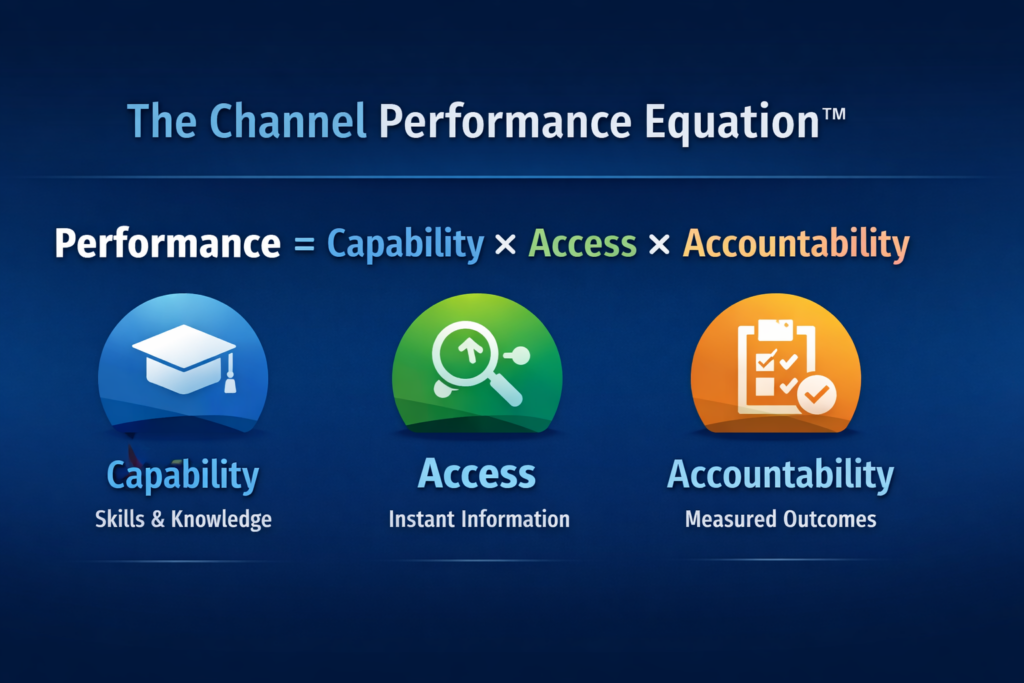
Capability defines what partners are trained to know and do. Access determines how quickly and reliably they can find the right answer in real time. Accountability ensures that performance is measured, verified, and enforced across the network.
If any one of these elements is missing or weak, performance does not degrade occasionally—it degrades systematically.
Most organizations focus their efforts on building capability. They invest in onboarding programs, product training, and certification paths designed to educate their partner networks. These initiatives are important, but capability is often misunderstood.
True capability is not about exposure to content; it is about verified ability. It is the difference between understanding a concept and being able to execute it correctly under real conditions. A salesperson must be able to position a product against a competitor, a technician must diagnose and resolve issues accurately, and a franchise team must deliver a consistent customer experience under pressure.
Achieving this requires structured development that moves beyond knowledge into application and validation. Effective programs begin by defining the desired business outcome and then working backward to determine what partners must know and be able to do. Structured training systems—what most organizations think of as an LMS—play a critical role here by organizing learning, defining roles, and managing certification.
However, capability alone does not ensure performance.
Even highly capable partners cannot retain every detail they have learned, especially in complex or fast-moving environments. In practice, performance depends less on memory and more on the ability to retrieve the right information at the right time.
This is where most organizations fall short. Knowledge exists within the organization, but it is fragmented across courses, documents, and disconnected systems. When a real situation arises, partners are forced to search, interpret, or guess.
That gap between knowledge and access is where inconsistency begins.
Organizations that address this challenge take a different approach. They establish a centralized, trusted layer of knowledge that allows partners to find accurate answers immediately. Instead of relying on recall, partners can access the information they need in the flow of work. This transforms knowledge from a static resource into an operational capability.
In internal environments, performance is typically enforced through management structures. In partner networks, that level of control does not exist. Organizations cannot rely on hierarchy alone to ensure that standards are met.
As a result, accountability must be built into the system itself. High-performing organizations define clear expectations for what it means to be qualified, establish certification requirements tied to real capabilities, and create visibility into performance across locations and roles.
This is where training becomes directly connected to business outcomes. It begins to influence revenue performance, service quality, brand consistency, and operational risk. At this level, training is no longer viewed as a support function; it becomes part of how the organization operates and scales.
The challenge is not that organizations ignore these elements entirely, but that they do not invest in them equally. Most training strategies emphasize capability while underinvesting in access and accountability. As a result, the system remains incomplete.
This leads to a familiar outcome: partners who have been trained but still struggle in real situations, knowledge that exists but is not effectively used, and programs that appear successful internally while failing to produce measurable impact externally.
It is not a failure of training. It is a failure of system design.
Organizations that successfully scale channel performance make a fundamental shift in how they think about training. Instead of treating it as a standalone program, they build what can be described as performance infrastructure.
This infrastructure typically consists of two primary layers. The first is the capability layer, which includes structured training, certification, and skill development. The second is the access layer, which provides real-time, trusted knowledge in the flow of work.
Together, these layers close the gap between learning and execution. Training builds capability, while knowledge systems enable action. Accountability ensures that both are consistently applied across the network.
When this system is in place, the difference is immediately visible. Salespeople respond with confidence rather than hesitation, technicians diagnose and resolve issues more accurately, and franchise locations operate with greater consistency.
These improvements are not isolated. They become repeatable across the entire network because the system supports performance at every level. The organization is no longer dependent on individual memory or variability; it operates with a consistent standard of execution.
Channel performance matters because your business does not operate in a single, controlled environment. It operates across a distributed network of partners who represent your brand every day.
Training is an important part of the solution, but it is not sufficient on its own. If training does not connect to real-time knowledge, verify actual capability, and enforce accountability, it will not produce meaningful performance outcomes.
Organizations that understand this do not invest in training alone. They build systems that ensure their networks can perform consistently, adapt in real time, and execute with confidence.
Training is not the goal.
And performance only happens when capability, access, and accountability work together as a system.
That is what separates organizations that train their partners from those that truly enable them.