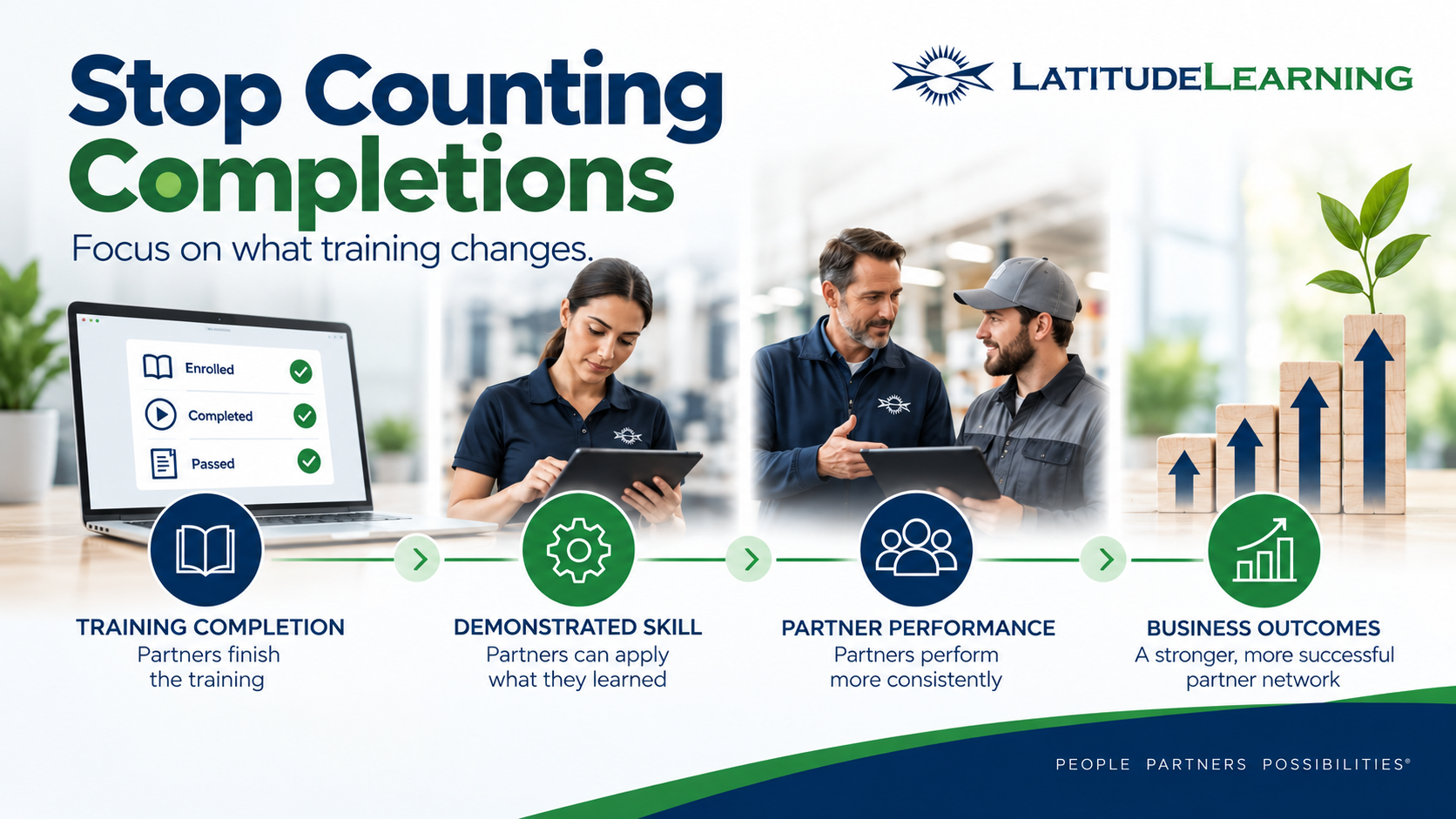

Your learning management system may show that 2,000 partners enrolled in training, 1,600 completed it, and 1,400 passed the assessment. Those numbers can tell you whether the program reached its audience and whether learners completed the assigned work. They cannot tell you whether a dealer salesperson explains the product more effectively, a service technician completes repairs correctly, or a franchise location follows operating standards more consistently.
That gap sits at the center of training impact measurement. Many organizations report what happened inside the training program because that data is readily available. Executives, however, need to understand what changed outside the program. They want to know whether trained people can perform, whether partner organizations are improving, and whether those improvements may contribute to business priorities.
Training activity matters, but it is an early measure. A credible measurement approach follows the full chain from training participation to capability, from capability to performance, and from performance to the business outcomes the organization is trying to influence.
Enrollments, course completions, learning hours, assessment scores, and certification counts are often called training metrics. More precisely, most are measures of activity, progress, or knowledge acquisition.
Each answers a useful operating question. Enrollments show whether the intended audience entered the program. Completion rates reveal whether people finished required training. Assessment scores indicate whether learners could recall or interpret the material presented. Certification status can show whether a person completed a defined set of requirements.
Training teams need these measures to administer programs and identify friction. A low enrollment rate may indicate poor communication or difficult access. A sharp drop between enrollment and completion may reveal that the learning experience is too long, poorly timed, or irrelevant to the audience. Weak assessment scores may point to confusing content or knowledge gaps.
None of those measures, on its own, shows that someone can perform the work. A completed service course does not prove that a technician can diagnose a fault. A passing product assessment does not establish that a reseller can handle a buyer’s objections. Even a certification only provides strong evidence of capability when its requirements include a valid demonstration of the knowledge or skills the credential is meant to represent.
The problem is not that organizations collect activity data. The problem begins when they present activity as the final evidence of training success.
Training reports and executive decisions operate at different levels. Training leaders often need to know who enrolled, completed, passed, or remained overdue. Business leaders need to know whether the people and organizations responsible for performance are becoming more capable.
Their questions may include:
These are performance questions. They connect training to the work partners are expected to do and to the outcomes the organization wants to influence.
That last word matters. Training can develop the knowledge and competency people need, but it does not operate in isolation. Product availability, pricing, incentives, local management, market conditions, staffing, tools, and processes can all affect performance. A sound training impact measurement strategy therefore avoids claiming that training automatically caused a business result. It builds evidence that shows how training, capability, and performance relate.
Surefire Training Impact™ begins with the destination in mind. Instead of starting with the course an organization wants to create, it starts with why partners are being trained and what business outcome the organization wants to influence.
The measurement chain can be expressed clearly:
Training activity develops knowledge and capability. Capability influences job performance. Improved performance can influence business outcomes.
Consider a manufacturer that wants to lower warranty costs across its service network. Course completion is one signal that technicians received the required instruction. An assessment can show whether they understand the repair procedure. A practical observation or skill verification can show whether they perform it correctly. Repair accuracy and repeat-repair rates reveal what happens on the job. Warranty expense shows the broader business outcome.
Each measure answers a different question:
A course completion cannot substitute for repair accuracy, and repair accuracy cannot by itself prove that training caused a reduction in total warranty expense. Together, however, these measures create a more useful body of evidence than any one measure alone.
Training impact measurement becomes more focused when the organization defines the destination before it builds the training. The desired outcome determines which audiences matter, which capabilities they require, and which measures should be collected.
If the destination is stronger dealer sales, the program may need to develop product knowledge, customer discovery, competitive positioning, and demonstration skills. Activity measures could include enrollment and completion. Capability measures could include product assessments, observed demonstrations, or sales simulations. Performance measures might include time to first sale, conversion rate, product mix, or sales per trained representative. The appropriate business measure depends on the goal the organization actually set.
If the destination is franchise consistency, the relevant measures will differ. Completion of operating training provides evidence of reach. Knowledge checks establish basic understanding. Observations, audits, or verified tasks can show whether managers and employees apply the standards. Location-level measures may include operating compliance, customer satisfaction, or selected quality indicators.
If the destination is better service quality, the program may track technical certification, demonstrated diagnostic skills, first-time repair accuracy, repeat visits, escalation rates, or customer feedback. The exact mix should reflect the work being trained and the systems that hold reliable performance data.
This approach prevents an organization from filling a dashboard with whatever the LMS happens to capture. It selects measures because they help explain progress toward an agreed business purpose.
Business impact often takes time to appear. A partner may complete training today, practice a new skill next week, and influence a customer or operational result months later. Waiting for a lagging business metric leaves the training team without timely information. Relying only on immediate activity measures creates the opposite problem because the organization sees movement without knowing whether performance improved.
A balanced measurement system uses indicators across the chain.
Early indicators include access, enrollment, completion, assessment, certification, practice, and skill verification. They help training teams manage adoption and confirm whether the conditions for improved performance are being created.
Performance indicators reflect what people and partner organizations do. They may include sales behaviors, service accuracy, process compliance, time to proficiency, customer handling, manager observations, or location performance. These measures provide stronger evidence that capability is being applied.
Business indicators reflect the destination. Depending on the program, they may include revenue, service quality, customer satisfaction, warranty costs, operational consistency, retention, compliance, or another defined organizational priority.
The goal is not to replace the completion report with a single business metric. It is to build a line of sight from participation through capability and performance to the outcome the program is designed to influence.
A performance metric becomes more informative when it has context. An increase after training may look encouraging, but other conditions may have changed at the same time. A seasonal sales cycle, product launch, staffing change, new incentive, or process update could also affect the result.
Useful comparisons can include performance before and after training, trained and untrained people, certified and uncertified locations, early and late adopters, or different levels of demonstrated capability. For example, an organization could compare repeat-repair rates among technicians before and after certification, then compare certified technicians with a relevant group that has not yet completed the program.
These comparisons do not automatically establish causation. They do help the organization test whether stronger training participation or capability is associated with stronger performance. The evidence becomes more credible when the comparison groups are similar, the measurement period is appropriate, and other important changes are documented.
Article 8 in this series will examine trained-versus-untrained comparisons in greater depth. At this stage, the important principle is that training impact measurement needs a baseline or comparison. A number without context rarely explains whether the program made a meaningful difference.
Many measurement efforts begin with a request for a dashboard. The more important work happens earlier, when training, channel, operations, sales, service, and other stakeholders agree on the purpose of the program and the evidence each group can contribute.
Begin with a small set of practical questions:
The answers define the measurement plan. The LMS may provide activity, assessment, certification, and skill data. A CRM may hold sales measures. Service or warranty systems may contain repair outcomes. Customer platforms may provide satisfaction or retention data. Operational systems may contain quality, productivity, or compliance measures.
Connecting those sources requires suitable training infrastructure, consistent identities for learners and partner organizations, reliable data, and shared definitions. It may begin with a modest manual comparison before progressing to integrated reporting. The sophistication of the technology should match the maturity of the program and the decisions leaders need to make.
Completion rates still matter. They tell you whether the program reached its audience and whether required work was finished. Assessment results, certifications, and learning paths also remain essential parts of a well-run partner training program.
Their proper role is to begin the measurement story. The next questions are whether learners developed the required capabilities, applied them in their roles, and contributed to stronger performance across their partner organizations.
That is the standard behind Surefire Training Impact™. Training is not the destination. Performance is. When organizations measure the full path between them, training reports become more useful to program managers, more credible to executives, and more relevant to the business.
Explore the Surefire Training Impact™ framework to begin aligning partner training with the capabilities, performance measures, and business outcomes your organization cares about.