
- Channel Performance
- Training Infrastructure
- LatitudeLearning LMS
- Lumina
- Services
- Company
- Pricing
- Demo
A service technician at an automotive service franchise completes every required training course, passes the final assessment, and earns a certificate. The learning management system marks the technician as fully trained.
But when a customer brings in a vehicle with a difficult diagnostic problem, the technician struggles to identify the cause and needs help completing the repair.
The training record is accurate. The conclusion about the technician’s readiness is not.
This is one of the most important distinctions in partner training: completing training does not necessarily mean someone can perform the work.
For automotive service franchises, manufacturers, and organizations that depend on external partners, that distinction has business consequences. A technician may understand the diagnostic process without being able to execute it correctly. A franchise manager may know the operating procedures but struggle to apply them consistently. A salesperson may understand product features without being able to explain their value to customers.
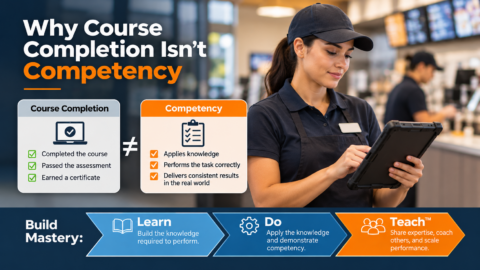
Competency-based training focuses on whether people can demonstrate the knowledge and skills required to perform their responsibilities, rather than simply whether they completed assigned learning activities.
Moving toward competency-based training requires organizations to look beyond completion records and determine what people can actually do.
Course completions are useful. They establish that someone participated in a required learning activity and, depending on the course, may have completed an assessment.
For organizations managing thousands of learners across independently operated franchise locations, this information is essential.
Training leaders need to know whether new service technicians completed onboarding, franchise managers received required instruction, and employees participated in updated safety and service training.
These records establish visibility and accountability across the network.
However, course completion answers a limited question: Did the learner complete the assigned training?
It does not necessarily establish whether the learner retained the information, understood how to apply it, or can consistently execute the required tasks.
Even passing a knowledge assessment has limitations.
An automotive service technician who correctly identifies diagnostic procedures on a multiple-choice test has demonstrated understanding. That is valuable, but different from troubleshooting an unfamiliar vehicle problem.
A technician who can describe the proper brake inspection process may still need supervised practice before performing that inspection accurately and consistently.
Completion and assessment data help establish what people have learned. They should not automatically be interpreted as proof of job competency.
Knowledge and competency are connected, but they are not interchangeable.
Knowledge is what someone understands. Competency is the demonstrated ability to apply relevant knowledge and skills to perform a task to an established standard.
Consider an automotive service technician responsible for diagnosing and repairing vehicles at a franchise location.
The technician completes an online course covering vehicle diagnostic procedures. The course explains how to interpret diagnostic trouble codes, use testing equipment, follow troubleshooting steps, and document findings.
After passing the final assessment, the technician has demonstrated an understanding of the material.
But that does not establish that the technician can diagnose a real vehicle problem.
Now consider the same technician working on a vehicle with an intermittent electrical fault.
The technician must interpret symptoms, select the appropriate tests, use diagnostic equipment correctly, evaluate the results, and identify the underlying cause.
The work requires more than recalling information. It requires applying knowledge, making decisions, and executing procedures accurately.
That is where competency becomes visible.
The same distinction applies to other franchise responsibilities.
A franchise manager may understand staffing procedures but still struggle to organize an efficient shift.
A service advisor may know the organization’s customer communication standards but have difficulty explaining an unexpected repair to a frustrated customer.
In each case, the individual has knowledge that supports the job. The remaining question is whether that knowledge translates into competent execution.
This distinction matters because the business depends on performance.
An automotive service franchise benefits when technicians diagnose problems accurately and complete repairs correctly, not merely when they finish technical training.
Knowledge makes performance possible. Competency provides stronger evidence that someone is prepared to perform.
Organizations frequently use course completions and certifications as their primary indicators of training success.
That approach is understandable. Completion data is relatively straightforward to collect, report, and compare across franchise networks.
The problem arises when training activity is treated as proof of operational readiness. Understanding the difference between training activity and business impact is essential to evaluating training success.
Suppose an automotive service franchisor introduces a new diagnostic procedure intended to improve repair accuracy across its locations.
The training department assigns an online course to every service technician in the network.
Within a month, nearly every technician completes the course.
From an administrative perspective, the rollout appears successful.
But several important questions remain unanswered.
Can technicians perform the new procedure correctly? Can they interpret unexpected diagnostic results? Do they know when additional testing is required? Can they apply the procedure consistently during a busy service day?
Until the organization examines actual execution, the training report describes participation and knowledge verification, not demonstrated competency.
This creates three risks.
First, capability gaps remain hidden. Completion reports may indicate that required training is finished even when technicians need additional practice.
Second, franchise managers may overestimate readiness. A manager may assign complex repairs to a technician who completed the required courses but has not demonstrated the ability to perform the work independently.
Third, training investments may be misdirected. When success is measured mainly through course activity, organizations may respond to performance problems by assigning more content rather than identifying missing skills.
The solution is not to abandon completions or knowledge assessments. It is to recognize what those measurements establish and add appropriate evidence of competency.
The Surefire Training Impact™ framework provides a structured approach to connecting training with partner performance.
At the center of its approach to capability development is Learn. Do. Teach.™, which describes the progression from knowledge to competency to mastery.
The distinction between course completion and competency becomes especially clear in the first two parts of this progression.
Learn: Build the knowledge required to perform
The Learn stage establishes the foundation.
Learners acquire the product information, operational procedures, standards, and concepts they need for their responsibilities.
Courses, videos, reference materials, and knowledge assessments are valuable here.
For example, an automotive service technician must understand vehicle systems, diagnostic procedures, safety requirements, and service standards before attempting complex repairs.
At this stage, successful training provides evidence that the learner has acquired the required knowledge.
It does not necessarily establish independent job readiness.
Do: Apply knowledge and demonstrate competency
The Do stage requires learners to move from understanding to execution.
The technician must perform the diagnostic procedure. The service advisor must communicate repair recommendations accurately. The franchise manager must apply operating standards during actual service operations.
This is where organizations begin establishing evidence of competency.
The difference is significant.
A knowledge assessment asks whether someone understands how a task should be completed.
A competency assessment examines whether the person can complete that task to the required standard.
Competency-based training therefore builds on knowledge acquisition rather than replacing it.
The ultimate aim is to ensure that people can perform their responsibilities with the accuracy, consistency, and judgment the role requires.
The Teach stage builds on this foundation by enabling people who achieve mastery to coach, mentor, and develop others. In an automotive service franchise, that might mean an experienced technician helping newer technicians develop their diagnostic abilities.
That progression allows individual expertise to strengthen capability across the franchise network.
Competency-based training begins by identifying what partners need to know and do to perform their responsibilities effectively.
Instead of asking only which courses a franchise technician should complete, training leaders identify the tasks, skills, and standards that establish readiness.
Consider an automotive service franchisor with hundreds of independently operated locations.
Every service technician might need foundational instruction on diagnostic procedures, repair standards, and customer service expectations.
But the franchisor also needs confidence that technicians performing critical repairs can execute the required procedures.
A competency-based approach connects training to specific responsibilities.
|
Training requirement |
Knowledge evidence |
Competency evidence |
|
Understand diagnostic procedures |
Pass a diagnostic knowledge assessment |
Diagnose a representative vehicle problem |
|
Know brake inspection standards |
Complete brake service instruction |
Perform a brake inspection to defined standards |
|
Understand service documentation |
Answer questions about required records |
Complete an accurate service record |
|
Know customer communication procedures |
Pass a scenario-based assessment |
Explain repair findings clearly and accurately |
The specific competency evidence depends on the role and its risks.
For some responsibilities, a realistic simulation may provide useful evidence. For others, a practical demonstration or observed workplace task may be necessary.
Organizations should establish clear performance standards before evaluating learners.
This means deciding what acceptable execution looks like, which errors are significant, and what evidence is required before someone is considered competent.
Training records can then distinguish between completing required instruction and demonstrating the ability to perform.
That distinction is especially important for franchisors because their service standards must be applied across independently operated locations where corporate training teams cannot directly supervise every technician. Scalable training infrastructure helps organizations establish consistent competency standards, track demonstrated capabilities, and identify gaps across their distributed networks.
Franchise training introduces another challenge: the franchisor depends on the performance of entire independently operated locations, not just individual learners.
An automotive service franchise may have employees who completed every required course. But that does not necessarily mean the location has sufficient capability to deliver the full range of services it offers.
Consider a franchise location with ten technicians.
All ten have completed the same diagnostic training.
However, only three have demonstrated the ability to perform advanced diagnostics independently.
The completion report suggests universal readiness. The competency evidence reveals a more specific operational picture.
That difference matters when the franchise owner or service manager evaluates whether the location has enough qualified technicians to handle its workload.
If the three experienced technicians are unavailable, the location may have difficulty handling complex diagnostic work even though every technician has completed the required courses.
This creates an important distinction between individual training records and organizational capability.
A franchise location’s readiness depends on having the right people, in the right roles, with the demonstrated capabilities needed to deliver its services.
The same principle applies beyond technical work.
A location may have managers who completed operations training but still need additional development in scheduling, quality control, or customer service management.
For franchisors, the important question is not simply how many people finished training.
It is whether each location has sufficient demonstrated competency to execute brand standards and meet customer expectations.
This supports more useful conversations between corporate training teams, field representatives, franchise owners, and location managers.
Instead of discussing only overdue courses, they can identify capability gaps that may affect service capacity, repair quality, operating consistency, or customer experience.
The Training Program Roadmap™ helps organizations understand how their training programs can mature from delivering content toward improving performance.
The distinction between course completion and competency is particularly important when moving from Stage 2 to Stage 3.
Stage 2 — Knowledge Acquisition emphasizes assigned training, knowledge verification, and certifications that establish a baseline of understanding.
Stage 3 — Skill Development introduces the practices needed to develop and evaluate demonstrated capability, including skill profiles, skill levels, practice, assessments, and feedback.
Moving toward Stage 3 does not mean abandoning Stage 2.
Organizations still need course assignments, completion tracking, and knowledge assessments. Those activities establish the foundation for competency development.
What changes is the evidence used to evaluate readiness.
For an automotive service franchise network, training leaders can begin asking more useful questions:
Which service responsibilities require demonstrated competency?
What evidence shows that a technician can perform those responsibilities?
Which technicians and franchise locations have verified capability gaps?
Where does additional development need to be concentrated?
Are improvements in demonstrated capability associated with better service performance?
The final question connects competency development with business impact.
Improving diagnostic competency may contribute to higher first-time repair accuracy. Stronger service procedures may help reduce repeat visits. Better management competency may support more consistent operations across franchise locations.
Those relationships should be evaluated through relevant performance measures rather than assumed. One approach is comparing trained and untrained partners to better understand how training relates to performance.
For example, a franchisor could examine whether locations with more technicians who have demonstrated advanced diagnostic competency also experience fewer repeat service visits.
That comparison would not automatically prove training caused the difference. Other factors, including equipment, staffing, workload, and vehicle complexity, may also influence results.
However, it provides a starting point for understanding how the capabilities developed through training relate to operational performance.
This is the larger purpose of Surefire Training Impact™: connecting training to the capabilities people develop, the performance those capabilities support, and the business outcomes organizations want to influence.
Course completion remains an important part of partner training. It provides evidence of participation, supports accountability, and helps establish consistent knowledge across distributed franchise networks.
But completion is not the same as competency.
An automotive service technician who completes diagnostic training has taken an important step. The next question is whether that technician can diagnose a vehicle correctly, execute the appropriate repair, and consistently meet established service standards.
For a franchisor, the same question extends across the entire network.
Do individual technicians have the capabilities required for their jobs? Do franchise locations have sufficient qualified people to deliver the services customers expect?
Organizations that recognize the distinction between completion and competency can make better decisions about training priorities, employee readiness, and franchise capability.
The shift begins with a straightforward change in expectations.
Don’t stop at asking whether people finished the training.
Determine whether they can do the work.
Training is not the destination. Performance is.
Explore the Surefire Training Impact™ framework to see how knowledge, competency, and mastery contribute to stronger partner performance.