Organizations have become increasingly effective at delivering knowledge. Learning management systems distribute courses, digital libraries provide access to procedures, and employees can learn from videos, presentations, manuals, standard operating procedures, and other resources regardless of location. Yet providing information does not guarantee that learners will be able to apply it when performance matters.
This is the challenge at the center of Grasply.
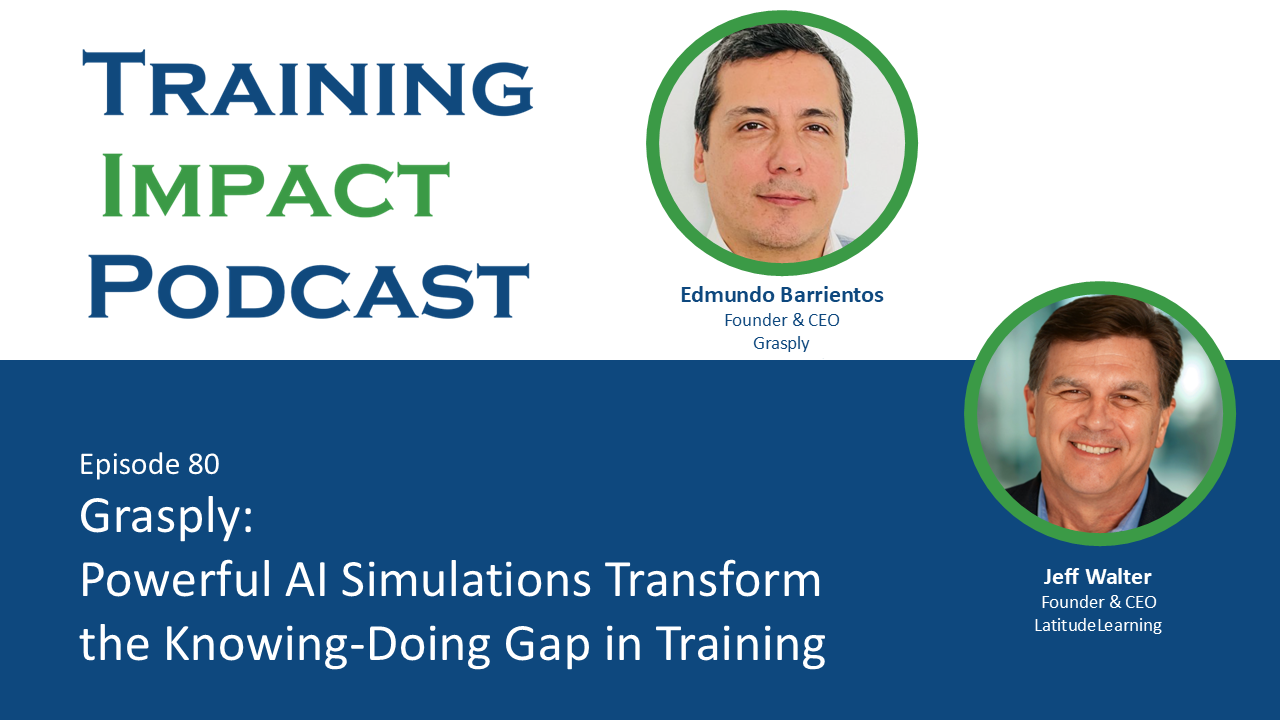
The company is focused on what it describes as the knowing-doing gap, the distance between understanding a concept and being able to put that knowledge into practice. An employee may complete a course about a procedure but struggle when an unusual situation occurs months later. A salesperson may understand an objection-handling methodology but lack experience using it during an unpredictable customer interaction. A manager may know the appropriate policy for addressing employee behavior without having practiced the difficult conversation required to apply it.
Grasply uses artificial intelligence and simulation to create an application layer between knowledge acquisition and workplace performance. Existing training remains important because learners need foundational knowledge. The difference is that learning does not have to end when the content has been delivered.
Grasply’s roots extend back approximately two decades to educational technology work in Chile. Its founder initially worked with K-12 teachers and students, building a company focused on helping learners understand academic subjects. As that business grew, attention increasingly shifted toward employee development and a related question: how do people move from understanding a concept to actually applying it?
That question eventually became the foundation for Grasply, which is now primarily based in the United States.
The company’s approach reflects an important distinction in learning technology. Courses, documents, videos, presentations, and other instructional resources are effective mechanisms for transferring knowledge, but knowledge acquisition is only one stage of development. Application requires opportunities to use that knowledge, make decisions, encounter mistakes, receive feedback, and try again.
Grasply is designed to complement rather than replace existing learning infrastructure. An LMS can continue organizing and delivering foundational learning while simulation gives learners opportunities to practice what they have learned.
The result is a progression from knowing toward doing.
Retention is one reason that progression matters. Knowledge that is not reinforced can deteriorate over time, particularly when learners have few opportunities to apply it.
This is a common workplace problem because many procedures contain both routine situations and uncommon exceptions. Employees may repeatedly perform the most common tasks, naturally reinforcing those skills through everyday work. An unusual scenario may not appear for months.
By the time it occurs, the learner may have forgotten information that seemed clear during the original training.
Course completion therefore does not necessarily equal performance readiness. A learner may successfully finish a course and demonstrate knowledge on an assessment while still requiring additional practice before that knowledge becomes durable and usable.
Grasply approaches repetition as part of the solution. Repeated engagement strengthens familiarity and helps learners build pathways for retrieving and applying information. The principle is similar to learning a physical activity. Watching someone ride a bicycle can explain the mechanics, but becoming capable of riding requires attempting the activity.
Workplace skills operate in much the same way. Reading about objection handling is different from responding to an objection. Studying a procedure is different from performing it. Understanding how a difficult management conversation should unfold is different from navigating one.
Simulation creates a controlled environment where that application can begin.
One of the more important concepts behind Grasply is cognitive fidelity. A useful simulation does not necessarily need to recreate the workplace perfectly. It needs to reproduce the thinking, decisions, or sequence of actions that matter to the real task.
Consider someone learning how to arrange beverage cases on a pallet for forklift handling. A physically realistic training environment might require a forklift, pallets, cases, floor space, and supervision. If the primary learning objective is understanding how the cases should be arranged, however, a much simpler simulation could still reproduce the relevant problem.
The learner does not necessarily need the forklift to practice the decision.
This principle can significantly change the economics of simulation-based learning. Perfect physical realism can be expensive, particularly when specialized equipment or facilities are required. Cognitive fidelity allows learning designers to ask a more practical question: what does the learner actually need to practice?
For some tasks, a screen-based environment can provide enough fidelity to develop familiarity with decisions, controls, or operational sequences. Physical practice can then occur later, once the learner has developed greater readiness.
This approach is particularly relevant when training involves equipment that is expensive, scarce, or difficult to make available to every learner.
Grasply uses generative AI to reduce another traditional barrier to simulation: development effort.
Organizations already possess much of the knowledge needed to define correct performance. SOPs describe procedures. Manuals explain equipment. Sales methodologies define expected approaches. Product documentation establishes capabilities and use cases. Presentations and other internal materials contain additional institutional knowledge.
Grasply can use these existing resources as source material for AI-generated simulations. Its AI assistant can process organizational knowledge and convert it into practice scenarios, with examples described in the source being generated in less than ten minutes.
This creates an important connection between knowledge management and experiential learning.
An SOP no longer has to function only as a document someone reads. It can provide the logic for a simulation. Product knowledge can shape a customer scenario. A sales methodology can guide how a learner is expected to respond. Operational documentation can define the sequence required to use a simulated device.
The technology therefore does more than accelerate content creation. It can accelerate the transition from content to application.
Within a broader training strategy, this approach fits naturally after foundational knowledge acquisition. The LatitudeLearning Training Program Roadmap emphasizes the importance of establishing a strong training foundation and developing knowledge before progressing toward more advanced performance capabilities. AI-enabled simulation provides one mechanism for helping learners move beyond understanding into structured practice.
Sales onboarding provides a straightforward example of how this approach can work.
A new salesperson needs product knowledge and an understanding of the organization’s sales methodology. But studying an objection-handling framework does not guarantee that the salesperson can apply it naturally during a live customer conversation.
A simulation allows the learner to practice those interactions repeatedly. Organizational product knowledge, processes, and methodologies provide the context while the learner works through objections in an environment where mistakes become opportunities to improve rather than lost customer interactions.
Leadership development presents a similar opportunity. Managers may understand policies governing sensitive workplace situations but have little experience conducting the conversations those policies require. Grasply can create scenarios involving difficult employee interactions so managers can practice before encountering similar circumstances in the workplace.
These applications demonstrate how simulation can extend experiential learning without requiring another person to participate in every attempt. Human coaching and role-play can remain valuable, but AI provides additional opportunities for rehearsal between those interactions.
Grasply is also applying the model to operational tasks.
A simplified example involves a digital representation of a coffee machine. The objective is not to reproduce every visual characteristic of the machine. Instead, the simulation represents the buttons, controls, indicators, and mechanisms necessary to practice the procedure.
A learner can begin with guidance from an AI coach that explains what to do and in what sequence. Once the learner becomes familiar with the process, the guidance can be removed and the procedure can be attempted independently.
The simulation can then evaluate whether the correct actions occurred in the appropriate order and provide immediate feedback when the learner makes a mistake.
This model has particular relevance for specialized equipment such as medical devices. Physical equipment can be expensive and difficult to access, and training may require either the learner or a specialist to travel. A digital simulation provides an intermediate stage where learners can become familiar with the process before gaining access to the actual device.
It does not eliminate the need for hands-on training. Instead, it helps learners arrive at that stage better prepared.
That distinction captures the broader role Grasply is attempting to play within the learning ecosystem. Traditional training establishes what learners need to know. Simulation creates a structured environment where they can begin learning how to do it.
The ability to adjust the level of support within a simulation is an important part of the Grasply approach. A learner can initially work through a process with guidance from an AI coach, then repeat the experience independently once the sequence becomes familiar.
This creates a natural progression from instruction to practice and eventually assessment. Instead of discovering errors long after training has ended, learners can receive feedback while they are still engaged with the task. They can identify what went wrong, correct their approach, and repeat the experience.
For organizations, this creates another layer between course completion and workplace performance. It also reduces the need for an instructor, manager, or experienced employee to supervise every practice attempt.
The result is not intended to eliminate human coaching or hands-on learning. It creates more opportunities for practice before those higher-value resources are required.
Grasply illustrates how simulation can complement an existing learning technology ecosystem rather than compete with it.
Learning management systems and instructional resources remain responsible for much of the foundational knowledge transfer. Simulation addresses the next question: can the learner use that knowledge?
This distinction is particularly relevant for distributed workforces and other populations that may not have equal access to instructors, equipment, or training facilities. Digital simulation can provide a more consistent opportunity to practice regardless of geography.
The same principle could have implications for extended enterprise environments in which customers, partners, technicians, franchise teams, or other external learners must apply organizational knowledge. These are potential applications of the model rather than documented Grasply implementations, but the underlying challenge is similar. Distributed learners need more than access to information when successful performance depends on applying it consistently.
For training leaders, this creates an opportunity to think of simulation as part of a broader learning pathway. The LMS establishes and manages knowledge acquisition, while practice technologies can help learners progress toward performance readiness.
Grasply’s longer-term vision includes increasing the fidelity of simulation when additional physical or spatial realism would improve the learning experience.
One potential direction is three-dimensional virtual environments. A two-dimensional simulation may be sufficient for practicing decisions or operational sequences, while virtual reality could become more valuable when spatial relationships and physical interaction are more important.
The company is also exploring the longer-term potential of 3D printing. The concept involves using AI to eventually generate models of physical components that could be printed and incorporated into a learning experience.
This is a future direction rather than a current production capability.
The goal would not necessarily be to reproduce an entire piece of equipment. A learner might only need a physical representation of the component being manipulated. That object could provide tactile interaction while a digital or virtual simulation provides the surrounding environment.
For specialized technical training, this could create a progression from screen-based simulation to virtual practice, physical interaction, and eventually the actual equipment.
The interest in 3D printing also reflects a broader consideration in learning experience design: people do not learn exclusively through screens.
Physical interaction can influence attention and engagement. Tactile approaches such as constructing models can also give learners another way to process and express ideas. Even familiar activities such as handwriting illustrate how physical actions can become part of the learning process.
This does not mean digital learning should become less important. Instead, the direction explored by Grasply suggests that future learning experiences may combine modalities more deliberately.
Digital simulation offers scalability and repetition. Virtual environments can add spatial context. Physical components can introduce tactile interaction. Actual equipment provides the final level of real-world experience when necessary.
The appropriate combination depends on what learners actually need to perform.
That principle returns to cognitive fidelity. More realism is not automatically better training. Additional fidelity is valuable when it helps learners practice something that matters to successful performance.
Grasply also illustrates an important shift in the role of generative AI within learning and development.
Many early applications of generative AI have focused on creating or organizing information. AI can summarize documents, generate instructional material, produce assessments, and make organizational knowledge easier to access.
Grasply applies the technology to what happens after that information has been delivered.
This changes the strategic question for learning leaders. Instead of asking only how AI can accelerate course development, organizations can begin asking whether it can improve the transition from training to performance.
Existing knowledge assets become particularly important in that model. SOPs, manuals, methodologies, and product documentation are not simply materials for learners to consume. They can become inputs for practice experiences.
The approach also reinforces the importance of maintaining accurate organizational knowledge. AI can accelerate simulation development, but the resulting experience still depends on reliable information about the process, product, methodology, or behavior being practiced.
Grasply addresses a persistent limitation in organizational learning: knowledge acquisition does not automatically produce performance.
Courses, videos, presentations, manuals, SOPs, and learning management systems remain essential because people need information before they can apply it. Grasply adds another stage by transforming organizational knowledge into simulations where learners can practice, repeat tasks, make mistakes, and receive feedback.
Its current applications demonstrate the model across conversational and operational learning, from sales and leadership scenarios to procedures involving specialized equipment. The longer-term exploration of virtual environments and 3D-printed components suggests how the same approach could evolve toward increasingly immersive and tactile forms of practice.
The larger significance for learning leaders is the shift from content generation toward experience generation.
Artificial intelligence has already made it easier to create and organize learning content. AI-enabled simulation could make another historically difficult part of training more scalable: giving people meaningful opportunities to practice.
That changes the measure of learning technology from how efficiently information can be delivered to how effectively learners can be prepared to use it.
For Grasply, closing the knowing-doing gap means connecting those two outcomes. Knowledge remains the foundation, but practice is what begins turning that knowledge into performance.
For more information on Grasply, visit their website – https://www.grasply.ai/