Organizations have become increasingly effective at distributing knowledge. Learning management systems can deliver training across large populations, digital content can make information available on demand, and artificial intelligence is making knowledge easier to create, find, translate, and personalize. Yet access to information solves only part of the performance challenge. People still have to apply what they know, remain motivated when progress becomes difficult, recover from setbacks, and adapt when circumstances change.
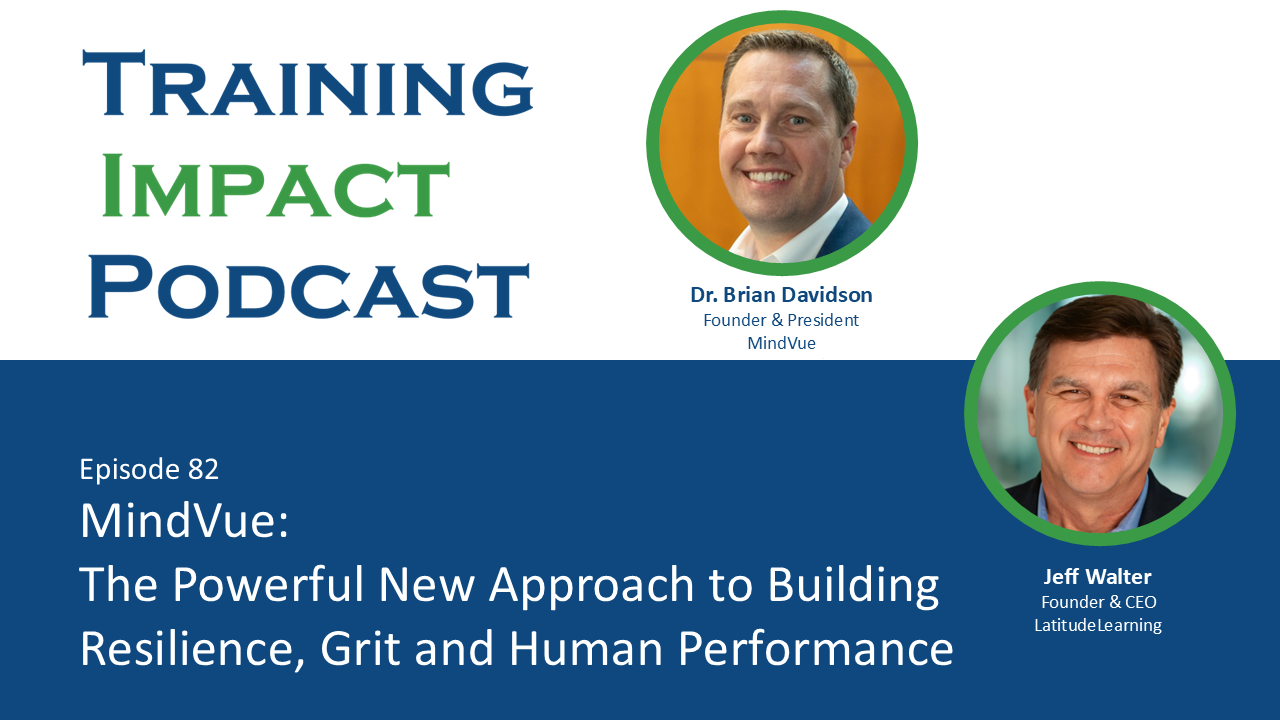
MindVue focuses on this human side of performance. Its approach centers on measuring and developing mindset skills including resilience, grit, motivation, growth mindset, self-efficacy, conscientiousness, adaptability, integrity, and purpose. While these capabilities are sometimes described as soft skills, MindVue treats them as performance skills because they influence how people pursue goals, respond to uncertainty, navigate change, and sustain performance.
Central to the MindVue philosophy is the understanding that these capabilities are more dynamic than they were once believed to be. People do not simply possess a permanent level of resilience, grit, or motivation. These factors can rise and fall as circumstances, relationships, goals, health, values, and purpose change. That also means they can be developed.
For learning and development leaders, this changes the role training can play. Instead of treating resilience or adaptability as characteristics people either bring to the workplace or lack, organizations can approach them as capabilities that can be assessed, practiced, coached, reinforced, and measured over time.
MindVue’s origins can be traced to research into a deceptively simple question: Why do some people consistently succeed while others struggle? Early observations of student performance pointed toward characteristics such as self-motivation and self-discipline, eventually leading to deeper work involving positive psychology, leadership development, resilience, grit, growth mindset, self-efficacy, and related psychological factors.
Rather than examining those factors entirely in isolation, MindVue began combining them into a broader assessment model designed to provide a more comprehensive picture of mindset. Early applications showed that the model could be strongly associated with academic performance, encouraging further validation and the development of curriculum intended to strengthen the capabilities being measured.
The more significant discovery was that assessment did not need to be the destination. If these mindset factors could change, then assessment could establish a starting point for development. MindVue subsequently explored curriculum, eLearning, coaching, expert-led training, and other methods for strengthening these capabilities.
An international training experience in New Delhi helped expand that objective. Seeing the scale of the potential need raised a larger question that continues to shape MindVue: How can individualized human development reach millions of people?
Traditional coaching can provide highly personal development because a coach learns about an individual’s goals, experiences, challenges, and motivations and adjusts accordingly. The difficulty is that every additional learner requires additional human capacity. MindVue has therefore continued exploring how individualized development can be combined with approaches capable of reaching much larger populations, an effort that has increasingly brought its work together with artificial intelligence.
The MindVue model has broad applicability because its central challenge is not limited to a single industry or type of learner. Its underlying work has extended across educational environments, leadership development, professional athletics, military leadership, corporate executives, faculty and staff development, and organizational training. The personalized learning model also creates possibilities for applying the same principles to other industries where individual circumstances influence what people need to learn.
Across these environments, the common challenge is performance that depends on more than knowing the correct answer. A leader may possess considerable expertise while becoming burned out or disconnected from purpose. An employee may perform exceptionally in a stable environment but struggle when technology, responsibilities, or expectations change. A learner may understand what needs to be done while lacking the motivation or perseverance necessary to follow through.
MindVue’s assessment work has demonstrated why understanding individual context matters. During the development of its methodology, some highly accomplished people produced unexpectedly low scores on factors that appeared inconsistent with their visible achievements. Further exploration revealed circumstances such as burnout, loss of purpose, relationship difficulties, health concerns, and other significant life events. The achievement remained visible, but the mindset behind it had changed.
This reinforced an important principle for MindVue: there is often a story behind the score. Psychological factors that appear relatively stable across large populations can move considerably at the individual level because human performance exists within a changing personal environment. Two people doing similar work can therefore have very different developmental needs.
That insight is particularly important for adult learners. Effective adult learning is relevant, problem-centered, and connected to experience. MindVue applies the same principle to mindset development by recognizing that resilience, motivation, or adaptability cannot be separated entirely from the learner’s goals and circumstances. Understanding the learner creates the context needed to make development meaningful.
MindVue also makes an important distinction between knowing about a capability and developing it. Someone can understand resilience without becoming more resilient, just as a learner can explain growth mindset without consistently demonstrating it when faced with failure or uncertainty. Knowledge matters, but behavioral development requires practice, reflection, reinforcement, and application.
These capabilities can be thought of as mental muscles. Physical fitness does not develop from a single trip to the gym, and resilience or grit does not emerge simply because someone completed a course. The capabilities have to be exercised and maintained over time.
Values and purpose play an important role in that process. MindVue does not view grit as something an organization can simply force onto an individual. Sustained perseverance is more likely when goals connect with something the learner considers meaningful. Values provide part of that foundation by helping create alignment between identity, goals, motivation, and the willingness to continue through difficulty.
The same learner-centered philosophy appears in the approach to resilience. Relationships can help people navigate difficult periods, while the way someone interprets change can influence how effectively that person responds. One important concept is adaptive forecasting, in which people anticipate possible changes rather than waiting to react to them. A change interpreted exclusively as a threat can create resistance, while the ability to identify opportunity within the same change can make adaptation more likely.
These practices illustrate why performance development has to extend beyond content delivery. MindVue is not simply trying to teach definitions of grit, resilience, or adaptability. The objective is to help learners examine how those concepts operate within their own goals, experiences, decisions, and responses to change.
Several aspects of the MindVue approach align naturally with the early stages of a performance-oriented training program roadmap. Stage 1 begins by defining the performance need before deciding what training should be created. The organization identifies the outcome it wants to influence, the people whose performance affects that outcome, and the capabilities those people require.
MindVue begins from a similar position by using assessment to understand the learner and the factors influencing performance. The goal is not simply to distribute generic information about resilience or grit. Assessment establishes a baseline that can help development become more intentional.
That foundation supports Stage 2, Knowledge Acquisition. Learners need relevant knowledge before they can successfully practice and apply a capability, but effective knowledge acquisition should connect new concepts with existing experience, make the relevance clear, and give learners opportunities to process what they are learning. MindVue incorporates these principles through assessment, personalized learning, coaching, reflection, and application.
The alignment is especially useful when considering organizations that train people beyond a traditional employee population. In extended enterprise training, organizations may need to influence performance among customers, partners, franchisees, dealers, distributors, or other external audiences whose experiences and motivations vary considerably.
The same challenge appears within franchise training networks, where consistency must be maintained across independently operated locations and learners with different levels of experience, and in customer training programs, where learners may have different roles, objectives, product knowledge, and reasons for engaging with training.
Standardized knowledge remains important for consistency, but individualized context can determine whether that knowledge becomes meaningful and usable. MindVue illustrates how training can move beyond the assumption that delivering identical information to everyone will produce an identical performance outcome.
Its approach starts with understanding where the learner is, establishes the knowledge and context needed for development, and then creates opportunities to strengthen the capability over time. That foundation sets up the next evolution of the model: using artificial intelligence to bring a more individualized combination of assessment, learning, reflection, and coaching to much larger populations.
The next evolution of the MindVue model addresses one of the most persistent challenges in learning and development: providing individualized development without making human coaching the only practical option. Coaching works because a skilled coach understands the learner, asks questions, adapts to changing circumstances, and connects development with goals that matter to the individual. Reproducing that experience across thousands of learners has traditionally required resources that few organizations can provide.
MindVue is exploring whether artificial intelligence can change that equation. Its emerging model begins with psychometric assessment, providing a snapshot of the learner’s mindset, and then adds a conversational intake with an AI coach. The conversation explores goals, challenges, hobbies, interests, and other personal context. Rather than immediately presenting predetermined content, the system first develops a deeper understanding of the person who will receive it.
That information is then used to generate a personalized podcast approximately 10 to 15 minutes long. The podcast incorporates the learner’s goals, challenges, interests, and assessment information, creating a narrative specifically for that individual. The significance is not simply that MindVue recommends different content to different learners. The learning experience itself can be generated around the individual, allowing concepts such as resilience, motivation, or adaptability to be explored within circumstances that already have meaning for that person.
After listening, the learner engages in another conversation with the AI coach to reflect on what was learned and consider how it applies to work or life. Those interactions become part of the learner’s growing history, giving future development experiences additional context. Over time, the model creates a cycle in which assessment informs personalized learning, learning leads to reflection, reflection generates additional insight about the learner, and that insight shapes what happens next.
This combination of narrative and conversation also introduces important learning principles into the model. People often make sense of complex ideas through stories, while reflective questioning helps them examine how those ideas connect to their own experiences. A personalized podcast creates the narrative, while the follow-up conversation introduces a form of Socratic reflection that asks the learner to participate rather than simply consume information.
The longer-term potential becomes even more interesting when MindVue combines these experiences with reassessment. If learners periodically complete the assessment again, changes in mindset factors can be compared with the development that occurred between assessments. Instead of measuring only whether someone completed training or remembered information, the organization can begin examining whether the capability itself changed.
As the amount of learner information grows, artificial intelligence could eventually help identify which approaches appear most effective for different individuals. One person might respond strongly to development that connects change with opportunity, while another might benefit from strengthening the connection between values and goals. Different examples, questions, analogies, or narratives may produce different outcomes for different learners. A sufficiently rich body of assessment and interaction data could help identify those patterns and adapt future development accordingly.
This represents a progression from personalized learning toward genuinely adaptive development. The objective is not simply to know who the learner is, but to learn which approaches appear most effective for that individual and use those insights to shape future experiences.
The model is still evolving, and the effectiveness of the newer AI approach continues to be evaluated. That distinction is important because the opportunity does not depend on assuming artificial intelligence has already solved individualized human development. The more significant innovation is creating a framework capable of learning more about which developmental experiences work, for whom, and under what circumstances.
The same architecture can also extend beyond mindset development. Consider a complex subject such as insurance coverage. Instead of presenting every customer with identical educational material, an AI-supported learning experience could first understand the individual’s circumstances and then provide education focused on the coverage most relevant to that person. The subject matter changes, but the underlying learning model remains consistent: understand the learner, provide relevant knowledge, encourage reflection or interaction, and use what is learned to improve the next experience.
Earlier MindVue development work provides evidence supporting the premise that mindset factors can change. Previous coaching, training, curriculum, and other human-led interventions have produced reported improvements of approximately 40 to 50 percent in some measured factors over periods typically lasting around six months. Shorter educational interventions lasting approximately 10 weeks have also produced improvement.
These outcomes are significant because they change the purpose of assessment. If resilience, grit, motivation, and related factors can change, assessment does more than categorize the learner. It establishes a developmental baseline. Training can then be designed to influence the capability, reinforced through practice and coaching, and followed by reassessment to determine whether meaningful movement occurred.
This approach shifts the definition of training success. Completion demonstrates participation, while knowledge assessments demonstrate that someone understood or remembered information. Neither necessarily demonstrates that the learner became more resilient, adaptable, motivated, or persistent. MindVue is working toward a model in which measurement becomes more closely connected to the performance capability the training was intended to influence.
That progression reinforces the performance-oriented approach established during Stage 1 and Stage 2 of a training program roadmap. Defining the performance need establishes the destination, while effective knowledge acquisition gives learners the foundation necessary for application. MindVue extends that process by connecting knowledge with reflection, coaching, personalization, reinforcement, and repeated measurement.
The result is a more complete view of training impact. Rather than asking only whether people completed training, organizations can begin asking whether people developed the capabilities required to perform differently.
The importance of this work becomes clearer as artificial intelligence begins changing the nature of work itself. Technical knowledge will continue to matter, but its useful life may become shorter as technology, processes, and job requirements evolve more quickly. People may need to acquire new skills repeatedly throughout their careers rather than relying on expertise developed for a relatively stable environment.
MindVue describes the larger objective in this environment as building human readiness. Organizations cannot predict every technological, organizational, or economic change their people will encounter, but they can help develop people who are better prepared to navigate uncertainty. Resilience supports recovery from disruption, grit helps sustain effort toward meaningful goals, adaptability supports behavioral change, and purpose provides direction when familiar paths become less certain.
In this environment, the ability to learn becomes closely connected with the ability to adapt. People need to encounter unfamiliar situations, acquire new knowledge, reconsider established assumptions, and continue performing even when the expertise that made them successful yesterday is no longer sufficient by itself.
Artificial intelligence may accelerate that process by compressing the time required to acquire knowledge and giving people access to increasingly sophisticated forms of coaching and guidance. At the same time, greater reliance on technology may make authentic human interaction even more valuable.
This creates an important balance for learning leaders. AI can provide personalization, scalable coaching, content generation, knowledge access, and continuous reinforcement, while people continue to provide relationships, empathy, community, shared experience, and culture. The future of development may therefore become both more technologically personalized and more intentionally human.
The question is not whether every learning interaction can be automated. It is where technology creates meaningful value and where human interaction remains essential to the developmental experience.
MindVue offers a useful model for learning organizations because its approach begins with the learner and the desired capability rather than with content. Assessment establishes where the learner is starting. Relevant knowledge creates a foundation for development. Coaching and reflection connect concepts with individual experience, while practice and reinforcement recognize that performance skills develop over time. Reassessment creates an opportunity to determine whether the capability itself has changed.
Artificial intelligence provides a potential way to bring more of that individualized experience to larger populations. Personalized podcasts and conversational coaching illustrate how AI can move beyond recommending courses and begin adapting learning around the person. While the model continues to evolve, it represents a meaningful shift in how individualized development can be imagined at scale.
The broader lesson extends beyond MindVue. As knowledge becomes easier to access and technical requirements change more rapidly, organizations may need to place greater emphasis on the capabilities that help people continually learn and adapt. Resilience, grit, motivation, adaptability, and purpose become part of the infrastructure that enables people to navigate change rather than simply react to it.
MindVue is building around that idea of human readiness. Its work suggests that the future of training may not be defined by how much information organizations can deliver, but by how effectively they help people develop the capabilities needed to perform through whatever comes next.
For more information on MindVue, visit their website – https://mindvue.com/