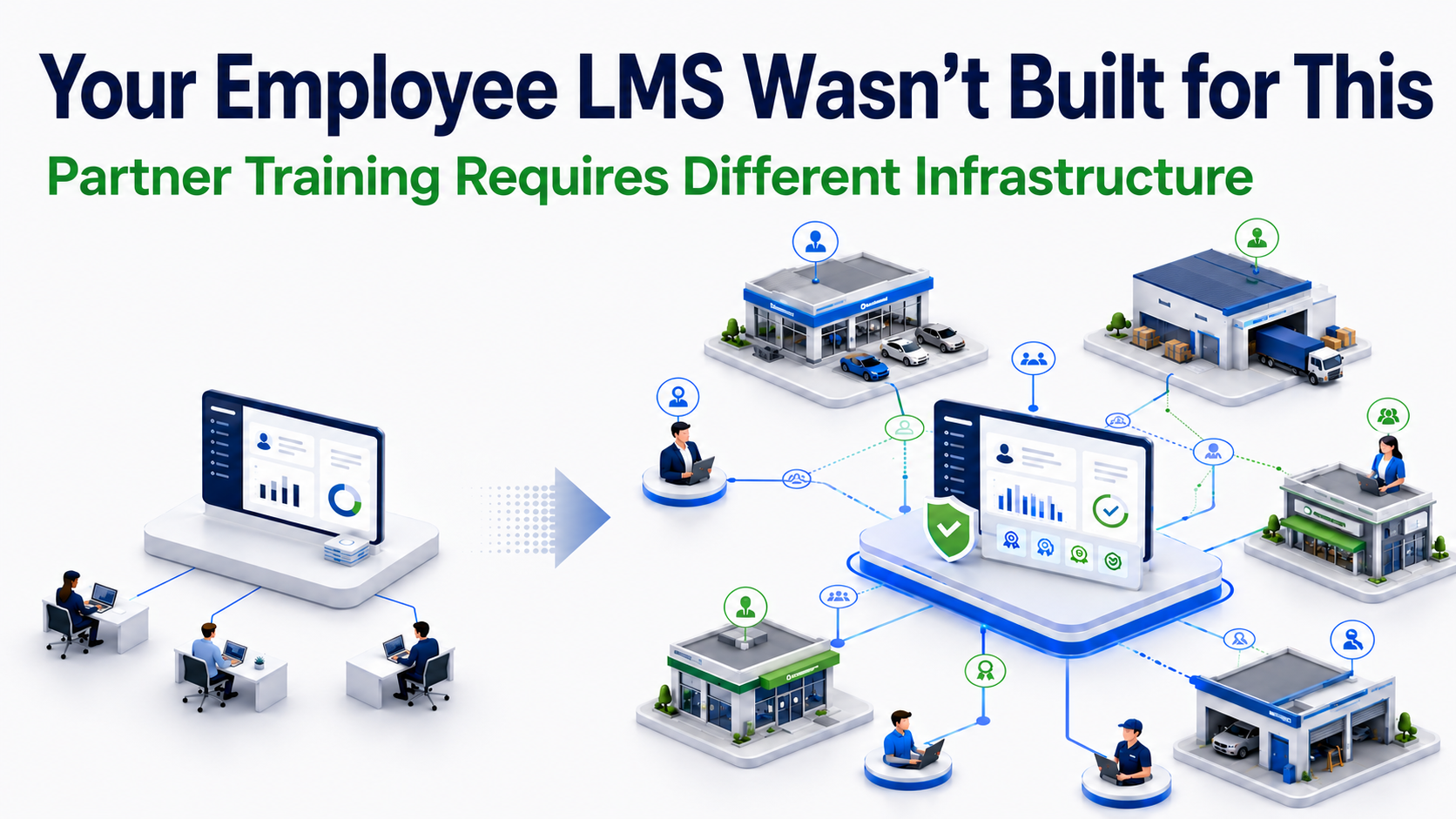

Many organizations begin partner training with an LMS they already own.
The reasoning appears sound. The company has courses to deliver, people who need those courses, and a system capable of managing enrollment and completion. Extending the employee LMS to dealers, distributors, franchisees, resellers, service providers, or customers can seem like the fastest and least expensive option.
Sometimes it works for a small pilot. Problems begin as the program expands.
Partner training introduces organizational relationships, learner identities, business rules, certifications, and performance expectations that employee training systems were not necessarily designed to manage. These differences are explored in greater detail in Employee Training vs. Partner Training: Why the Difference Matters. The issue is not simply whether external users can log in. The more important question is whether the LMS can support the way the partner network actually operates.
A partner training LMS must do more than make courses available outside the company firewall. It must provide training infrastructure for developing capabilities and supporting consistent performance across independent organizations.
An employee LMS typically operates within a controlled environment.
Employees are known to the organization. Their records can be supplied by an HR system. They have established job titles, managers, departments, and reporting relationships. When someone joins, changes roles, or leaves the company, an internal system can update the LMS.
The organization also has direct authority over these learners. Employees can be assigned mandatory onboarding, compliance, safety, or professional development training. Managers can reinforce deadlines, and completion may be connected to established employment requirements.
Partner networks rarely provide the same certainty.
The organization may know which companies sell, install, service, or support its products without knowing every person working within those companies. A dealer may hire a new technician without notifying the manufacturer. A franchise location may experience frequent turnover. A distributor employee may represent several product lines, while a contractor may work for more than one partner organization.
These are not minor administrative differences. They change how users must be registered, organized, assigned training, supported, and tracked.
Employee Training vs. Partner Training: Why the Difference Matters explains why external audiences create fundamentally different training requirements. The next question is whether the LMS used for employees can support those differences. That depends on whether the platform can manage the organizations, relationships, access rules, certifications, and performance expectations found across the partner network.
Most employee learning systems are built around a relatively clean organizational chart. An employee belongs to a department, reports to a manager, and occupies a defined position within one company.
A partner ecosystem is more like a network than a hierarchy.
A manufacturer may work with regional distributors, dealer groups, independently owned locations, service centers, installers, and field support teams. A franchisor may need to organize franchise owners, multi-unit operators, location managers, and frontline workers across hundreds of independently managed businesses.
Those relationships frequently overlap. One dealer group may own several locations. Individual locations may support different brands. A person may hold several roles or work across multiple locations. Corporate sales and service teams may also divide the same network into different territories.
A partner training LMS must be able to reflect those relationships. This may require support for:
If the system forces every user into a single employee-style hierarchy, administrators often compensate with duplicate accounts, spreadsheets, manual assignments, or separate portals. Each workaround makes the program harder to manage and makes reporting less reliable.
The LMS should represent the network as it exists, not force the network into a structure designed for employees.
Employee access is often straightforward. The HR system creates an account, single sign-on confirms the employee’s identity, and the LMS assigns training based on information already maintained by the company.
Partner learners can enter from many different directions.
Some may be imported by corporate administrators. Others may register themselves. A dealer or franchise manager may need to create accounts for local employees. Some users may come through a partner portal, CRM, association database, or another external system.
The LMS must determine more than who the learner is. It may also need to establish:
This makes access management a core part of partner training infrastructure.
If joining the program is difficult, external learners may never begin. If registration is too open, people may enter the wrong organization or gain access to irrelevant or restricted content. A capable partner training LMS must balance low-friction access with accurate placement and appropriate control.
Employees often complete training because the organization requires it. External partners have different incentives.
A dealer salesperson may prioritize customers waiting on the showroom floor. A service technician may have repairs scheduled throughout the day. A franchise owner may be balancing staffing, inventory, customer service, and local operations. Training competes with work that produces an immediate and visible result.
Corporate authority alone cannot create sustained participation across an independent network. Training must be relevant to the learner’s responsibilities and connected to something that matters.
That could include faster onboarding, authorization to sell or service a product, eligibility for incentives, access to co-marketing funds, recognition, professional credentials, or improved ability to serve customers.
The LMS must support this relevance by creating audience-specific experiences. A service technician should not have to search through sales courses. A franchise manager should see the operational and leadership requirements associated with that position. A reseller should receive training for the products that reseller is authorized to represent.
Role-based catalogs, automated assignments, targeted communications, personalized learning paths, and partner-specific branding are therefore not cosmetic features. They help make training understandable and worthwhile for people the company does not directly manage.
Employee LMS platforms frequently treat certification as an individual achievement. A person completes the required courses, passes an assessment, and receives a credential.
Partner networks may need certification to operate at several levels.
An individual technician might need to demonstrate the ability to complete a repair correctly. A dealer location might be required to maintain a certain number of certified technicians. A franchise unit may need certified managers in place before opening. A partner company may qualify for a preferred status only when it satisfies training, staffing, and performance requirements.
A partner training LMS may therefore need to answer questions such as:
This distinction is central to the Surefire Training Impact™ approach. Training should develop the knowledge and competency people need to perform, while the infrastructure should help the organization understand whether that capability exists across the network.
Course completion alone cannot provide that assurance.
An employee LMS may be sufficient when the main requirement is distributing courses and documenting completion. High-impact partner training demands a broader progression.
The Learn. Do. Teach.™ model describes how learners can advance from foundational knowledge to demonstrated competency and eventually to mastery that can be shared with others.
During the Learn stage, partners build the product, process, service, brand, and compliance knowledge required for their roles.
During the Do stage, they apply that knowledge through practice, observation, simulations, field activities, coaching, and performance-based assessment.
During the Teach stage, experienced practitioners help develop others, reinforce standards, and expand capability locally.
A partner training LMS should support that progression. This can require more than online courses and quizzes. Organizations may need learning paths, practical assignments, skill profiles, observation checklists, mentor workflows, coaching records, certifications, and recertification rules.
Without those capabilities, the program may document what people have viewed without establishing what they can do.
Training is not the destination. Performance is.
Employee training reports usually emphasize individual participation, departmental compliance, and completion status. Those measures remain useful in partner training, but they are not sufficient.
Channel and operations leaders need visibility at multiple levels. They may want to examine results by learner, role, location, partner company, dealer group, franchise region, product line, brand, or field territory.
They may also need to compare training information with operational performance. Depending on the program’s purpose, relevant measures might include sales performance, service quality, first-time fix rates, warranty claims, compliance results, customer satisfaction, or operating consistency.
This does not mean training automatically causes better business results. Many factors influence partner performance. It does mean the organization should be able to investigate whether differences in knowledge, skills, certification, and training participation are associated with meaningful performance differences.
An LMS built primarily for employees may report how many people completed a course. A partner training LMS should help leaders understand where capability exists, where it is missing, and how those differences relate to performance across the network.
An existing employee LMS does not automatically need to be replaced. It does need to be evaluated against the requirements of the partner ecosystem.
Begin with the network rather than the feature list. Document the partner organizations, locations, roles, brands, products, geographies, certifications, access methods, and reporting relationships the system must support. Identify how learners enter the program, who manages them, what they need to know and do, and how capability will be validated.
Then test the LMS against those real scenarios.
Can it maintain one accurate learner record across several roles or affiliations? Can partner managers administer their own people without seeing another partner’s data? Can training be assigned based on role, location, brand, product, or certification status? Can leadership report at both the individual and partner-organization level?
Most importantly, can the platform support the program as it advances from making learning available to developing skills and connecting capability with performance?
The LatitudeLearning LMS is designed as structured training and certification infrastructure for dealer, distributor, franchise, service, and other distributed partner networks. Its role is not simply to host more external users. It is to help organizations manage the complexity required to develop and understand capability across the channel.
The right partner training LMS should fit the network you have and the program you intend to build. If the system can only reproduce an employee-training model for a larger audience, it may provide access without providing the infrastructure required for scalable partner performance.