
Partner training is easy to classify as an expense. There are platforms to license, content to develop, administrators to support, certifications to manage, and partner time devoted to learning instead of selling, servicing, installing, or operating.
Viewed only through that lens, the financial question becomes predictable: How much does training cost?
A stronger question is: What performance is the organization trying to improve, and how can better partner capability contribute to it?
That shift changes the conversation around partner training ROI. Training does not become a strategic investment because the training department delivers more courses or increases completion rates. It becomes strategic when the organization can connect the capabilities it develops to partner performance and then examine how that performance influences the business outcomes leadership cares about.
That is the central idea behind Surefire Training Impact™: training is not the destination. Performance is.
Most training budgets are highly visible. The return is often much harder to see.
Executives can identify the cost of an LMS, content development, administration, or certification. What may be less visible is the operational cost of a partner who cannot position a product correctly, a technician who cannot complete a repair correctly the first time, or a franchise location that executes standards inconsistently.
The organization can see what it spends on training, but it may not have built the measurement structure needed to see what partner capability is worth.
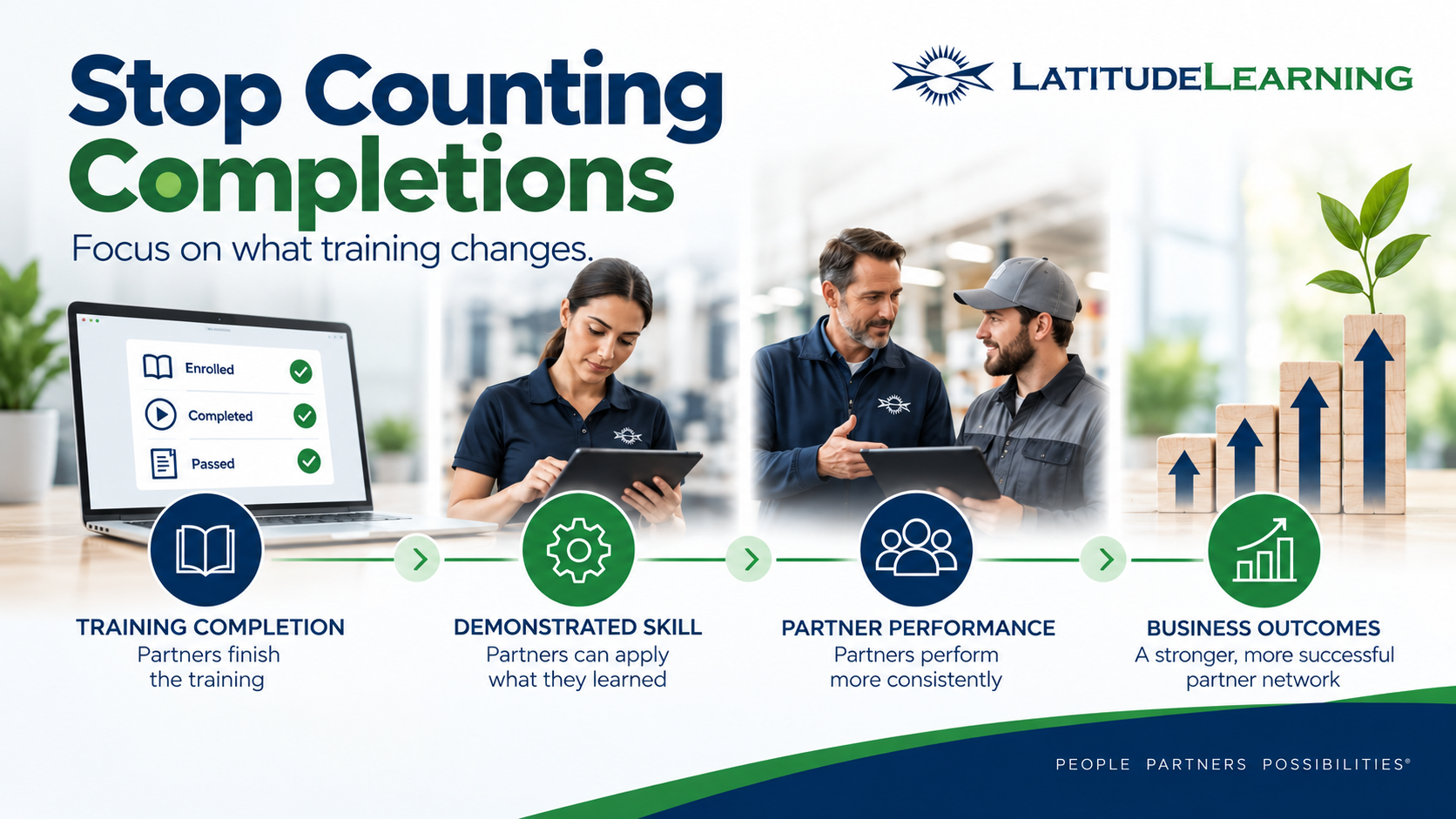
Enrollments, completions, assessment scores, and certifications tell you something important about training activity and learning progress. They do not, by themselves, tell you whether partner performance changed. A strategic investment case starts by moving the conversation closer to performance.
A useful partner training ROI discussion begins with the destination. Why are you training partners in the first place?
A manufacturer may need dealers to sell a new product more effectively. A franchisor may need new locations to reach operating standards faster. A service organization may need technicians to improve first-time fix performance. Another organization may be trying to reduce warranty costs, strengthen compliance, improve customer satisfaction, or create more consistent execution.
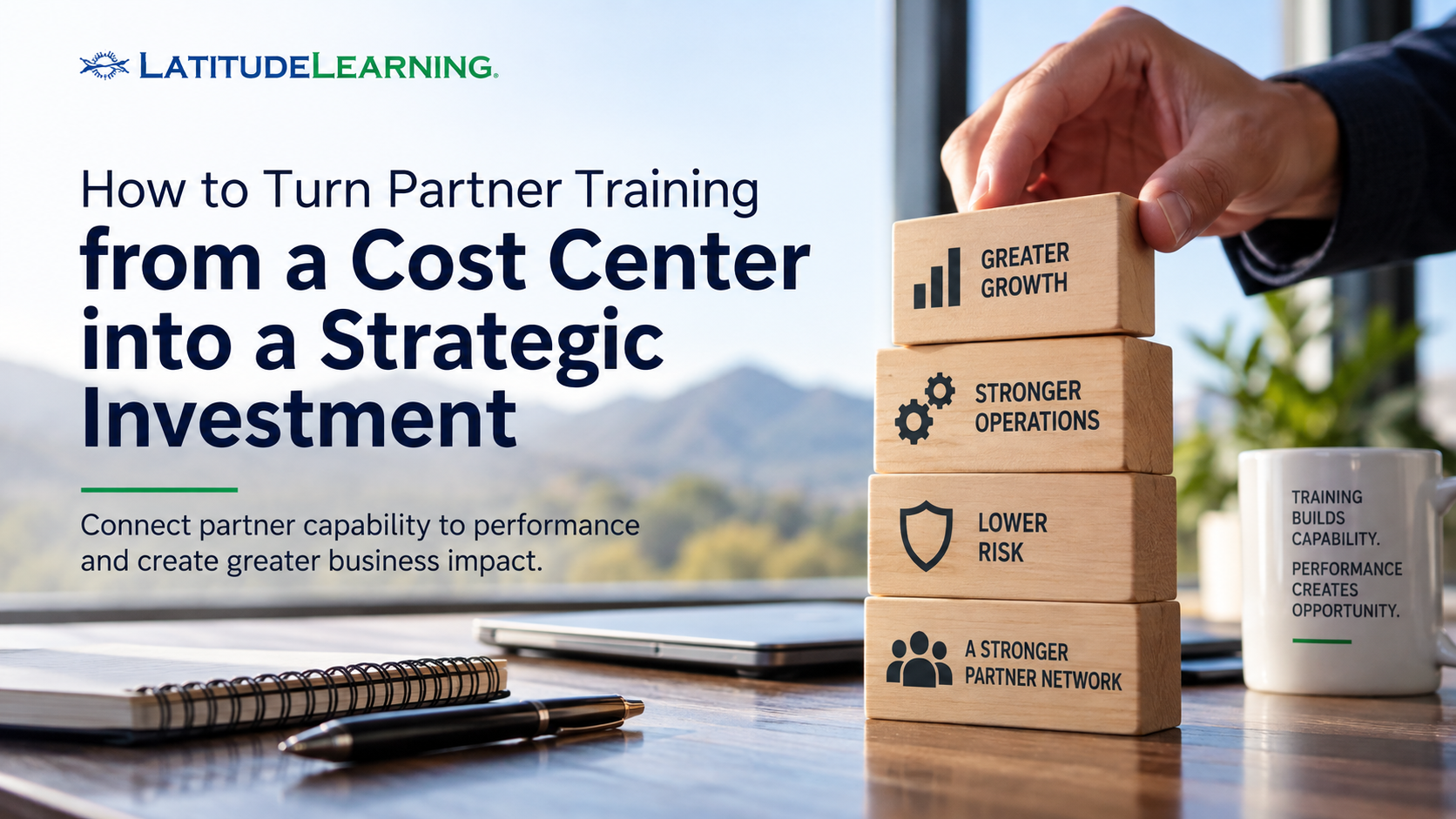
Surefire Training Impact™ groups potential partner-training benefits around four broad needs: drive growth, improve operations, protect the business, and strengthen the network.
Those outcomes should shape the investment. If the objective is better service quality, the program should develop and validate the capabilities required for better service. If the objective is stronger sales performance, the program should focus on the knowledge and competencies that can influence selling behavior.
The relationship matters: training develops capabilities. Capabilities influence performance. Improved performance can influence business outcomes. That is more defensible than claiming a course completion caused a revenue increase.
The bridge between training and ROI is performance.
Consider a dealer service network. The business may care about warranty expense, repair quality, customer satisfaction, and service throughput. Training cannot guarantee improvement in those metrics because many factors affect them. But technician knowledge and competency can influence how work is performed.
The chain is something the organization can evaluate: training develops product and service knowledge; practice and assessment help build competency; competency can improve technician performance; better technician performance may contribute to stronger service outcomes.
The same logic applies across distributed networks. Franchise training can build the capabilities needed to execute operating standards consistently. Distributor training can strengthen product knowledge and sales readiness. Supplier training can reinforce quality processes. Partner onboarding can reduce the time required for people to become capable in their roles.
The clearer that chain becomes, the easier it is to decide what should be trained, what should be measured, and where the investment is expected to create value.
Training leaders do not need to invent a separate business language for partner training ROI. They need to connect training to measures the organization already uses.
Revenue is one possibility. If partner sales capability is a priority, examine sales performance alongside training participation, certification, or demonstrated competency.
Cost is another. Service training may be evaluated alongside warranty claims, repeat repairs, support escalations, or other measures reflecting the cost of inconsistent performance.
Customer experience matters where partners directly represent the brand. Training can develop the knowledge and behaviors needed for stronger interactions, while customer satisfaction or service-quality measures provide a downstream view.
Compliance and brand protection can also create value. In regulated or standards-driven environments, verifying that partners know and can follow required processes can reduce operational risk and improve consistency.
The objective is not to assign every change in a business metric to training. It is to determine whether people and organizations developing the intended capabilities are performing differently in ways that support the desired outcome.
A strategic training program still needs learning data. The difference is that learning data becomes part of a larger measurement system.
Completion rates show participation. Assessments can show knowledge acquisition. Certifications show whether defined requirements were met. Skill validation can provide evidence of demonstrated competency. The next step is connecting those measures to performance data.
An organization might compare service results among certified and non-certified technicians, examine sales performance among partners with different levels of training participation, or compare operating measures among franchise locations that reached defined capability milestones.
Those comparisons do not automatically prove causation. They do create evidence that is more useful than training activity alone. They can reveal patterns and help leaders determine where additional training investment may have the greatest potential.
This is also why training infrastructure matters. Distributed networks span independent organizations, locations, roles, brands, and geographies. Connecting capability with performance requires clean training records, meaningful organizational structures, certification data, and reporting that can align with business measures.
The biggest change occurs when leaders stop viewing partner training as a collection of learning events and start viewing partner capability as infrastructure.
A dealer network cannot consistently deliver strong service if technician capability is left to chance. A franchise system cannot scale operational consistency if every new location develops its own interpretation of the brand. A distributor network cannot represent complex products effectively if product knowledge disappears every time people change roles.
Training infrastructure creates a repeatable way to develop, validate, maintain, and measure those capabilities across the network. The organization is no longer funding courses simply because partners need training. It is building the capabilities the channel depends on to perform.
LatitudeLearning’s strategic focus is training infrastructure for scaling channel performance. Technology alone does not create performance. Organizations need the structure to deliver role-relevant training, manage certification and capability across distributed networks, and connect those efforts to the performance measures the business is trying to influence.
Partner training ROI is sometimes reduced to a single financial formula. A financial calculation can be useful when the underlying data supports it, but forcing every initiative into a precise dollar return can create false confidence.
A more useful objective is better investment decisions. Which capabilities matter most? Where are performance gaps occurring? Are trained or certified populations performing differently? Where does the evidence justify more investment, a different approach, or less spending?
Those questions make training accountable without pretending it operates in isolation.
Surefire Training Impact™ begins with the destination because training’s value depends on where the organization is trying to go. When training is designed around capabilities required for performance, and performance is connected to meaningful business measures, the conversation changes.
Training is no longer an expense defended by counting activity. It becomes an investment evaluated by the capabilities it builds, the performance it influences, and the business outcomes it is designed to support.
Training is not the destination. Performance is.
Explore Surefire Training Impact™