
For prospective franchise owners, a franchise expo offers an extraordinary opportunity to compare brands, meet franchisors, explore business models, and imagine a different professional future. For the people responsible for franchise training and operations, however, there is another side to that experience that is equally important. Every prospective franchisee walking the show floor is evaluating not only the business opportunity, but also the systems, processes, culture, training, technology, and support they will receive after signing the agreement.
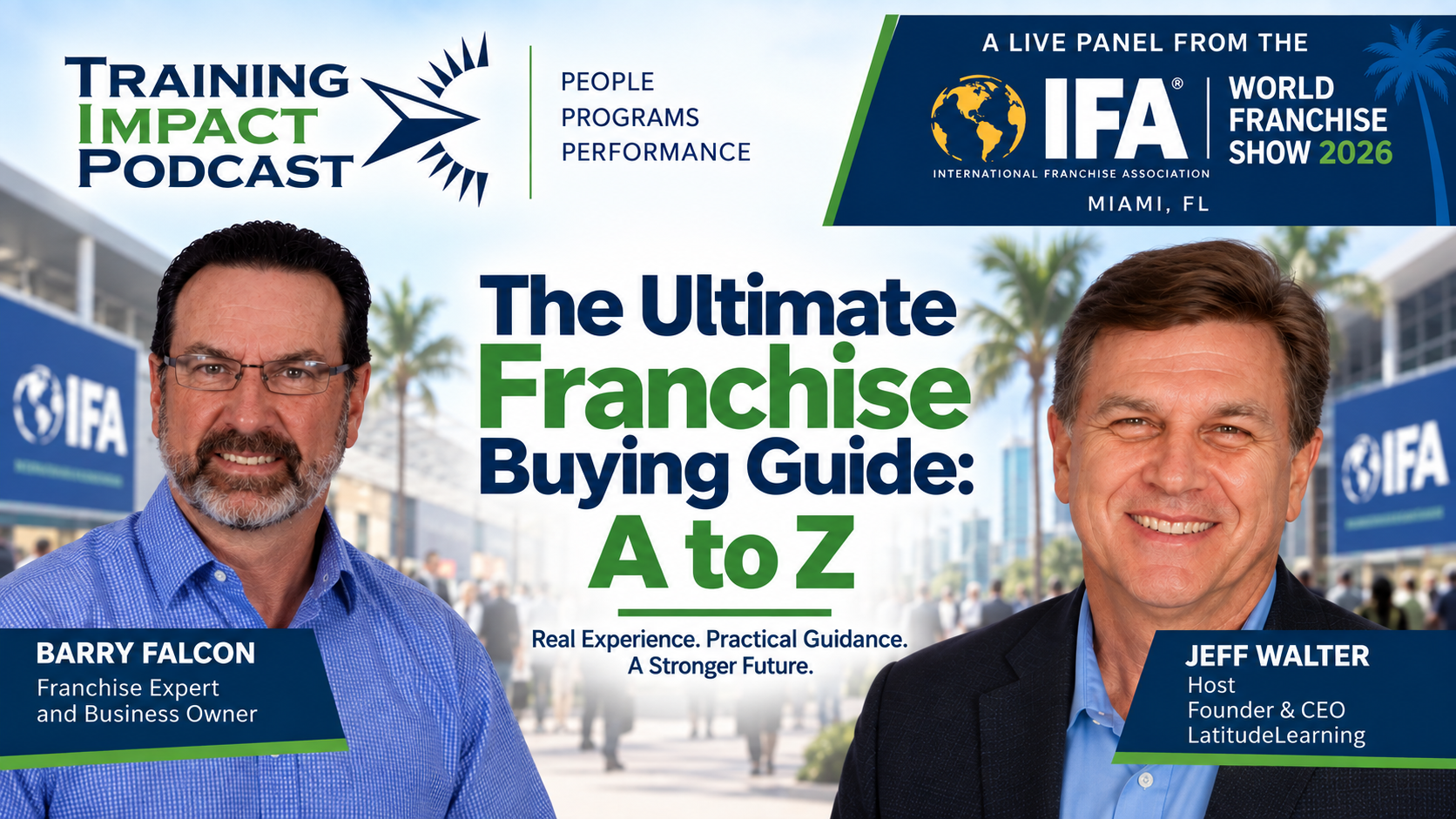
That intersection between franchise selection and franchise support was at the center of “The Ultimate Franchise Buying Guide: A to Z,” a live presentation at The IFA World Franchise Show: Franchising Expo USA featuring Barry Falcon and Training Impact Podcast host Jeff Walter, Founder and CEO of LatitudeLearning.
While much of the conversation focused on helping prospective franchisees make better buying decisions, the discussion also provides an interesting perspective for L&D professionals, training managers, enablement teams, and operations leaders. Listening to what an experienced franchise owner believes buyers should expect from a franchisor provides a useful framework for evaluating the training and support infrastructure that franchisors need to build.
Barry Falcon brings approximately 25 years of franchise experience to the conversation, and his perspective is grounded in having experienced franchising from multiple sides of the relationship. He began as a franchisee, grew and sold that business, and subsequently became a franchisor. During the presentation, Falcon explained that he has been involved as a franchisor four times, has exited three businesses, and remains involved with another.
That history gives Falcon a particularly practical perspective on franchise ownership. His advice is not centered simply on finding an attractive brand or pursuing the concept with the most exciting growth story. Instead, he repeatedly brings the conversation back to alignment between the individual, the business model, and the organization behind the franchise.
Falcon illustrates that point through his first franchise, Velocity Sports Performance, which he purchased in 2003. His daughter was a competitive tennis player, and one of his personal priorities was having the freedom to travel with her to tournaments. Rather than buying a business that required him to open and close the location every day, he selected a model that could operate with a general manager. His business decision was therefore connected directly to the lifestyle he wanted to preserve.
For franchise training leaders, that story highlights something that can easily be overlooked once a franchisee enters the system. Franchisees arrive with different goals, backgrounds, capabilities, motivations, and levels of operating experience. Effective franchise training has to create consistency around the brand without assuming that every franchisee begins at the same place.
Falcon describes the first stage of choosing a franchise as “know thyself.” Before prospective owners evaluate brands, they should understand what kind of business and lifestyle they actually want. Someone considering a restaurant that operates seven days a week faces a very different working environment from someone purchasing a business that can eventually operate under professional management. A service business can create another set of demands because when an employee fails to show up, the owner may ultimately be responsible for delivering the service.
Walter expands that idea by adding cultural alignment. Franchisees are not simply buying a product or licensing a logo. They are entering a network in which they will build relationships with the franchisor, other franchisees, employees, field support teams, and customers. Walter argues that the strongest performance comes not only from finding capable franchisees, but also from finding people whose values and expectations fit the organization they are joining.
That observation has implications for training because onboarding should do more than transfer operational information. A strong onboarding program also helps franchisees understand how the network operates, what the brand values, what the franchisor expects from them, and what they can expect from the franchisor in return. In an extended enterprise training environment, that organizational context matters because the learner is part of an independent business rather than a traditional employee population.
Another recurring theme in Falcon’s presentation is the importance of defining goals before making the investment. He refers to his long-term financial objective as “go-to-the-beach money,” meaning the financial outcome that would eventually allow an owner to step away from the business on their own terms.
Falcon built one of his franchise businesses with a specific exit objective in mind. He initially expected the journey to take approximately eight years, although it ultimately took 12. The company grew to 165 locations before being sold to private equity, allowing him to achieve the financial objective he had established years earlier. His larger point is that franchisees should know what they are trying to accomplish rather than treating the grand opening as the destination.
Walter adds that franchisees should also understand where they get their energy. Managing 50 locations may represent an attractive financial opportunity to one person and an exhausting responsibility to another. Sustainable performance requires some alignment between the work the business demands and the type of work the owner finds rewarding.
For training and enablement teams, this suggests that franchise development should not stop with initial knowledge transfer. As franchisees mature, their needs change. Someone preparing to open a first location requires different knowledge and skills from someone developing a multi-unit organization. A mature franchise training strategy should therefore provide learning paths that can evolve alongside the franchisee’s responsibilities.
One of Walter’s most important observations comes later in the presentation when he discusses what franchisees believe they are purchasing. He notes that one of the biggest disappointments can occur when a franchisee believes they are buying a completely finished “business in a box,” only to discover that important processes have not been defined as thoroughly as expected.
Walter recommends that prospective buyers investigate exactly what the franchisor provides across marketing, sales, operations, finance, technology, and other business processes. They should also determine where the franchise system requires strict standardization and where individual franchisees have room to innovate. Some systems prescribe nearly every element of the operating model, while others standardize only the components necessary to protect the core product or service.
For L&D and operations teams, this is an important distinction because training cannot compensate for an undefined operating model. Before someone can build effective franchise training, the organization needs to know what franchisees and their employees are expected to know and do. Training then becomes the mechanism for transferring those standards consistently across the network.
This is also where the discussion naturally connects with the LatitudeLearning Training Program Roadmap. The roadmap describes an evolution from self-directed learning through knowledge acquisition and skill development to individual and organizational performance. Falcon and Walter do not explicitly classify the live presentation using those stages, so it would be inappropriate to assign a specific roadmap stage to a franchise organization based on this transcript alone. However, the operational challenges they identify help illustrate why that progression matters.
A new franchise system may begin by making manuals, videos, resources, and courses available to franchisees. As the network grows, simply providing information becomes less sufficient. The franchisor needs to ensure that people actually acquire the required knowledge, develop the skills necessary to operate consistently, and ultimately translate those capabilities into stronger business performance.
That evolution is particularly important because the learners extend beyond franchise owners. Franchisees may need business and operational training, managers need leadership and supervisory skills, and frontline employees need role-specific knowledge and skills. Field support teams also need enough visibility into training progress to identify where a location may require additional assistance. The result is a training environment organized around the performance of the franchise location, not simply the completion records of individual learners.
That same organizational perspective distinguishes franchise and partner training from conventional employee learning. A franchisor is ultimately trying to create capable locations that consistently represent the brand, which requires developing the people inside those locations while maintaining visibility into the performance of the larger organization.
The conversation also addresses technology from a perspective that extends beyond the tools a franchisor provides. Falcon challenges prospective buyers to consider whether a business is “Amazon proof” or “AI proof,” while Walter adds that information-oriented businesses may be particularly susceptible to artificial intelligence disruption. Businesses requiring significant physical work or human interaction may be more resistant to direct replacement, although technology will continue changing how those businesses operate.
Walter also discusses using AI as part of the franchise evaluation process itself. Because a Franchise Disclosure Document can exceed 100 pages, he suggests that prospective franchisees could establish their personal criteria and use an AI project to help identify sections of an FDD that conflict with their financial limits, brand preferences, or other requirements. He is careful to distinguish this from legal advice, positioning AI instead as a tool for navigating a complex body of information and identifying areas that warrant closer examination.
For training leaders, the larger implication is that technology literacy is quickly becoming part of operational readiness. Franchisees need to understand not only how to operate today’s business model, but also how the technologies embedded in that model are changing the way customers are served, employees are supported, and locations are managed.
One of the strongest connections between franchise selection and franchise development appears when Barry Falcon discusses Meet the Team Day, sometimes called Discovery Day. He describes the experience as a two-way interview. The franchisor is determining whether the prospective owner belongs in the network, but the prospective franchisee should be conducting an equally serious evaluation of the people and organization they may be joining.
Falcon recommends using that time to understand the people behind the business rather than focusing exclusively on financial projections and operating details. Informal conversations about goals, family, community involvement, and personal values can reveal aspects of the organization that never appear in the Franchise Disclosure Document. His recommendation is not to leave the meeting and immediately sign an agreement, but to walk away, digest the experience, and consider whether the relationship feels right.
For L&D leaders, culture should continue to matter after that decision has been made. Franchisee onboarding is one of the earliest opportunities to reinforce what membership in the network means, establish expectations, communicate brand values, and begin building relationships between the franchisee and the support organization. If culture matters when selecting a franchisee, it should also be intentionally reinforced through the training and support experience that follows.
The discussion also illustrates why franchise training is fundamentally more complicated than creating a single onboarding course. A franchise network contains different learner populations with different responsibilities. The franchise owner needs to understand the business model and operating system, managers need to understand how to lead the location and execute those systems, and frontline employees need the knowledge and skills required to deliver the product or service consistently.
That makes the structure of the training program important. The transcript does not describe a specific franchise training curriculum used by Falcon’s organizations, so it would be inappropriate to invent one. What the presentation does provide is a clear picture of the operational knowledge a franchise system needs to transfer. Walter specifically encourages prospective owners to ask what processes the franchisor provides for marketing, sales, operations, and finance, what technology supports those processes, and which areas require strict adherence to the franchise model.
Those questions can also become a useful framework for a training manager evaluating an existing program. If the franchisor expects a particular operating process to occur consistently across the network, there should be a corresponding method for teaching it, reinforcing it, and determining whether the people responsible can execute it.
This is where the progression described in the LatitudeLearning Training Program Roadmap becomes relevant. Making information available is valuable, but a mature training program progressively moves beyond access to information and toward knowledge acquisition, skill development, individual performance, and eventually organizational performance. In a franchise environment, the ultimate objective is not simply to produce individuals who have completed courses. It is to develop franchise locations with the collective knowledge and capabilities required to execute the business model successfully.
Falcon’s advice about franchise validation provides another useful parallel for training leaders. When evaluating a franchise, he strongly recommends talking with the people already operating within the system. Rather than relying exclusively on the franchisor’s description of the opportunity, prospective buyers should speak with franchisees and understand what their experience has actually been.
Falcon boils those conversations down to three practical questions: Would you buy the franchise again? Is the home office taking good care of you? Are you making money? He also describes going directly to customers when evaluating his first franchise so that he could understand their experience rather than relying entirely on what he had been told about the business.
There is an important lesson here for training programs. Training managers frequently measure activity because activity is readily available. Enrollments, completions, assessment scores, and certifications all provide useful information, but they do not necessarily tell you whether the training is improving operations. The same philosophy Falcon applies to franchise validation can be applied to learning. Go beyond what the program is supposed to accomplish and investigate what is actually happening in the field.
That could mean gathering feedback from franchise owners and managers, comparing trained and less-trained locations, examining operational metrics, or identifying whether franchisees believe training is helping them execute the business more effectively. As programs mature, those measures move training closer to the performance-oriented stages of the Training Program Roadmap.
Falcon devotes considerable attention to real estate because, for brick-and-mortar concepts, location decisions can determine whether the economics of a franchise work. He encourages buyers to understand requirements such as square footage, parking, plumbing, ceiling height, neighboring businesses, construction, lease terms, zoning, and permitting rather than choosing a location simply because it looks attractive or is conveniently located.
Later in the audience discussion, Falcon returns to the subject and explains that established franchisors may have dedicated real estate teams or relationships with local brokers, while emerging systems may provide less infrastructure. He also highlights the potential consequences of signing an agreement before location, zoning, and permitting questions have been adequately addressed.
For training and operations leaders, the example demonstrates why franchise learning cannot exist in isolation from the operating model. Franchisee development may need to support decisions that happen long before the doors open, followed by the operational knowledge required for launch and the continuing development needed after the location is established.
A structured program should therefore reflect the franchise lifecycle rather than treating training as a single event. Initial franchisee education, pre-opening preparation, launch support, manager development, frontline employee training, and ongoing operational improvement are connected parts of the same performance system.
Throughout the presentation, Walter and Falcon repeatedly return to the importance of understanding what the franchisor will actually provide. That becomes especially important because franchisees are independent business owners. Unlike employees, they cannot simply be managed through the traditional corporate hierarchy, which is one reason extended enterprise training requires a different approach to learning and performance.
The relationship is based on shared economic interests, contractual responsibilities, standards, support, and the value each side receives from participating in the network. Training therefore becomes part of the value proposition of the franchise relationship. The stronger the franchisor becomes at transferring knowledge, developing capabilities, supporting execution, and identifying performance gaps, the better positioned the network is to create consistency without requiring every franchisee to reinvent the business independently.
For L&D professionals, that represents an opportunity to think beyond courses. Effective franchise training can connect people, processes, technology, operational standards, field support, and performance measurement into a coordinated system that helps independent businesses execute a common model.
“The Ultimate Franchise Buying Guide: A to Z” was designed to help people make smarter decisions about buying a franchise, but many of its lessons work in reverse for the people responsible for supporting franchisees after they join the network. If prospective owners should investigate culture, the franchisor needs to build and reinforce a healthy culture. If buyers should investigate processes, the franchisor needs to define those processes clearly. If buyers should understand the technology stack, the organization needs to make that technology usable. If prospective franchisees should ask about support, the franchisor needs the infrastructure and people necessary to provide it.
Training sits across many of those responsibilities. Well-designed franchise training programs help translate the franchise model from something documented in manuals and agreements into something people can consistently execute. While customer training addresses a different external audience, both illustrate the broader challenge of developing people who sit outside the organization’s traditional employee structure and whose performance can nevertheless have a substantial impact on the business.
Falcon’s experience also reinforces why that support needs to evolve. The knowledge required to buy and open a first location is not the same knowledge required to operate it effectively, develop managers, train frontline employees, or expand into multiple units. Franchise training therefore works best when it grows with the franchisee rather than ending when onboarding is complete.
The most useful takeaway from the live presentation may be that a successful franchise relationship begins long before the agreement is signed and continues long after the location opens. Prospective franchisees need to choose carefully, but franchisors also need to deliver the systems, training, technology, culture, and operational support that made the opportunity compelling in the first place.
That makes the conversation relevant well beyond the franchise buyer. For training leaders and operations teams, it offers a valuable opportunity to hear the franchise relationship described from the perspective of someone who has spent decades living on both sides of it.
Watch Barry Falcon and Jeff Walter explore “The Ultimate Franchise Buying Guide: A to Z” and hear the complete discussion on franchise selection, culture, risk, technology, operational support, real estate, and due diligence.
The presentation was recorded live at The IFA World Franchise Show: Franchising Expo USA.
For more from the Training Impact Podcast, follow us on Social Media: Training Impact Podcast Social Media