
Your training dashboard says 4,200 partners completed a course.
Is that good?
Maybe.
It tells you people participated. It may tell you they passed an assessment or earned a certification. What it does not tell you is whether they perform differently because they developed those capabilities.
That distinction matters when you need to measure training effectiveness.
The Surefire Training Impact™ philosophy starts with a simple principle: training is not the destination. Performance is.
Training develops capabilities. Those capabilities can influence how people perform. Improved performance can then influence business outcomes such as sales, service quality, customer satisfaction, operational consistency, compliance, or warranty costs.
The challenge is proving that connection.
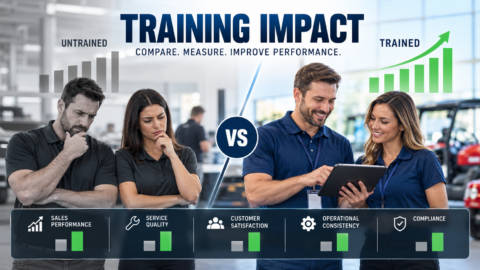
One of the most practical places to start is also one of the easiest for business leaders to understand: compare the performance of people or partner organizations that have received relevant training with those that have not.
That comparison can turn training measurement from a report about activity into an investigation of impact.
Most training systems make activity easy to measure.
Those metrics have value. They tell you whether the training program is operating and whether learners are participating.
But they answer a training question: What happened in the learning environment?
Executives usually want a different answer: What happened in the business?
Suppose 90% of dealer sales representatives complete a new product certification. That is useful evidence that the certification reached its intended audience.
But the business probably launched the program for a reason. Perhaps leaders wanted representatives to position the product more effectively, improve conversion, or accelerate adoption of the new line.
Completion alone cannot tell you whether any of those things happened.
To measure training effectiveness, you need to extend the analysis beyond the LMS and examine the performance the training was designed to influence.
That is where comparison becomes useful.
Before comparing two groups, define exactly what qualifies someone as trained.
“Trained” should not become a vague label applied to anyone who has touched the learning platform.
Depending on the program, trained might mean someone who:
At the partner level, trained might mean a dealership, franchise location, distributor, or service organization that maintains the required number or percentage of trained people in critical roles.
That definition matters because different training experiences represent different levels of capability.
Someone who watched a five-minute product video should not automatically be grouped with someone who completed a certification requiring assessment and demonstrated proficiency.
The same principle applies to partner organizations. A location where one employee took a course is not necessarily equivalent to a location with certified managers, salespeople, and technicians.
The comparison should reflect the capability you are actually trying to evaluate.
This is also where the Surefire Training Impact™ progression becomes important. The broader framework moves from knowledge toward competency and mastery through Learn. Do. Teach.™ The closer your definition of “trained” gets to demonstrated capability, the more meaningful your performance comparison can become.
The next question is not “What training data do we have?”
It is: What performance was this training intended to influence?
If the program was created to improve selling capability, compare a relevant sales KPI.
If the goal was stronger service capability, examine service performance.
If franchise training was designed to improve operational execution, use an operating metric that reflects that work.
For example:
|
Training focus |
Possible performance measure |
|
Dealer sales training |
conversion, sales volume, product mix |
|
Service technician training |
first-time fix rate, callbacks, repair accuracy |
|
Franchise manager training |
operational consistency, customer satisfaction |
|
Customer onboarding |
product adoption, support demand |
|
Supplier training |
defects, quality measures, compliance performance |
The metric must have a plausible connection to what the learner was expected to know or do differently.
A product-knowledge course may reasonably influence a salesperson’s ability to position a product. It would be much harder to argue that the same course should directly influence an unrelated operational KPI.
That is why Surefire begins with the business outcome and works backward. Measurement becomes much easier when the reason for training was clear before the course was developed.
Once you have defined the training condition and the relevant KPI, the basic analysis becomes straightforward.
Create two comparable groups:
Then compare their performance.
Imagine a manufacturer wants to understand whether its dealer certification program is associated with stronger sales performance.
Instead of reporting:
|
78% of dealer salespeople are certified. |
The training team asks a different question:
|
How does sales performance differ between dealers meeting the certification standard and dealers that do not? |
The same logic works for service.
Instead of:
|
1,850 technicians completed advanced diagnostics training. |
Ask:
|
Do technicians who completed advanced diagnostics perform differently on the service KPIs the training was designed to influence? |
For a franchise system:
|
Do locations with trained managers perform differently on relevant operating or customer-experience measures than locations without trained managers? |
This is the foundation of what the Surefire methodology describes as Training Impact Analysis.
The goal is not merely to prove that training happened. It is to investigate whether meaningful differences in training status are associated with meaningful differences in performance.
A trained-versus-untrained comparison can be powerful because the result is easy to communicate.
But it should also be handled carefully.
If trained partners outperform untrained partners during one reporting period, you have useful evidence. You do not automatically have proof that training caused the entire difference.
Other factors may influence performance.
A high-performing dealer may be more likely to invest in training in the first place. One region may have stronger market conditions. Larger franchise locations may have more experienced managers. A new product might be selling better in one territory regardless of training.
That does not make the analysis useless. It means you should treat it as a performance investigation rather than a search for a promotional statistic.
Start with simple comparisons, then strengthen the analysis over time.
Compare similar roles. Compare similar partner types. Examine multiple reporting periods. Look at certification levels rather than lumping every learner together. Segment locations where useful. See whether the pattern remains consistent.
You can also move beyond a single trained-versus-untrained split.
For example, compare:
As your data matures, more advanced analysis can help identify which courses, certifications, skills, or learning pathways have the strongest relationship with performance.
The important discipline is to avoid claiming more than the evidence supports.
Training develops capability. Capability can influence performance. Performance can influence business outcomes.
Your analysis should test those relationships.
Comparing individuals is an important starting point, but extended enterprise training eventually requires a wider view.
Dealers, distributors, service centers, and franchises operate as organizations.
A dealership does not succeed because one salesperson passed a test. It succeeds because the right people across sales, management, service, and other functions can perform their roles.
The Training Program Roadmap™ reflects this progression.
At Stage 4 — Individual Performance, training becomes connected to position-based KPIs. You begin examining whether training, certifications, or skill levels are associated with better individual performance.
At Stage 5 — Organization Performance, the analysis moves to the partner level.
Now you can ask:
This is an important shift.
Partner training exists because your business depends on the performance of organizations you do not directly manage. The stronger your ability to connect capability data with partner performance data, the more useful training becomes as part of your channel performance infrastructure.
Training information can begin to help leaders identify where capability is strong, where performance gaps exist, and where additional development may be warranted.
The most valuable outcome of this analysis is not a presentation slide saying training works.
It is better decision-making.
Suppose trained technicians consistently show stronger performance on a relevant service KPI.
That insight can help you ask better questions:
Now training data is helping guide performance improvement.
The same principle applies when the comparison does not show a meaningful difference.
That is valuable information too.
Perhaps the training is teaching the wrong thing. Perhaps learners know the material but cannot apply it. Perhaps the assessment is too weak to distinguish competency. Perhaps the KPI is too distant from the capability being developed. Or perhaps another business constraint is preventing trained people from performing differently.
The answer is not automatically “create more training.”
The answer is to investigate the connection between capability and performance.
That is what makes measurement strategic.
Training teams have spent years becoming very good at measuring what happens inside training systems.
The next step is measuring what happens after learners leave them.
Comparing trained and untrained partners is one of the most practical ways to begin.
Define what trained means. Choose the performance measure that the training is intended to influence. Compare relevant groups. Look for repeatable patterns. Control for obvious differences where possible. Then use what you learn to improve the program.
You do not need to begin with a complicated analytics initiative.
Begin with a question executives already understand:
|
Are the people and partners who have developed the capability performing differently from those who have not? |
When you can answer that question credibly, the training conversation changes.
You stop talking only about participation.
You start talking about capability and performance.
And that is the purpose of Surefire Training Impact™: creating the infrastructure and discipline required to connect training to the performance your organization is trying to improve.
Explore the Surefire Training Impact™ framework to see how business outcomes, partner capabilities, training strategy, and performance measurement fit together. Visit the framework.