

A manufacturer can onboard every dealer principal and still miss the people who diagnose faults, order parts, and explain repairs to customers. The partner list is complete. The training audience is not.
That distinction matters before anyone builds another course.
Partner training audiences are the groups outside your corporate workforce whose knowledge, skills, and actions influence the business outcomes you want to improve. Identifying them means looking beyond company names to the people doing the work, the locations they serve, and the responsibilities they carry.
The goal is not to train everyone on everything. It is to identify whose capability matters, why it matters, and where your current program leaves gaps.
The Surefire approach begins with the business outcome, not the course. Audience mapping follows the same logic: identify the result you want to influence, then work backward to the people whose performance contributes to it.
Suppose a manufacturer wants to reduce repeat service visits. Technicians are an obvious audience, but they may not be the only one. Service managers assign work and reinforce procedures. Support representatives capture the initial problem. Customers operate the equipment after the repair.
Each role influences a different part of the service experience. Sending everyone the same technical course would ignore those differences.
Ask who performs the work, who supervises or reinforces it, and who supplies information or actions that affect the result. Those questions create a more useful starting point than an existing email list.
This does not mean every performance problem is a training problem. It means identifying where stronger capability could contribute to better performance before deciding what training to provide.
The Surefire Training Impact™ framework identifies four broad audience categories. Use them to check the reach of your program rather than assuming that “partners” means only the organizations selling your products.
Channel partners include dealers, distributors, franchisees, resellers, service providers, agents, and retailers. Look at the people responsible for selling, delivering, servicing, and representing your brand, not only the primary business contact.
Operational partners support activities such as logistics, customer support, and technology implementation. Their performance can affect whether a customer receives a complete, consistent experience after the sale.
Suppliers provide materials, components, products, and services your organization depends on. Relevant learners may include quality teams, production managers, and account or contract managers whose work must align with your requirements.
Customers also belong in the picture when successful product use requires knowledge or skill. The relevant audience might be a new user, an experienced operator, or a customer champion who helps others use the product.
These categories are starting points, not rigid boundaries. A business that sells, installs, and supports your products can contain several distinct training audiences. Map its actual responsibilities rather than forcing all its people into one category.
“Train our dealers” describes a network, not a usable audience definition.
A dealer training program may need to reach owners, managers, salespeople, technicians, customer-facing associates, and administrative staff. Their connection to performance differs, even when they work at the same location.
Owners decide whether training receives time and resources. Managers help translate expectations into daily work. Frontline employees perform the sales, service, and customer interactions the program is intended to improve. Support staff handle activities such as scheduling, documentation, and reporting.
In franchise training, an owner completing orientation therefore cannot stand in for the readiness of every manager and associate across the owner’s locations.
Separate three things in your map: the partner organization, the location where work happens, and the role responsible for that work. Then identify the people occupying those roles.
This reflects a central difference between employee training and partner training: knowing the external business does not necessarily mean knowing its workforce. You may need the partner’s help to identify learners your central team has never met.
Partner job titles are not a reliable common language.
A “Sales Advisor” at one dealership and a “Customer Specialist” at another might perform the same function. Conversely, two people called “Service Manager” may have very different responsibilities.
The Partner Position Model addresses this by mapping local titles to standardized positions based on what people actually do. That shared structure supports consistent training assignments, certification tracking, and reporting without requiring partners to rename their jobs.
Confirm responsibilities before assigning a standard position. Record the local title as useful context, but do not let it determine the learning requirement by itself.
Also account for people who hold multiple positions. At a small partner, the owner might manage the location, sell products, and perform service work. A technician might support several locations.
The audience map should preserve those relationships rather than forcing every person into one role and one location. A person can have one learning history while carrying several sets of responsibilities. Your view of readiness must reflect both.
Do not build the map entirely from headquarters assumptions. Use a Role Mapping Workshop to bring together people who understand how the network operates, including field managers, trainers, regional representatives, and experienced partners.
Start with one business outcome and walk through the work that influences it. Identify the roles involved, group them by function rather than title, and ask where performance breaks down or support is missing.
For an illustrative service network, the discussion might produce this starting map:
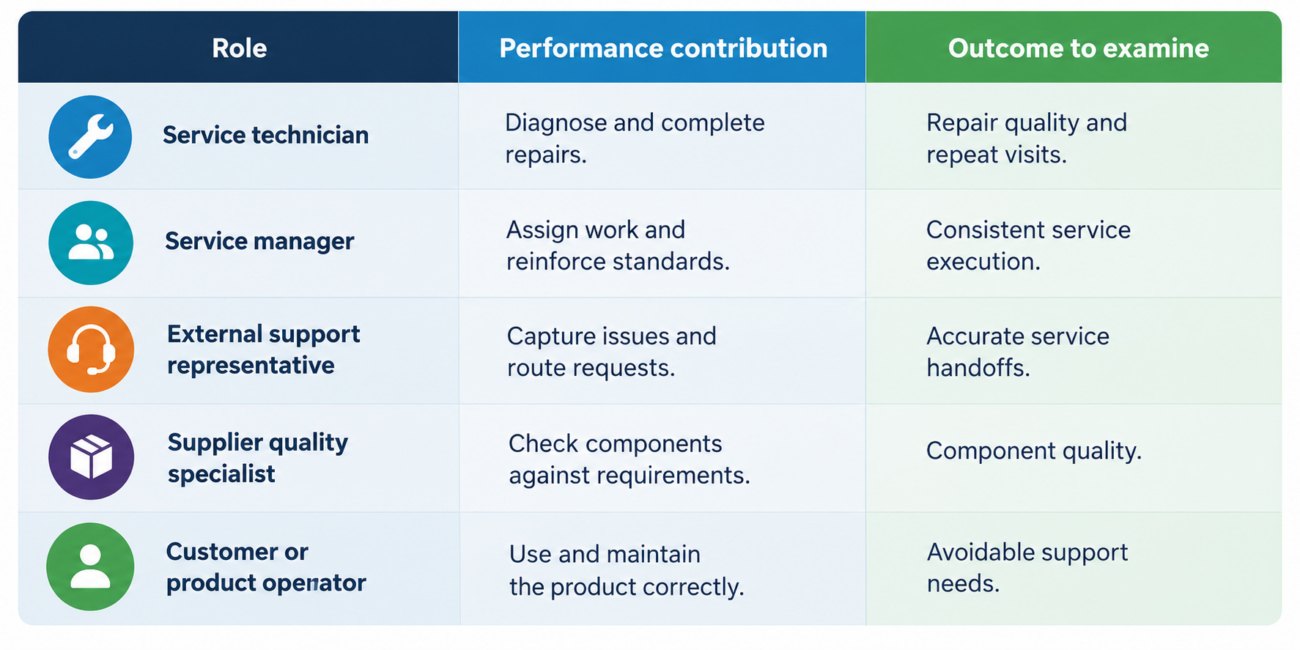
This is an example, not a universal roster. Validate the roles against your own network.
For each audience, record its partner organization and location, standardized position, connection to the selected outcome, and who will confirm the learner roster. Note relevant product lines or brands when responsibilities differ.
The immediate deliverable is a validated audience map. Detailed task analysis, competency requirements, and curriculum design come next; they should not obscure the first decision about who needs to be included.
A complete ecosystem map does not require a simultaneous training launch for every audience.
Start with roles that directly influence the selected outcome and for which field input indicates a knowledge or skill gap. Include the managers and supporting roles needed to reinforce the desired performance.
For the service example, that could mean focusing first on technicians and service managers, while investigating whether support handoffs or customer product use also need attention. The map guides the investigation; it does not predetermine the answer.
Avoid choosing audiences simply because they are easy to reach or already active in the learning system. An overlooked role may matter more to the outcome than a large group of frequent course users.
Discuss priorities with partner leaders. Confirm both the business relevance and the practical opportunity for their people to participate and apply what they learn.
Audience mapping is not finished when the workshop ends. People join and leave partners, responsibilities change, locations open, and product lines expand.
Give someone responsibility for maintaining the map and confirming changes with partners. Otherwise, a sound training plan can gradually stop matching the people doing the work.
This is where audience clarity becomes part of training infrastructure. The organizational and role relationships inform access, assignments, manager visibility, and reporting. The system should reflect the network rather than make the network fit an oversimplified learner list.
Clear audience definitions also support meaningful trained-versus-untrained comparisons: you need to know which roles and locations are being compared, not merely whether someone at a partner completed a course.
Once the audiences are clear, define what each role needs to know and do. That creates the foundation for developing knowledge, competency, and mastery through Learn. Do. Teach.™
Training is not the destination. Performance is. Identifying the right people is how you connect that principle to the work your network actually performs.
Explore the Surefire Training Impact™ framework to connect business outcomes, partner audiences, and capability development.