
Learning and development professionals spend enormous amounts of time thinking about how to deliver knowledge. We build courses, create assessments, track completions, and measure participation. Yet one of the most important questions comes after all of that work: can the learner actually use what they learned?
That question sits at the center of Jeff’s Training Impact Podcast conversation with Amy Fox, co-founder and CEO of LearningQ, a learning platform focused on helping people develop skills for work, independent living, and personal wellness. LearningQ primarily serves people with disabilities, including many learners with intellectual disabilities who may benefit from lower literacy requirements, shorter learning experiences, additional time, and repetition.
What makes the conversation especially relevant for L&D professionals is that the principles behind LearningQ extend well beyond any one learner population. Amy and Jeff explore microlearning, repetition, assessment, real-world application, content improvement, learner access, and the challenge of measuring whether training produces something more meaningful than a completed course.
At its core, the conversation is about shortening the distance between knowing and doing.
Amy’s path to LearningQ began long before the company itself. She started her career as a book editor, working with educational publishers including Wiley and National Geographic and contributing to approximately 60 titles and more than 300 articles. That experience gave her an early foundation in education and content development before her career expanded into healthcare, health and wellness, disability-related issues, and population health management.
Much of that work involved using education to address larger problems. Amy developed programs for organizations and government entities, including the USDA and the State of Florida, often starting with a particular health or population challenge and building an educational response around it.
Her connection to disability services became more personal after the birth of her son. Over time, that experience helped shift her attention toward microlearning specifically designed for life-skills development.
About four years ago, Amy joined two co-founders to launch LearningQ. Small Business Innovation Research funding helped the company get started, providing nearly half a million dollars toward development of the platform.
The resulting learning environment was designed around a straightforward idea: start with the learner.
That sounds obvious, but it has significant implications. Amy points out that many platforms serving disability organizations are designed primarily around the support professional. LearningQ instead focuses the experience directly on the person trying to learn and apply the skill.
Many LearningQ learners have intellectual disabilities and may need additional time to understand a new skill, lower literacy requirements, shorter learning experiences, or repetition to retain information. Rather than forcing those learners into a traditional course structure, the platform breaks learning into small, focused experiences that can be revisited as needed.
The learner logs into the platform, watches a short video, answers questions, and generates data that can help participating organizations understand outcomes. The simplicity is intentional.
One of Amy’s examples captures the approach particularly well.
Imagine teaching someone how to safely prepare their home before going to bed. A traditional course might combine that task with a much larger collection of independent-living topics. LearningQ can instead create a roughly 90-second video focused entirely on the nightly routine: check the doors, check the windows, turn off the lights, make sure the kitchen appliances are off, and complete the other necessary steps.
The learner can watch the video at nine o’clock and then immediately perform the routine. If the same reinforcement is useful tomorrow night, the video remains available.
This is where microlearning becomes more interesting than simply making courses shorter. The lesson begins functioning as both training and performance support because it is available near the moment when the learner needs to act.
For L&D leaders, that creates a useful design question: instead of asking only how much information belongs in a course, should we also be asking how close we can place the learning to the moment of application?
The conversation becomes particularly interesting when Amy explains how the platform approaches assessment.
LearningQ initially used questions focused on knowledge and understanding. Using the nightly home-safety example, a learner might be asked whether they had identified all the doors and windows that needed to be locked. Those questions can establish whether someone understands the material, but participating organizations wanted another level of information.
They wanted to know whether the learner actually did it.
That feedback led to application-oriented questions being added to certifications. A learner might not only demonstrate that they know the proper steps for securing a home, but also verify that they completed the routine. A support professional can then see that activity on the learner’s dashboard.
That distinction has implications far beyond accessible learning.
As an industry, we frequently measure whether learners consumed information and whether they can recall it on an assessment. Yet many training programs ultimately exist because we want someone to do something differently. We want a technician to perform a repair correctly, a salesperson to handle a customer interaction more effectively, a franchise employee to follow an operating process consistently, or a customer to successfully use a product.
The same challenge appears across customer training, franchise training, and broader extended enterprise training environments. The audience and business objectives may change, but the central question remains the same: did the learning translate into capability?
LearningQ’s use of self-verification offers one relatively simple way to begin closing that gap. It does not replace direct observation or formal skill assessment, but it moves the learning experience beyond the assumption that knowing automatically leads to doing.
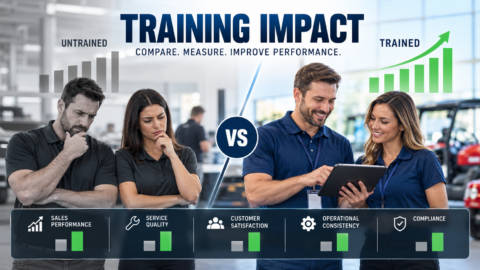
The program adds another important measurement practice through pre- and post-assessment.
A certification may contain approximately 25 microlearning units representing about an hour of total learning. Before beginning, learners complete a ten-question assessment that pulls questions from topics throughout the certification. This establishes a baseline before the learning experience begins. Another assessment after completion creates a comparison point.
The distinction is important because completion by itself tells us relatively little about learning.
A learner can complete every video in a program without acquiring the intended knowledge. By establishing what someone knows before training and comparing that with what they know afterward, the organization begins measuring change rather than activity.
Across its work with dozens of organizations, LearningQ reports an average 127 percent skills increase, combining knowledge, understanding, and application within its measurement approach.
That result reinforces a theme that runs throughout the conversation: training metrics become more meaningful as they move closer to the outcome the program is actually trying to create.
LearningQ also reports an 85 percent completion rate, and the reasons behind that level of engagement are particularly interesting because the company does not attribute the result to a single factor.
Microlearning may contribute because individual experiences are short and manageable. Content quality may matter just as much. The organization develops material with subject matter experts and involves people with lived experience in reviewing the content. When a pilot reveals that something is not connecting with learners, the team can revise the affected unit and put an improved version back into the program.
A manufacturing and warehousing project illustrates the value of that approach. Learners were consistently struggling with an assessment question involving the colors of warning signs. Instead of assuming the learners were the problem, the team reviewed the question and concluded that it was not a fair measure of the intended skill. The content could then be adjusted and the concept taught differently.
That example offers a useful reminder for any training team. Poor assessment performance does not automatically mean learners failed to learn. Sometimes it means we need to improve the way we taught or measured the concept.
Microlearning makes that process more manageable because the unit being revised may represent only a minute or two of education rather than a large course that must be extensively rebuilt.
The result is a more iterative approach to learning design. Create the content, observe what happens, measure learner performance, identify friction, and improve the experience based on evidence.
That continuous cycle is one of the strongest practical lessons in the LearningQ story.
Another theme that emerges from the LearningQ approach is the importance of repetition. For learners who may need additional reinforcement to retain information, a short lesson can be revisited without requiring them to repeat an entire course. More importantly, the reinforcement can happen near the moment when the knowledge is actually needed.
Amy explains that this thinking influenced the platform from its early development. The three co-founders had read Atomic Habits and were interested in the idea that meaningful change can develop through small actions repeated consistently over time.
For training professionals, this creates an important distinction between repetition and redundancy. Asking someone to sit through the same 30-minute course repeatedly is unlikely to create an engaging experience. Providing a focused refresher on a specific concept, particularly when the learner is about to use it, can serve a very different purpose.
It also changes the way we think about course completion. Completion does not necessarily need to represent the end of learning. A short learning resource can continue functioning as reinforcement or performance support long after the learner has technically completed the program.
LearningQ is testing that idea in a much more complicated environment through Project Reset, a six-month pilot designed for 500 teenagers in addiction treatment. At the time of the conversation, approximately 100 participants had progressed through about six weeks of training.
The initiative is particularly interesting because the desired outcome extends beyond knowledge acquisition. The treatment environment ultimately wants behavior change, but Amy is careful about the role training can realistically play. Addiction involves trauma, lifestyle factors, social determinants of health, and many other influences. A microlearning platform cannot replace therapy, counseling, treatment, or the larger support system surrounding a teenager.
Instead of attempting to solve all of those challenges through training, Project Reset focuses on one specific behavior: creating a moment of pause before taking the next action.
Amy describes the concept as similar to taking a deep breath, counting to ten, and reassessing the situation. In an environment where staff may encounter anger, self-harm, fights, and other difficult situations, developing that moment between impulse and action could become a useful capability.
The project is also experimenting with reinforcement. Participants can receive refreshers that revisit material they have already encountered, allowing the team to explore whether reinforcement should happen daily, weekly, monthly, or at another interval. The goal is not to position microlearning as a standalone solution, but as a tool that reinforces an existing program, counseling, therapy, or training.
That distinction may be one of the most useful takeaways for L&D leaders. Training does not always need to carry the entire burden of changing performance. Sometimes its greatest contribution comes from reinforcing the knowledge and behaviors supported by a much larger system.
Even well-designed learning cannot create an impact if learners cannot reach it.
Interestingly, Amy says learners themselves are often very interested in the material. Some of the more significant barriers come from the environment surrounding them. A support professional may decide there is not enough time to use the platform, a parent may limit computer access, or something as ordinary as a login problem may prevent participation.
That observation has implications for virtually every training program.
We frequently think about accessibility in terms of content. Is the language appropriate? Is the interface understandable? Are videos accessible? Those considerations are essential, but operational accessibility matters as well. If getting into the learning environment requires too many steps, if people do not have time to participate, or if the surrounding organization does not support the learning experience, even exceptional content can struggle to produce results.
For training leaders and operations teams, learner experience therefore extends beyond instructional design. It includes everything that happens between deciding someone needs training and that person successfully using what they learned.
Although LearningQ has been designed around learners with disabilities, many of the principles discussed throughout the conversation have much broader applications.
Short, focused learning reduces unnecessary complexity. Repetition provides reinforcement. Point-of-need access places information closer to application. Pre- and post-assessment help measure change. Application questions begin connecting knowledge with action. Subject matter expertise improves accuracy, while lived experience can help determine whether the content actually makes sense to the intended learner.
None of those principles are valuable only for one population.
In fact, designing for learners who face greater barriers can force training professionals to examine assumptions that are sometimes easier to overlook with a general learner population. How much information is really necessary? Does the learner understand what is expected? Can they easily access the training? Will the information still be available when they need to use it? Are we measuring what matters, or simply what is easiest to track?
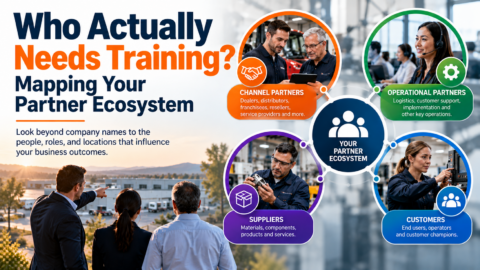
Those questions apply whether the audience consists of employees, customers, franchisees, technicians, resellers, partners, or people developing independent-living skills.
For L&D professionals, the larger lesson is that accessible learning does not have to mean simplified learning. It can mean more intentional learning.
The conversation provides an engaging introduction to the ideas behind LearningQ, but there is considerably more to examine when the program is viewed as a complete training operation.
The companion case study, LearningQ: Turning Accessible Microlearning Into Real-World Skills, takes that deeper look by examining the organization’s training structure, learner populations, operational challenges, measurement practices, and instructional methods through the lens of the LatitudeLearning Training Program Roadmap.
The case study explores how the program’s self-paced resources, accessible learner experience, microlearning, continuous content improvement, assessments, certifications, and pre- and post-training measurement establish strong foundational practices while supporting a Stage 2 Knowledge Acquisition approach. It also examines how application questions, repetition, and reinforcement begin extending the model beyond simply determining what learners know.
Together, the conversation and case study provide two different perspectives on the same challenge. One explores the ideas, experimentation, and experiences shaping the program, while the other looks more systematically at how those ideas come together as a training strategy.
LearningQ is also beginning to explore where this model could go next.
Potential applications include physical exercise, addiction, emotional wellness, aging, and cognitive decline. The organization has been invited to fast-track several potential NIH grant projects based on results from its initial learner population, while early thinking around aging includes practical topics such as fall prevention, scam avoidance, hygiene, healthy eating, and other activities that could support people who want to remain independent longer.
Artificial intelligence is another area under consideration, although Amy describes the organization as deliberately watching how the technology develops before becoming more aggressive about incorporating it. Larger partnerships may also help the company reach more learners as it moves into what she describes as its second phase.
That measured approach fits the larger philosophy that comes through throughout the conversation. The objective is not to add technology simply because it is available. The question is whether it can make the learning experience more useful for the person who ultimately needs it.
Jeff’s conversation with Amy Fox is ultimately about much more than microlearning.
It is about what happens when training teams begin with the outcome they want learners to achieve and work backward from there. If the goal is independent living, employment readiness, improved wellness, or another practical capability, completing a course is only one step in the process.
The more meaningful questions come afterward. Did the learner acquire the knowledge? Can they remember it? Can they use it? Does repetition help reinforce it? Can the learning experience be improved when the data shows something is not working?
LearningQ offers an interesting example of how those questions can be incorporated into the design of a training program rather than asked only after the program has been delivered.
For learning and development leaders, that may be the most important takeaway. Better training is not necessarily about creating more content or introducing more sophisticated technology. Sometimes it begins by getting much more specific about what the learner needs to do, providing exactly enough learning to support that action, and then measuring whether the learning made a difference.
Want to go deeper?
🎧 To explore the full conversation, listen to the Training Impact Podcast episode featuring Amy Fox of LearningQ.
📄 Download the companion case study: LearningQ: Turning Accessible Microlearning Into Real-World Skills
🌐 Learn more about LearningQ on their website: https://www.learningq.org/